

The Next China Shock Will Hit Defence

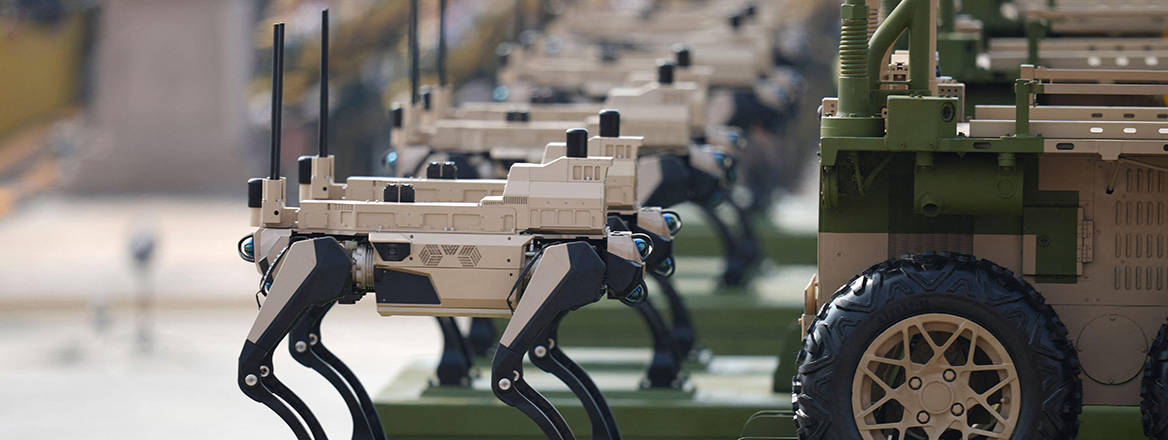
If tomorrow’s wars are fought mainly by machines, victory belongs to the power that can fuse AI with robotics and build the result by the million. Today, that is China.
If most of the fighting in the next conventional war is done by unmanned systems, military power gets redefined: as the capacity to fuse artificial intelligence with robotics and build the result at scale. Your author has seen both halves of that capacity from the inside, the AI software and AI data centre world at Google and military hardware production at Airbus Defence and Space.
Anyone trying to understand what the next conventional war might look like should observe developments in the AI unicorn headquarters of San Francisco and the factories of Shenzhen, not the halls of power in Washington and Moscow. For Europe, the starting position is uncomfortable. Europe will not produce world-class AI frontier models in the foreseeable future. And in high-end industrial production, Germany is being overtaken by China, which applies equally to electric cars and to defence.
The Rise of the Machines
Before asking who wins such a war of machines, it is worth looking at the motivations behind the rise of machines. By 2050, China’s population will shrink by 250 million people and its workforce by at least a quarter. Russia went to war already in demographic decline and has churned through roughly 1.4 million dead and wounded along the way. And Germany, which wants to field Europe’s strongest conventional army, can barely find enough volunteers for its NATO target of 260,000 soldiers and has passed legislation preparing a possible return to conscription. For Beijing, Moscow and Berlin alike, machines that can fight are becoming a demographic necessity.
The current wars show what that means in numbers. Ukraine built around 4 million drones and robotic systems last year; whereas of the 22,320 systems ordered under the Pentagon’s drone initiative, fewer than 3,000 had been delivered by mid-2026. Russia fired more than 50,000 Shahed drones at Ukraine in 2025 alone; a working example of the China–Iran–Russia axis in defence production. In the Iran war, swarms of drones costing a few thousand dollars apiece forced the expenditure of interceptors costing millions; the US burned through about half its Patriot inventory, with replacement timelines of four to five years. Modern battlefields consume unmanned systems the way the trenches of the First World War consumed shells.
China is training robots for combat in dedicated centres, and its missing battle experience may prove purchasable
The statistics are similarly overwhelming, in China’s favour, for high-end industrial production. 295,000 industrial robots were installed in China in 2024, against 32,200 in the US and 26,982 in Germany. Kuka, once a global leader in industrial robotics based in Germany, was sold to China in 2016. In humanoid robotics, Chinese firms took close to 90% of the world market in 2025; the market leaders Unitree and AgiBot each sold more than 5,000 robots, while all American manufacturers combined sold fewer than 500. The bill of materials cost for Western robots runs nearly three times higher. Admittedly, most military robots will not fight; they will scout, clear mines and haul supplies. The machines that do fight will not be humanoids but autonomous quadrupeds, aircraft and boats. Crucially, they all rely on similar autonomous systems manufacturing capabilities, down to a bill of materials that may include the same actuators, batteries and sensors.
China's Industrial Position
China’s lead is no accident. It is the same playbook that has powered China’s dominance of the electric-vehicle market: early state support, dozens of competing entrants, components flowing straight into military supply chains. A War on the Rocks analysis describes the quiet administrative ecosystem of incentives, certifications and procurement platforms that systematically turns commercial technology firms, Unitree included, into suppliers of the People’s Liberation Army. At the World Defence Show in Riyadh in February, a state-linked Chinese firm unveiled a production-ready robot dog carrying four anti-tank missiles, built for export.
Beneath all of this sits the hardest bottleneck to fix. China makes 90-98% of the permanent magnets inside every drone motor and every actuator, and has been tightening export controls on rare earths since 2025. German auto suppliers know what that feels like: stalled magnet shipments nearly idled production lines, and even Tesla’s Optimus robot production ground to a halt. Defence equipment is no different. More than 80,000 components across some 1,900 American weapons systems depend directly on minerals under Beijing’s control. Every drone that Rheinmetall, Helsing, or Stark wants to build in volume needs a magnet Beijing can withhold.

And artificial intelligence? When I worked in AI partnerships at Google Cloud, the lead of American AI frontier models was universal. That lead has evaporated. Stanford’s AI Index finds the performance gap to Chinese models essentially closed, achieved with less than 5% of America’s private AI investment. Part of the catch-up is plain copying: Chinese models train on the answers of American frontier models and thereby inherit their capabilities at a fraction of the cost. The Pentagon’s AI edge is being ‘distilled away’ as Chinese models are, in effect, being schooled by American ones. And because China does not observe Western intellectual-property protections, Chinese models routinely train on each other as well. Imagine Claude learning from the outputs of ChatGPT and Gemini, and vice versa. A surveillance state also generates vast stores of citizen data with which Chinese models could be further improved.
Moreover, training and running models at scale comes down to electricity and chips. China excels there too: in 2024 it added around 429 gigawatts of electric generating capacity, while the US added just 51 GW and Germany added about 20. And because Chinese models are cut off from the newest Nvidia chips, they are tuned for efficiency, a property that matters for resource-constrained battlefield computing environments.
Unlike the leading American models from OpenAI and Anthropic, the leading Chinese models are open-weight and up to 50 times cheaper than US models. This explains their tremendous popularity; Alibaba’s Qwen family has passed a billion downloads.
When we port this setup to the military domain, we see massive proliferation risks: Open-weight models are not subject to export controls – though these are under consideration by the Chinese government. They are not constrained to run in US-controlled hyperscaler data centres only, do not have mandatory safety filters or an implicit government kill switch and their open model weights can be tweaked and optimized by state and non-state actors for specific use cases. Moreover, Chinese models have been starved of the latest generation of Nvidia chips. It would be a fair guess to extrapolate that they will perform well in resource-constraint battlefield situations, what the tech crowd would call hardened edge computing.

China does not yet hold every card. Several variables decide an unmanned war: the ability to produce autonomous military systems cheaper, faster and in greater numbers than the adversary, together with the ability to secure and scale the minerals, metals and supply chains behind them. But those systems must also hold up in an actual conflict – and there, China is the one catching up. By Stanford’s count, AI robots still fail nine out of ten everyday tasks. The US holds a genuine lead in autonomy software, not least through Waymo and Tesla. The People’s Liberation Army has not fought a war since 1979. Yet that residual advantage is eroding. China is training robots for combat in dedicated centres, and its missing battle experience may prove purchasable: Moscow’s drone war has generated the largest corpus of battlefield telemetry in history, and Moscow needs Chinese components. In a crisis, NATO’s eastern flank would face not an isolated Russia but a military-industrial complex running from St. Petersburg to Shenzhen.
The Outlook Beyond China
What follows for Europe and the Western alliance? Minerals, metals and magnets are strategic goods now, and so is the training data thrown off by autonomous systems in the field. China has spent decades building an industrial base that has pushed European and US industry out of one world market after another, and it would be naive to assume those capabilities will sit unused as the geopolitical context worsens. By one widely cited estimate, China’s civilian drone factories could, on command, turn out nearly a billion armed drones a year.
The Western answer points toward industrial policy for supply chains and production capacity. For the West’s industrial heartland, places like Detroit, Wolfsburg, Turin, the UK’s Midlands, that could be an opportunity: the skills and supply chains of the car industry overlap with those of defence robotics, and China’s own advantage grew out of its car industry. For Europe, there is a second, geopolitical argument. If the Pentagon halts access to the most capable AI foundation models and thereby takes the rest of the world partly hostage, Europe needs bargaining chips of its own. A capable, AI-enabled robotics manufacturing base would be exactly that: an asset Europe can contribute to the alliance and, if necessary, trade within America’s neo-mercantilist system, for instance against local production of air defence systems. Dependence cannot be negotiated away. It can be balanced out.
None of this is simple. Car plants are tooled for multi-year model cycles, not for cheap, fast-iterating production. The mobile phone, the last mass product with a rapid clock speed and falling prices, showed where it leads when Europe fails to master that discipline: Siemens sold its handset division in 2005, Nokia’s plant in Bochum closed in 2008 and in the end every European maker exited. Ukraine, by contrast, learned to compress drone innovation cycles to weeks and to mobilize a startup ecosystem.
Industrial policy will have to find new instruments if it is to avoid wasting taxpayer money on subsidies. Defending our democratic, open societies is worth the attempt.
© Andreas Urbanski, 2026, published by RUSI with permission of the author.
The views expressed in this Commentary are the author's, and do not represent those of RUSI or any other institution.
For terms of use, see Website Terms and Conditions of Use.
Have an idea for a Commentary you'd like to write for us? Send a short pitch to commentaries@rusi.org and we'll get back to you if it fits into our research interests. View full guidelines for contributors.
WRITTEN BY
Andreas Urbanski
Guest Contributor


- Jim McLeanMedia Relations Manager+44 (0)7917 373 069JimMc@rusi.org