

Making Europe ‘Great’ Again: US Hostility and the New World Order

Europe is being recast, sharper and stronger, reflecting the world order at work in the forge.
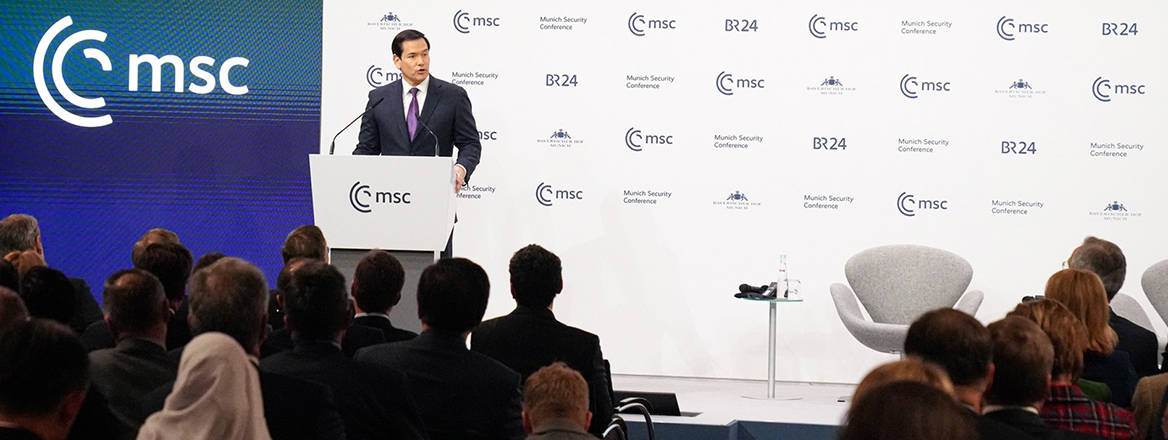
The German Chancellor’s opening at the 2026 Munich Security Conference stated what Europe’s defence and security leaders already knew – the ‘old world order’ of the Transatlantic Alliance is dying. Mertz’s address echoed the French President's fiery speech at Davos in January. Emmanuel Macron's declaration of Europe’s preference for the ‘rule of law to brutality’ – aimed not at Russia or China, but at America – captured an atmosphere of open hostility. But during this past weekend of meetings in Munich, what was once stunned disbelief is now turning to resolve.
Donald Trump and his second administration are accomplishing what seventy years of French or German diplomacy could not. By treating the EU not as a partner but as a delinquent debtor, the US has inadvertently supplied the one ingredient the European project always lacked: necessity.
The humiliation of Ukrainian President Volodymyr Zelensky in the Oval Office, the hurried Russo-US Alaska Summit aftermath, and finally the territorial threat to Denmark, have inadvertently solved the continent’s oldest problem: the lack of a unifying existential threat. Life under the American umbrella was too comfortable but the security shocks of the last twelve months – from watching the US bypass Brussels, to the partition of security interests with Russia, to treating a NATO ally’s territory as real estate – have acted as a radical accelerant. Trump is not humiliating Europe into submission but hardening it.
The Anatomy of a ‘Great’ Power
Far from creating a submissive periphery, Washington’s hostility is setting Europe on a path to being the one thing the US never actually wanted: a fully independent, nuclear-capable and economically protectionist rival. To understand this shift, one must understand one of the fathers of international relations theory – Kenneth Waltz and structural realism. He argued that ‘Great Power’ status is a composite of specific capabilities: population and territory, resource endowment, economic capability, military strength and political stability.
The final axis of Great Power status, political unity, has historically been the brake on the continent’s ascension. Yet, here too, setting is forcing adaptation
For seventy years, Europe has been a truncated power; possessing the demography, resources and mass of a giant, but stunted in other capabilities so as to remain a civilian power under Washington’s protection. As American security guarantees evaporate, the experiment has failed. Europe is now being brutally shoved back on the path of structural realist history through a Waltzian logic of survival: hostility creates necessity; necessity forces internal balancing; and internal balancing will finally transform a half-formed giant into a functional superpower.
Strategic Sovereignty
To the necessity of Europe’s first major missing capability, military might, the first Trump administration served a warning. The second term has been, as the conference in Munich declared, a ‘wrecking ball’. Trump’s stance on the Russia-Ukraine war finally forced a pivot from slow theoretical autonomy to the grim reality of the ReArm Europe plan – an arms programme that has no global precedent in peacetime. Within weeks of the disastrous Zelensky-Trump meeting in the Oval Office, Brussels activated the ‘defence escape clause’, effectively exempting defence spending from national debt limits and even Germany’s long-held fiscal and military taboos.
It will unlock €650 billion in rearmament capital over the next four years, funnelled through the Security Action for Europe (SAFE) mechanism - a ‘Buy European’ mandate that explicitly prioritises the European Defence Industrial Strategy (EDIS), beginning the painful process of purging American contractors from the continent’s core procurement pipelines.
But the true indicator of ‘Superpower’ status is the shift in mass and trajectory. By 2030, the combined defence expenditure of Europe’s nations is projected to reach over €800 billion ($870 billion) – effectively achieving parity with the current US defence budget. This financial and military muscle will be matched by personnel and geographic reach: the combined active personnel of the European powers and Ukraine already exceeds 2.5 million, dwarfing Russia and India, and rivalling China.
An Economic Fortress
In the Waltzian framework, economic capability is only a power if the unit possesses the competence to weaponize it. ‘Liberation Day’ followed by the ‘Vance Ultimatum’ at the 2025 Munich Security Conference set the EU on a different course from its free market origins. When the Vice President explicitly linked the survival of the NATO security umbrella to deregulation of American tech platforms, Europe realised that in a world of bullies, a market of 450 million people is not just a commercial space to facilitate the expansion of Silicon Valley – it is a weapon to be wielded.
The continent is now on an accelerated pathway of strategic decoupling, following the precedent set with other rivals: just as the 5G Toolbox and the 2026 Cybersecurity Act effectively banned Chinese vendors like Huawei and ZTE from Europe’s technology backbone, Brussels knows it is capable of turning that same regulatory machinery toward the US.

Help your search results show more from RUSI. Adding RUSI as a preferred source on Google means our analysis appears more prominently.

In Davos, Macron’s speech threatened the use of the Anti-Coercion Instrument (ACI) the trade ‘bazooka’, first aimed at China, but also fully capable of unilateral retaliation against US technology and financial services. The continent is quite simply no longer content to be a customer. Europe is now mandating a domestic preference for its critical infrastructure. From digital sovereignty to the green-tech transition, the bloc wants an industrial base that is no longer hostage to Washington’s ‘America First’ shocks or the perceived algorithmic belligerence of its tech giants.
The Death of the Veto
The final axis of Great Power status, political unity, has historically been the brake on the continent’s ascension. Yet, here too, setting is forcing adaptation. All other poles in the international system – China, Russia, India and the US – now possess increasingly centralised, executive-heavy models of governance. This is a classic Waltzian indicator of how ‘ruthless consistency’ forces peer powers to resemble one another. To survive in a world of giants, the EU is realising it can no longer afford the luxury of twenty-seven separate foreign policies or defence ministries.
While the treaties technically still demand unanimity, the central Commission is systematically bypassing this through the creative use of ‘Emergency Instruments’ like Article 122, invoked to freeze Russian assets indefinitely. Just as Brussels centralised power to procure vaccines, it is now seizing the authority to procure weapons and sanction adversaries, effectively stripping dissenters like Hungary of their veto. This centralisation is the ultimate Trump Dividend. Facing a volatile, transactional White House, even historic heavyweights like Germany and France are ceding authority to the Commission President, with Foreign and Defence Chiefs realising they are too small to negotiate alone. Europe is starting to provide the ‘single phone number’ Henry Kissinger once joked did not exist.
Making Europe Great Again?
For decades, Washington demanded a Europe that paid its bills and took responsibility for its own borders. For many in the administration, Trump is finally succeeding where many previous presidents have failed. But the long-term result might not be a grateful junior partner. By forging a Europe through hostility rather than shared values, the US could birth a transactional Third Pole that over time owes Washington nothing. Armed, protectionist and centralised, it could act in its own interests, trading with China if it suits its economy and regulating American tech if it suits its security. The US spent a century trying to unite Europe. It is succeeding – but it might discover that a united continent has no need for an American master.
© RUSI, 2026.
The views expressed in this Commentary are the author's, and do not represent those of RUSI or any other institution.
For terms of use, see Website Terms and Conditions of Use.
Have an idea for a Commentary you'd like to write for us? Send a short pitch to commentaries@rusi.org and we'll get back to you if it fits into our research interests. View full guidelines for contributors.
WRITTEN BY
William Dixon
RUSI Senior Associate Fellow, Cyber and Tech


- Jim McLeanMedia Relations Manager+44 (0)7917 373 069JimMc@rusi.org