

Japan's Ambivalent Policy Towards Russia and Ukraine

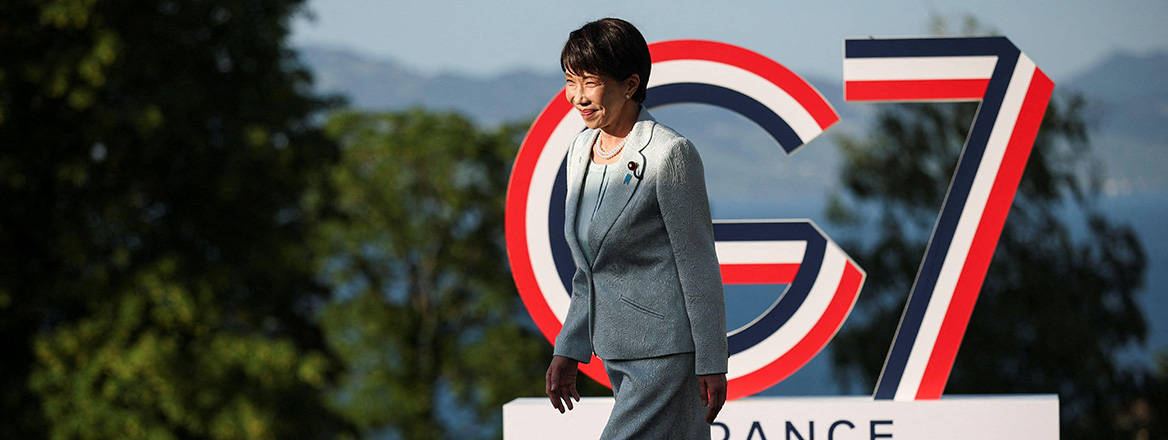
Prime Minister Takaichi’s equivocal stance on policy towards Russia has encouraged a revival in activity from those in Japan who seek reengagement with Moscow.
On 2 July, Watanabe Hiromichi and Suzuki Muneo, both members of parliament from Japan’s ruling Liberal Democratic Party (LDP), attended an event at the Russian embassy in Tokyo to celebrate the 30th anniversary of the creation of the Union State between Russia and Belarus, a largely unfulfilled integration project between the post-Soviet states. Taking to the podium, the two politicians said nothing of the 570 drones and missiles with which Russia had pounded Ukraine’s capital during the preceding hours. Instead, they congratulated their hosts on the formation of the Union State and stressed the importance of Japan-Russia dialogue.
This is just one example of a recent trend of reengagement by Japanese politicians and officials with Russia. On 11 June, the same Suzuki Muneo spoke at the Russian embassy to mark Russia Day. His colleague, Nishida Shōji, gave an interview to Russian state media in which he remarked on the decline of US influence and argued that ‘the most important thing is to get rid of hostility towards Russia.’
Other developments include the report that, on 8 April, Japan’s ambassador to Moscow Mutō Akira proposed a face-to-face meeting between the countries’ foreign ministers, thereby resuming high-level political contacts that have been suspended since Russia’s full-scale invasion of Ukraine in 2022. A month later, the irrepressible Suzuki Muneo, who was then visiting Moscow, raised the idea that this meeting take place on the sidelines of the ASEAN Regional Forum on 23 July.
Also notable is that, on 11 May, Mikhail Shvydkoi, President Vladimir Putin’s special representative for international cultural cooperation, was welcomed to Tokyo. Officially, he was there to preside over the opening of the Festival of Russian Culture in Japan. However, Shvydkoi held several political meetings, including with administrative vice foreign minister Funakoshi Takehiro.
Even more surprisingly, on 26 May, a business delegation headed by Arai Masayoshi, director general of the Trade Policy Bureau of Japan’s Ministry of Economy, Trade and Industry (METI) made a two-day visit to Moscow. Although the visit was supposedly to protect existing Japanese investments, the presence of 13 company executives raised concerns that Japan’s government was exploring new business opportunities.
Advocates of the continued isolation of Russia will be alarmed by these reports. Yet, a parallel set of developments tells a very different story.
On 29 May, the very same week that the METI-led delegation visited Moscow, Japan announced that it was joining the Prioritised Ukraine Requirements List (PURL), the NATO initiative that purchases US-produced military equipment for Ukraine. Japan’s Ministry of Defence also revealed that it will dispatch four Self-Defence Force personnel to be stationed in Germany at the headquarters of NATO Security Assistance and Training for Ukraine.
While Kishida’s policy towards Ukraine and Russia continued during Ishiba Shigeru’s one-year tenure as prime minister, momentum was lost after Takaichi took office in October 2025
Added to this, on 23 June, State Minister for Foreign Affairs Kunimitsu Ayano and State Minister for METI Yamada Kenji made a joint visit to Kyiv. Ahead of Ukrainian foreign minister Andrii Sybiha’s visit to Tokyo, from 30 June to 2 July, Foreign Minister Motegi Toshimitsu stressed that Japan’s support for Ukraine is ‘unwavering’.
What is going on? Is Japan seeking reengagement with Russia or does it remain steadfast in opposing Russian aggression and supporting Ukraine? Both are, in fact, true.
Like any other democracy, Japanese politics is not monolithic. What makes it unusual is that political competition plays out largely, not between political parties, but within the LDP, a big-tent party that has ruled Japan for all but four years since 1955.
Within the LDP, there are two distinct approaches to Russia. The first is associated with Abe Shinzō, prime minister from 2006 to 2007 and again from 2012 to 2020.
Persuaded of the need to drive a wedge between Russia and China, Abe set aside concerns about Russian aggression in Europe and prioritised closer relations with Moscow. Abe met Putin 27 times and hosted him in his home prefecture of Yamaguchi in December 2016.
Abe also viewed Russia as an important economic partner, unveiling an 8-point economic cooperation plan and overseeing a Japanese consortium’s purchase of a 10% stake in Arctic LNG-2, a Russian gas project.
Abe was assassinated in July 2022 but his vision of Putin’s Russia as a partner is kept alive by figures who were close to him. These include the aforementioned Suzuki Muneo who returned from a jail sentence for corruption to serve as Abe’s unofficial advisor on Russia.
Another important figure is Imai Takaya, a former METI official who was Abe’s executive secretary and now serves as an advisor to Prime Minister Takaichi Sanae. Imai was closely involved in Abe’s economic engagement with Russia. It is almost certain that he was the key figure behind the METI-led delegation to Moscow in May.

Abe’s widow, Abe Akie, has also strived to maintain contacts, travelling to Moscow for a tearful reunion with Putin in May 2025.
The alternative approach is personified by Kishida Fumio, prime minister from 2021 to 2024. When Russia’s full-scale invasion of Ukraine began in February 2022, Kishida took the view that the conflict directly impacted Japan’s security. His concern was that, if Russian aggression were to succeed against Ukraine, it could embolden China to try the same against Taiwan, or even Japan. This line of thinking was encapsulated in Kishida’s phrase, ‘Ukraine today may be East Asia tomorrow’.
This calculation prompted Kishida’s government to impose multiple rounds of sanctions on Russia, including against Putin himself. By contrast, Abe’s government had largely avoided imposing restrictions after Russia’s annexation of Crimea in 2014.
In addition to offering Ukraine generous financial assistance and signing a 10-year accord on support for Ukraine, Prime Minister Kishida visited Kyiv in March 2023 and welcomed President Zelenskyy to the G7 Hiroshima Summit in May 2023.
While Kishida’s policy towards Ukraine and Russia continued during Ishiba Shigeru’s one-year tenure as prime minister, momentum was lost after Takaichi took office in October 2025. Takaichi made her name as a loyal protégé of Abe, but she has not straightforwardly revived his Russia policy. Rather, she has been largely inactive on this issue.
Takaichi is yet to visit Kyiv as prime minister. She also did not hold a bilateral meeting with Zelenskyy at the G7 Summit in France in June. A further opportunity for a face-to-face meeting was missed when Takaichi opted not to attend the NATO Summit in Turkey on 7-8 July. Also notable is that Kishida’s slogan of ‘Ukraine today may be East Asia tomorrow’ has been dropped.
This lack of leadership by Takaichi explains Japan’s ambivalent position. Since she has not reversed policies implemented by her predecessors, the mechanisms of support for Kyiv and sanctions on Russia continue. However, since she has expressed no personal commitment to this issue, she has given a green light to die-hard advocates of Abe’s agenda to reengage with Russia.
Ukraine’s government will understandably be concerned, yet they should not panic. Ukraine retains many committed supporters within the top ranks of the LDP, including Defence Minister Koizumi Shinjirō, Minister of Internal Affairs and Communications Hayashi Yoshimasa and former Prime Minister Kishida Fumio himself.

Cooperation between Japan and Ukraine is also likely to intensify because Ukraine has much to offer. Most obviously, Ukraine has world-class expertise in military drones, especially interceptors. This will prove valuable as Japan seeks to develop SHIELD, a defence system that proposes to use more than 10 types of drone for multilayered defence of Japan’s coastline.
On 9 July, President Zelenskyy also raised the prospect of cooperation with Mitsubishi Heavy Industries (MHI) in the production of Patriot missiles within Ukraine. This followed US President Donald Trump’s announcement that he will grant Ukraine the licence to produce these air-defence interceptors. MHI is an attractive partner because it already manufactures Patriots under licence within Japan.
Meanwhile, there are several factors limiting the prospects for Japan-Russia reconciliation. One is Moscow’s increasingly close relationship with Beijing and Pyongyang. This includes Russia’s participation in joint aviation and naval patrols with China that are intended as a show of force against Japan.
Russia is reported to be sharing military technology and expertise with China and North Korea. It is also contributing to Beijing’s groundless campaign to portray Tokyo’s security reforms as a dangerous return to militarism. The New York Times report on 12 July that Putin has turned Japan into a ‘den of spies’ since 2022 will further undermine public trust in Russia.
Lastly, Russia’s own diplomats have placed restrictions on the warming of ties. A wise policy from Moscow’s perspective would be to exploit every opportunity for reengagement, thus widening divisions between Japan and its European partners. Instead, Moscow is overplaying its hand.
In May, when it was reported that the Japanese ambassador had raised the idea of a foreign ministers’ meeting, Russian Foreign Ministry spokeswoman Maria Zakharova responded, not with enthusiasm, but with a list of arduous demands that Japan must fulfil before high-level contacts can be restored, including the lifting of sanctions and ending of support for Ukraine.
Overall, Japan’s policy towards Ukraine and Russia now sits between that of prime ministers Abe and Kishida. This creates some distance between Japan and Ukraine’s most enthusiastic supporters, including the UK. However, with many factors incentivising closer relations between Japan and Ukraine and fewer militating for a revival of Japan-Russia ties, the likelihood is that, even as some reengagement with Moscow occurs, Japan’s overall policy will not diverge far from the European mainstream.
© James Brown, 2026, published by RUSI with permission of the author.
The views expressed in this Commentary are the author's, and do not represent those of RUSI or any other institution.
For terms of use, see Website Terms and Conditions of Use.
Have an idea for a Commentary you'd like to write for us? Send a short pitch to commentaries@rusi.org and we'll get back to you if it fits into our research interests. View full guidelines for contributors.
WRITTEN BY
James D J Brown
Senior Associate Fellow


- Jim McLeanMedia Relations Manager+44 (0)7917 373 069JimMc@rusi.org