

Iran War Delivers a Tough Lesson in Hard Power to the UK

Aside from policy differences with the US, the UK’s Armed Forces’ size and capacity make difficult any large UK involvement in war with Iran.
The outbreak of a new war in the Middle East has led to questions about the UK's relevance in international affairs. Alongside debates about legality and politics there are some hard truths about military power and the reality of the readiness of the UK's armed forces. Pressure is growing for the deployment of more UK forces to the region and direct involvement in strikes, but the government will need to answer difficult questions about prioritisation and the effect that it might be trying to achieve. The consequence is that as much as intent and policy drive UK involvement, the practical realities will constrain what the UK can do.
The UK’s Regional Military Presence
The foundations for the UK’s military presence in the Middle East are relationships with the US and other regional states. This manifests in the UK having air and maritime component commands collocated with US facilities in Qatar and Bahrain, as well as a naval support facility in Bahrain, a large naval logistics facility at Duqm port in Oman, and a facility at the Al Minhad Airbase in the UAE.
The network of bases and facilities is augmented by the Sovereign Base Areas on Cyprus, which together provide a home for: forces operating in the region; a variety of training teams; exercises and short- or long-term deployments that include personnel specialising in air defence present in Iraq and Saudi Arabia; the operation to counter Daesh (Op SHADER); and involvement in various coalitions, often with a maritime focus.
There is of course also a network of defence attaches across the region, and the UK’s large commercial and military presence in Saudi Arabia.
Diminishing Presence, Increasing Pressure
The challenge for the UK is that in the past few years, the commitments and visible presence of UK Armed Forces in the region have been shrinking, as a result of the pressure on the military, and a conscious decision to prioritise elsewhere, most recently in the ‘NATO First’ approach of the Strategic Defence Review of 2025.
In other words, we have a maritime command and a naval support facility, but currently lack UK ships to command or support
What was once a reasonably significant Royal Navy and Royal Fleet Auxiliary presence under Operation KIPION is now down to zero major ships, replaced with training visits and exercises. The last major Royal Navy surface warship in the region retired in December 2025, and the minehunter force – previously regarded as a major UK contribution to regional security, especially in the event that Iran mined the Strait of Hormuz – has also disappeared as the Royal Navy grapples with the use of autonomous vehicles as part of its future mine-hunting capability. In other words, we have a maritime command and a naval support facility, but currently lack UK ships to command or support. Meanwhile, Operation SHADER is winding down, though UK personnel remain in Iraq, including under a NATO Mission, and in Cyprus.
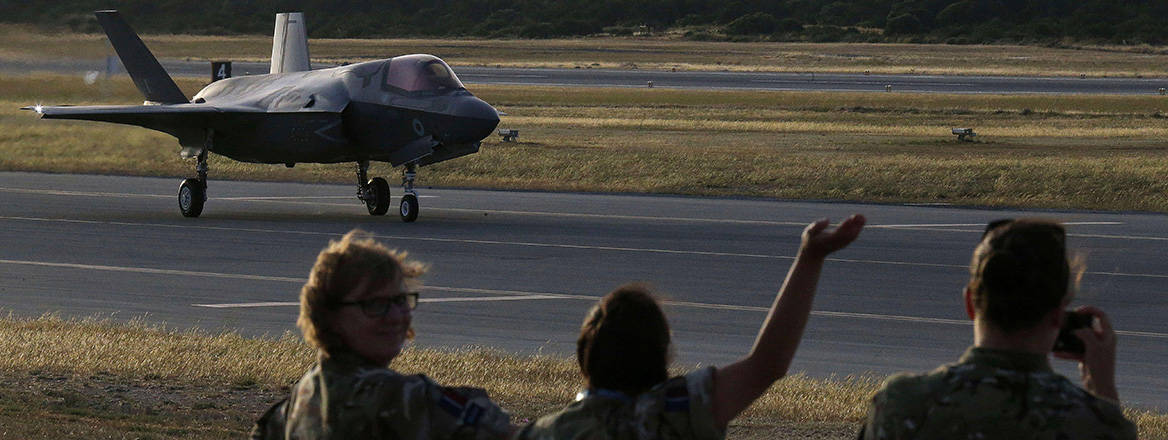
There is still a baseline from which the UK can build, and it has done so in anticipation of the crisis. The UK operates a joint Typhoon squadron with Qatar, and sent four jets to Qatar in January to provide air defence. Six F-35B stealth jets were sent to Cyprus in February to join the Typhoons already present there, and, as mentioned, there are a number of ground-based air defence personnel in the region already who could have been augmented with personnel from the Royal Artillery or RAF Regiment.
The Potential UK Contribution
Yet the UK response has been criticised as neither ‘sufficient’ defence in the face of the threat, nor as grasping the opportunity to ‘end’ the Iranian threat by joining the strike campaign. Much has been made of the legal debate over the war, but resource constraints are bound to be an additional factor.
One potential UK contribution, echoing previous campaigns, would have been the use of an attack submarine to launch Tomahawk cruise missiles. But the UK has an appalling availability record for its Astute-class submarines, with one under construction, one undergoing trials, and five in service – of which only one is operating, and that was sent to Australia in January.
The UK could also have made an air contribution, perhaps starting with Typhoons armed with Storm Shadow cruise missiles to conduct long-range strikes, moving to Typhoons and F-35s using stand-in weapons like Brimstone missiles or Paveway IV bombs now that Iranian air defences have been dramatically reduced. Again though, the volume of firepower the UK could add needs to be put in the context of the massed Israeli and US airpower available. The Israelis have said that over 200 combat aircraft were involved in the initial strikes, flying over 700 sorties. The US has probably used a further 200. The totality of the RAF’s in-service combat force of Typhoons and F-35s is probably around 140-150, and not all will be ready for frontline combat at any one time.

The four Typhoons in Qatar (now being augmented with an additional four) and the F-35s have already seen action in shooting down incoming drones. But assuming the six F-35s and eight Typhoons in Cyprus had all been committed to strike operations, and had all flown twice (with UK Voyager tanker support) in punishing long-distance operations over the 1000km+ to Iran, they could have contributed 28 sorties to this total. A UK submarine would probably have fired between four and six Tomahawks in an initial salvo (limited by available tubes), set against the reported 140 used by the US. Even if the UK had sent all its available F-35s (when the F-35 force is still recovering from the Carrier Strike Group deployment in 2025) this would only amount to two squadrons with a maximum of 24 aircraft. The available UK carrier could also be sent, but it is doubtful that it would do so with a full strike group given ship availability at present. This is not to say that UK efforts would not have been precise and effective, but that the size of the forces available would represent a token contribution, rather than a decisive one.
The UK Has Limited Missile Defences
On the defensive side the UK has not been idle, given the above deployments – which also appear to have included some counter-drone units – have been involved in downing Iranian drones while defending Jordan and Iraq. But these are pinpricks against the wider volume of Iranian strikes being aimed in all directions. The issue is that the UK has a fundamentally limited set of ground-based defensive systems, both in terms of numbers and range. While it can call upon various weapons based upon the Starstreak missile, suitable for tackling drones, as well as jammers as part of the ORCUS system, these are short-ranged (a few miles) and intended for point defence. The slightly longer-ranged Sky Sabre system (25km), designed against aircraft, drones and cruise missiles has been notable by its absence. It is possible that it is considered overkill for the threat to Cyprus, and unsuitable for sending to Iraq, Jordan or Saudi Arabia. But a probable factor is also that the UK has a handful of deployable batteries at present: one is in the Falklands and another spent nearly three years in Poland as part of Operation STIFFTAIL to reassure the Poles against Russia. A deal to double the number of launchers was only agreed in August 2025 and will take several years to deliver. Meanwhile, the decision to send two Wildcat helicopters armed with Martlet missiles will add another ‘layer’ to the defences at Cyprus; their relatively short range (up to 8km) and the fact that only two are deploying probably means just one will be on point defence most of the time, but it could carry up to 20 such missiles.


The final challenge on defensive capabilities is the much-debated decision on whether to send a Type 45 Destroyer, now resolved by the announcement of the deployment of HMS Dragon, albeit possibly ten days from being near Cyprus. It represents the most capable UK anti-air system in terms of range, sophistication and capacity. Not only does it have the formidable Sea Viper system with Aster missiles, but it also has a variety of on-board guns giving it cheaper options for slower-moving targets. Set against this is the fact that if the issue is the threat from ballistic missiles (rather than drones or cruise missiles launched from Iran or Lebanon), Type 45s are currently limited. Although HMS Diamond shot down a Houthi anti-ship ballistic missile in 2024, unless Dragon was to be sent through the Red Sea to the Gulf itself, the most likely missile threat to the Mediterranean is from medium-range ballistic missiles. Sea Viper is currently going through an upgrade to both its sensors and the Aster 30 missiles to give it a more reliable anti-ballistic missile capability.
Mass and Physics Matter
This brings into focus the issue for the UK. Almost any significant deployment is consequential, because it represents the commitment of a large percentage of the UK’s combat power. To return to the Type 45s, the UK has six in total. One has – lamentably – been ‘in maintenance’ for nearly nine years. Out of the remainder, it’s not unreasonable to expect two to be ready for operations if we assume the others are in refit, training or the crew and equipment are just back from operations. But this means the commitment of a single ship represents committing 50% of the active force: no small decision. After years of arguing that a smaller fleet was justified because modern warships were as capable as multiples of their predecessors, the reality remains that a ship can only be in once place at one time. In the case of Iran, the UK had already announced that HMS Dragon was going to be part of Operation FIRECREST this year as the Royal Navy looks to the North Atlantic and Russia. This also committed the UK’s available aircraft carrier, and presumably a significant proportion of the UK’s F-35s. Newspaper headlines might ask about the point of aircraft carriers, but the deployment of a CSG into a combat zone would commit almost the entirety of the Royal Navy’s deployable ships – and of course it is going to be used – just not where some people want it.
Curse the Inevitable Consequences of My Actions
This reality sits ill at ease with the UK’s self-image, and reflexive suggestions that the UK should instinctively back the US. Actions have consequence, and the current challenges for the UK are a logical consequence of saying that NATO and the Atlantic are priorities while also assuming that the UK will mostly fight as part of an international coalition. The UK’s mass has therefore been whittled down to the point where most major decisions are binary.
It has often been said that when all you have is a hammer, everything looks like a nail. The UK doesn’t have a hammer for conventional operations; it has a scalpel, small and precise, requiring careful choices over where it should be employed
It is fair to ask whether a Type 45 should have been sent earlier: the announcement of the deployment of the Ford carrier group in February was probably the key indicator that military action of significant scale was likely. At the same time, we don’t know what threat assessment was made for the region, and why a single drone striking Cyprus now necessitates new deployments. Either way, it is concerning that for almost any major air threat, the answer seems to be to send a ship, rather than deploy ground-based air defences – a consequence of the limited GBAD capabilities that the UK currently possesses. This reflects both investment and doctrinal decisions; the UK has largely assumed it will present the air threat, as part of a coalition, and therefore under-resourced GBAD until recently.
There are solutions available, but many are long-term. Improvements in maintenance resourcing and the conclusion of the upgrade of the Type 45 engines might help availability. The UK’s overall lack of escorts – which necessitates the overcommitment of the Type 45s – will be alleviated somewhat as the Type 31 frigates come into service, although this is still several years away. And as mentioned, there will be more Sky Sabre – eventually. The UK could more rapidly develop some new counter-drone weapons like the microwave system currently being trialled, or invest in cheaper interceptors like the Octopus system now being manufactured for Ukraine. Acceleration would come at a cost elsewhere, however.
When All You Have is a Scalpel…
None of this changes the fact that the UK is a middle power having to make choices with limited resources. It has often been said that when all you have is a hammer, everything looks like a nail. The UK doesn’t have a hammer for conventional operations; it has a scalpel, small and precise, requiring careful choices over where it should be employed. In the case of Iran, cheerleaders are calling for involvement in a war where the main coalition partner is unable to stick to a consistent rationale, and has recently been berating European countries about their lack of focus on European security. It is therefore unclear why the UK should divert scarce resources from Europe that would neither be decisive nor influence a mercurial US Administration that does not need them.
When the UK joined the coalition against Iraq in 2003, it did so believing that a major investment as the lead US partner would give it influence over US planning and activity, only to later discover it had over-estimated its influence. It stretches credibility to believe that with a much smaller contribution now it would have more influence with a more transactional US administration. If there is somehow a successful political outcome to the war with Iran, then there are broad benefits regardless. If there is chaos, then the UK will still be affected, but at least it will not have wasted efforts better directed elsewhere.
Where this leaves the UK is facing up to several hard truths. Choices made over decades on military capabilities now leave the UK Government with reduced military options and therefore a narrower set of political choices. It is probably right that it prioritises defensive actions and protecting partners, while enabling actions by others that reduce direct threats. But this will necessitate being up front about the limits of UK power, and arguing that when ‘something must be done’, for the time being that something might have to be done by others.
© RUSI, 2026.
The views expressed in this Commentary are the author's, and do not represent those of RUSI or any other institution.
For terms of use, see Website Terms and Conditions of Use.
Have an idea for a Commentary you'd like to write for us? Send a short pitch to commentaries@rusi.org and we'll get back to you if it fits into our research interests. View full guidelines for contributors.
WRITTEN BY
Matthew Savill
Director of Military Sciences
Military Sciences


- Jim McLeanMedia Relations Manager+44 (0)7917 373 069JimMc@rusi.org