

The Great Power Delusion: Western Governments and China

Neutrality between China and the US, sidestepping two competing chauvinisms for fear of being crushed in between them, plays into Beijing’s hands.
A recurring tragedy of statecraft is our habit of coining grandiose phrases to obscure our own incompetence. ‘Great Power Competition’, which seeks to characterise tensions between China and the US, is the latest variant on this theme.
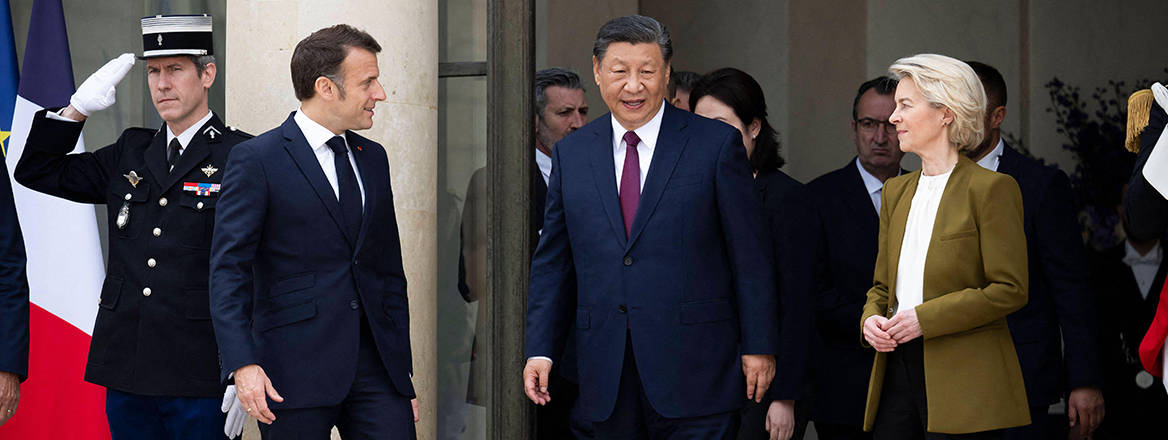
Great Power framing is not just a distraction; but a delusion constructed to enable leaders to pretend that problems posed by the rise of the People’s Republic of China somehow are not their problem. It is a familiar refrain among advocates for ‘strategic autonomy’. President Emmanuel Macron, when questioned about Taiwan as he returned from his 2023 visit to Beijing, warned Europe against becoming ‘vassals’ caught in ‘crises that are not ours’. It is a seductive piece of political theatre – neutral, even sophisticated. Indonesia and Malaysia have a more finessed version: ‘active non-alignment’.
But it is fantasy. The reality is that the threat posed by the Chinese Communist Party (CCP) is not a ‘side’ to be picked in a Washington-led crusade. It is a domestic policy crisis for every sovereign nation on earth. Addressing those challenges is not a choice between two superpowers, but a domestic policy imperative.
The Fallacy of Neutrality
In recent years, the idea that we can opt out of our own problems by appealing to Great Power neutrality has become increasingly farcical, as if our dependencies are the result of our geopolitical preferences rather than our vulnerabilities, or our addiction to economic decision making linked to electoral cycles. When the CCP uses its control over critical mineral supply chains or green-tech manufacturing to punish dissent, the challenge isn't to ‘the West’ as an abstract bloc. It is a challenge to the jobs, the energy security and the industrial viability of individual nations.
Look at Germany. They wanted ‘Wandel durch Handel’ (change through trade). Instead, they got the ‘China Shock.’ German industry, the very backbone of the European economy, now finds itself hollowed out by state-subsidised competition and coerced by its own reliance on an authoritarian market. This isn't a ‘Great Power’ chess move; it is a failure of domestic economic stewardship. ‘There are no allies, only interests’ goes Palmerston’s maxim. By feigning blindness to Beijing's economic statecraft, our leaders are behaving as if there are neither.
Because of our collective exposure to Taiwanese semiconductor dependence, shipping routes, and myriad second order impacts, an escalation in the Strait would trigger a domestic economic depression in nearly every country on the planet
Of course, there are pockets of resistance. Australia didn't pass foreign interference laws because they wanted to please the White House. They did it because they realised their own democratic institutions, their universities and their political parties were being subverted.
When Lithuania allowed a ‘Taiwanese Representative Office’ to open in Vilnius, Beijing did not just protest; they effectively deleted Lithuania from the global customs system. They attempted to use the plumbing of global trade to overwrite the sovereign administrative decisions of a European state. To call this ‘Great Power Competition’ is an insult to the victims of coercion. It is an assault on the right of a nation to govern itself.
Yet actions like these are too few, and when they happen, Beijing responds with coercion, leaving nations to face the music alone. ‘We jumped out in front of the dragon, and nobody came to help’, as one former Lithuanian minister put it to this author.
Potential for Disruption over Taiwan
Nowhere is the Great Power Delusion more acute than over Taiwan. Strategic autonomy enthusiasts speak of Taiwan as if it were a distant territorial dispute; its fate to be determined by the United States and China. Keir Starmer and Macron find themselves in the dubious company of Malaysia’s Anwar Ibrahim as proponents of this strained logic: ‘we refuse to pick a side’, goes the appeal.
This view does not hold one solitary drop of water. The Strait is one of the world’s most vital commercial arteries. If the CCP decides to escalate, appeals to ‘Great Power’ will not save us, and will not be a plausible scapegoat. It will be too late, as nothing will have been done to anticipate the catastrophic implosion of the global supply chain.
Because of our collective exposure to Taiwanese semiconductor dependence, shipping routes, and myriad second order impacts, an escalation in the Strait would trigger a domestic economic depression in nearly every country on the planet. You do not have to pick a side to be affected by the fallout. The economic shrapnel from a Taiwan conflict would hit every hospital, every factory, and every household. The peoples of our countries would have to bear the cost – at least five times worse than the energy crisis created by Putin’s Ukraine invasion (sustained substantially by, you guessed it… China).

Help your search results show more from RUSI. Adding RUSI as a preferred source on Google means our analysis appears more prominently.

The politicians who talk about ‘working people’ are the same folk who outsourced our manufacturing to China, accelerated the defenestration of European industry, left us nowhere to turn but to crippling dependency. The same people have no deterrence plan to avoid the greatest economic catastrophe in our lifetimes. We must stop hiding behind the ‘Great Power’ label to conceal this urgent truth. It is a shield for the cowardly and an excuse for the unprepared – a fig leaf barely concealing the pre-emptive self-censorship that governs so much of China policymaking.
The problem we face is not whether we prefer Washington or Beijing. It is about whether we have the courage to protect our own people from dependency, our own politics from interference, and our own economies from total exposure. A nation that cannot defend its own integrity against the CCP’s grand strategy is not being neutral but actively capitulating.
Gazing across the Atlantic with performative suspicion will not rid us of the rot in our own floorboards. The choice is not between two masters; it is between a partnership of imperfect democracies and the slow, quiet strangulation of our own sovereign agency by a regime that views our neutrality as an opportunity. Beijing is set on a path towards the Great Rejuvenation of the Chinese Nation – an effort to right what they see as historic wrongs and to prevail over the United States as the preeminent global hegemon. Middle powers will not prevent China bending their economies and societies out of shape by pretending that these challenges are about alignment. More Palmerston, less Great Power Delusion.
Luke de Pulford is the founder and Executive Director of the Inter-Parliamentary Alliance on China. Previously he co-founded the anti-slavery charity Arise, which he ran from its inception until 2022. He specialises in human rights campaigning, for which he is widely known.
© Luke de Pulford, 2026, published by RUSI with permission of the author.
The views expressed in this Commentary are the author's, and do not represent those of RUSI or any other institution.
For terms of use, see Website Terms and Conditions of Use.
Have an idea for a Commentary you'd like to write for us? Send a short pitch to commentaries@rusi.org and we'll get back to you if it fits into our research interests. View full guidelines for contributors.
WRITTEN BY
Luke de Pulford


- Jim McLeanMedia Relations Manager+44 (0)7917 373 069JimMc@rusi.org