


In response to the threat of conflict with Russia, and as with the Great Wars of the 20th Century, Europe is finding a new resolve.
Comparisons between the build up to previous world wars and the present day are not overstated. It is sensible to seek guidance from past international conflicts. The Second World War ended only 80 years ago and still offers rich insights. In fact, an older gentleman recently reminded this author the war is a living memory; as an infant, he was wounded by a bomb falling on his house in London during the V-Weapons Campaign of 1944-45. In early December, the Secretary General of NATO, Mark Rutte, publicly warned ‘we must be prepared for the scale of war our grandparents and great grandparents endured.’ US intelligence has also found Vladimir Putin maintains his objectives for Russia to annex Ukraine and neighbouring European territories. Meanwhile, Russian operations to target, divide or discredit European societies persist. Europe is in a ‘gathering storm’. To face it, we need a societal response and a leader to invigorate an alliance.
Mobilising Society
Several weeks ago, the Royal United Services Institute sent a British delegation to the Institut Montaigne in Paris for a conference on ‘Cooperating in Defending Europe.’ Senior European diplomats, defence experts and industry leaders discussed a ‘whole-of-society’ response to the threat from Russia. Behind closed doors the prevailing mood was sombre, though delegates showed remarkable resolve – not least from northern and eastern Europe. The delegates worked from the assumption if Europe is not at war with Russia, it is at the very minimum in a confrontational, pre-war phase. They concluded European states cannot keep operating as if they were in peacetime, a conclusion Secretary Rutte echoed by urging the ‘shift to a “wartime mindset”.’ What can Western Europe retain from its preparation for the last world war? And how can Western Europe undertake the necessary shift to deter Russia?
It is a commonly held view that Great Britain was completely immobile in the run up to the Second World War. Although British political leadership in the 1930s truly sought to appease or delay war at grave costs, at least a minority of energetic figures in the political class were feverishly alert to the threat from Nazi Germany. The MP Winston Churchill devoted his ‘wilderness years’ to unpopular interventions in favour of British rearmament and absolute firmness against Germany. As early as November 1932, he warned ‘every concession [to Germany] . . . has been followed immediately by a fresh demand . . . Now, the demand is that Germany should be allowed to rearm. Do not delude yourselves.’ Churchill’s biographer, Andrew Roberts, described how Churchill surrounded himself, outside of the House of Commons, with ‘experts in their fields who brought warnings about German military strength and plans, and also about German military weakness’ – including experts from the Foreign Office, the Royal Air Force, the Committee of Imperial Defence and a few anxious politicians from France and Germany. Nonetheless, in 1937, he counted only two allies in Parliament.
Despite having partially recognised the threat, Western Europe has not yet adopted the wartime mindset to respond to it
By 1938, a growing group within the British establishment supported Churchill, or anti-appeasement more generally. The First Lord of the Admiralty, Alfred Duff Cooper, left the government spectacularly after the Munich Agreement. The young Anthony Eden and Harold Macmillan increasingly mobilised. In mid-September 1939, the Chatham House scholar Arnold Toynbee contacted a French counterpart to even warn ‘if France and the UK won’t . . . constitute one country, so-to-speak, it is inevitable that sooner or later the unification of Europe will happen in the shape of German dominance exercised over our two states.’ Toynbee, along with the Frenchmen Étienne Dennery and Emmanuel Monick, paved the way for the extraordinary but little-known British offer of Union to France on 16 June 1940. The agreement brokered by Churchill and Charles de Gaulle stated ‘France and Great Britain shall no longer be two nations, but one Franco-British Union . . . [with] joint organs of defence, foreign, financial and economic policies. Every citizen of France will enjoy immediately citizenship of Great Britain, every British subject will become a citizen of France.’ By that stage, it was too late, and the project was put to bed when Marshal Philippe Pétain took power in France later that day. Great Britain was therefore not completely immobile in the 1930s, but its preparation proved barely sufficient to ward off an invasion by Germany in 1940-41. Meanwhile, a large share of Western Europe fell to the Axis.
Today, Western Europe has an active minority calling to deter Russia, consisting of several political leaders and part of the foreign policy establishment. The British Chief of the Defence Staff, Sir Richard Knighton, told an audience at RUSI that Britain ‘needs a whole of nation response . . . The Russian leadership has made clear that it wishes to challenge, limit, divide and ultimately destroy NATO . . . While the price of peace may be rising, the cost of strong deterrence is still far, far less than the cost of war.’ The British Chief of the Secret Intelligence Service, Blaise Metreweli, stated on the same day ‘Russia is testing us in the grey zone with tactics that are just below the threshold of war.’ In terms of threat perception, Western Europe is perhaps better off today than it was in 1938 or early 1939. We may have retained some wisdom from previous world wars.
Yet despite having partially recognised the threat, Western Europe has not yet adopted the wartime mindset to respond to it, and a great share of public opinion is clueless about the gathering storm. In France, the political class has agonised over minor reforms in the pensions system and tweaks in the budget, blissfully unaware or wilfully ignorant the very stability of the system is at stake. Delegates at the Institut Montaigne concluded that for Europe to undertake a whole-of-society response, its governments first need to communicate the threat to the public and develop a shared European narrative. Churchill’s father, Lord Randolph, would tirelessly repeat: ‘trust the people.’ In a democratic system, trusting the people means telling them the truth. Short of spreading panic, governments must honestly spell out the threat of Russia to citizens, teach them to recognise disinformation, and set expectations of how they could contribute in a conflict.
Where’s Our Churchill?
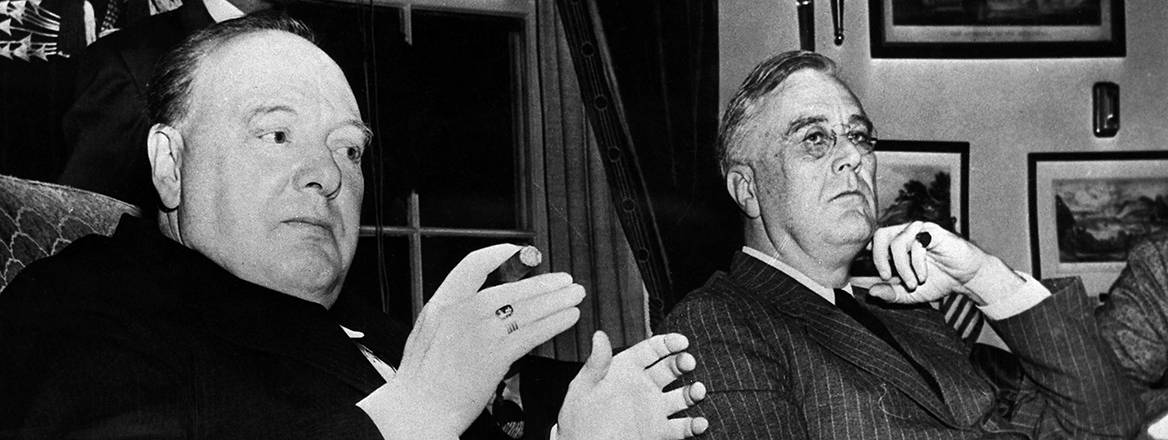
This past year, diplomatic convenings in Europe often concluded with murmurs or a sigh: what happens if NATO’s political leaders are not all on board? Extraordinarily, De Gaulle and Churchill shared similar anxieties about Transatlantic relations in the early 1940s. De Gaulle sought to establish a French government-in-exile from London, but was dismayed at Franklin Roosevelt’s refusal to back it and the United States’s continued engagement with the Vichy Regime. De Gaulle maintained his line until the Liberation of 1944 and was vindicated for having resisted from abroad. Churchill himself understood that without the United States, most of Western Europe could be dominated by Germany. Consequently, he used every ounce of personal diplomacy to bring Roosevelt on Britain’s side and travelled perilously to the United States five times during the war, staying in the White House for weeks on end.

Help your search results show more from RUSI. Adding RUSI as a preferred source on Google means our analysis appears more prominently.

One may point out the Euro-Atlantic does not currently have its Churchill. However, leaders like de Gaulle and Volodymyr Zelenskyy have shown Churchillian characters can emerge from the margins, from smaller states or severely weakened positions. Such characters can also emerge at a later stage in a war: during the Great War, Georges Clemenceau took over as France’s ‘Tiger’ Premier in late 1917 – over three years into the conflict. Clemenceau was an old man, an embattled Radical politician supposedly past his prime, who took a simple stance: ‘I too want peace . . . It is not by whining for peace that we silence Prussian militarism . . . Domestic policy: I wage war. Foreign policy: I wage war. I always wage war.’ When individuals lead by example, enthusiasm can be generated from unexpected places.
Immeasurable Success
Taking the threat from Russia seriously, what would a war with Russia resemble? If war is avoided, we will never know. Deterrence is a thankless task, crowned by immeasurable success. As Sir Knighton reflected, ‘“How much [deterrence] is enough?” . . . It is almost impossible to answer that question, except in hindsight. But if we get it wrong the cost could be huge.’ Failure to deter, on the other hand, would lead to a war, or to pockets of conflicts – unlike the previous two world wars.
Until Europe is in a full all-out war, it is worth seizing every available minute to prepare. Political leaders in Western Europe may be more aware of the threat of war than they were in the 1930s – but only just. Awareness will be of no use if it not matched by concrete mobilisation. During the Great War, the President of France’s lower house, Paul Deschanel, asked a question similar to today’s: ‘Has the lesson of 1870 at least been useful? . . . The first of our duties is to work towards the disappearance of war; but meanwhile, we must foresee it and consequently, prepare it. To prepare it is not to want it.’ Political leaders should place defence at the top of the agenda and inform public opinion accordingly. If in five or ten years, France is again debating pension reforms, Europe will know it has weathered the storm.
© RUSI, 2026.
The views expressed in this Commentary are the authors', and do not represent those of RUSI or any other institution.
For terms of use, see Website Terms and Conditions of Use.
Have an idea for a Commentary you'd like to write for us? Send a short pitch to commentaries@rusi.org and we'll get back to you if it fits into our research interests. View full guidelines for contributors.
WRITTEN BY
Dr Elias Forneris
Head of Research Governance and Editorial
Publications


- Jim McLeanMedia Relations Manager+44 (0)7917 373 069JimMc@rusi.org