

Europe Started Talking Nuclear Deterrence. Still Missing: A Plan

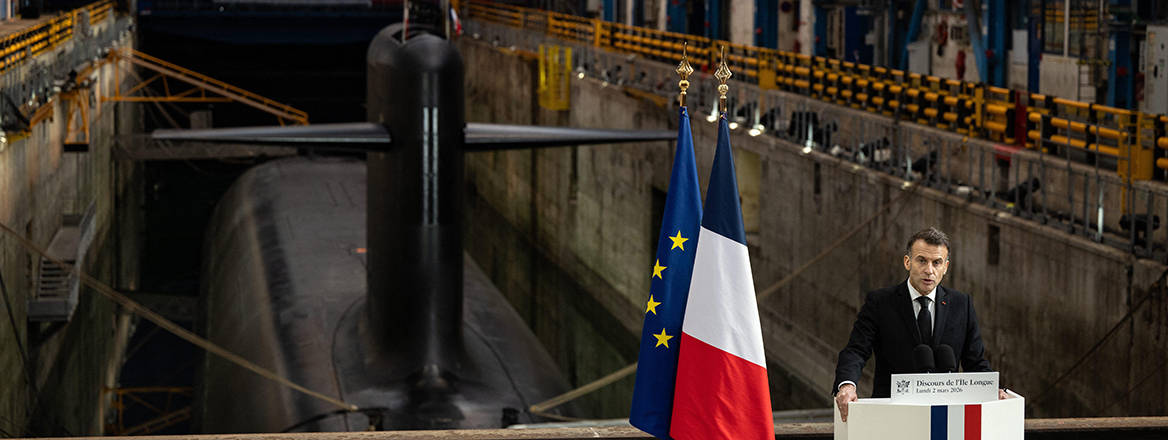
Europe's nuclear future prominently on the agenda. But talk is cheap, even of grand designs, and the debate lacks an understanding of joint responses or near-term steps.
For the very first time, German troops will take part in a French nuclear exercise this year. While such a participation sounds technical, it is not. Rather, Germany’s decision to take part in a French nuclear manoeuvre is of high political relevance and the latest move in a series of decisions and announcements touching upon Europe’s nuclear future.
Correspondingly, French President Macron unveiled his concept of ‘forward deterrence’ earlier this year, according to which France would offer its allies the opportunity to contribute their conventional forces to France’s nuclear activities and open the possibility of deploying France’s nuclear-capable aircraft, temporarily, on the soil of its allies.
In addition, French and German governments have established a framework in which to further their nuclear cooperation: a German-French Nuclear Steering Group, co-chaired by the French President and Germany’s Chancellor. Nine other European countries, including Belgium, the Netherlands, Poland and the UK, are, apparently, also engaged in structured talks with France about its ‘forward deterrence’ proposal.
Hence, it is fair to say that political momentum surrounding Europe’s nuclear future is real – and for good reason, since Russia has decreased its threshold for nuclear use and repeatedly fired nuclear-capable missiles at Ukraine. These steps on the part of Moscow seem to aim at exerting political pressure on NATO allies, first and foremost, rather than representing a military necessity. Concurrently, Washington’s plans to reduce its conventional contributions to Europe’s deterrence posture, though formally separate from its nuclear guarantees, undermine the trust those promises rest on. Both developments – Russia’s intensified nuclear signalling efforts and American retrenchment trends – reinforce each other, casting doubt on the potency of Europe’s nuclear deterrence arrangements. A Kremlin that sees a waning US commitment to Europe’s security has every incentive to continue testing where NATO’s red lines are and, if overstepped, whether and how the Alliance reacts.
Momentum Without a Clear Plan
On closer examination, though, it is evident that the current debate reveals aspects that bear the potential of letting the political momentum dry up.
The challenge is to find out how the French forward proposal can interact with – and potentially reinforce – the arrangements in place
First, a shared understanding of how to react to the threat is missing. While most Europeans agree that Russia poses the biggest peril to the continent’s security, the tools and urgency with which to respond differ between the continent’s capitals. Poland has been most adamant about its desire to forward-deploy capabilities on its own territory. Supporting those pushes, Prime Minister Donald Tusk proclaimed that his country is ‘arming up together with our friends so that our enemies will never dare to attack us.’ While Germany is embracing France’s nuclear overtures, it remains clear that Berlin’s desire is to continue relying on NATO’s nuclear sharing arrangements, and thus America’s primacy – a preference that is not in contradiction with France’s forward deterrence. The UK, for its part, is likewise mentioned in the same breath as France when it comes to options for furthering Europe’s nuclear deterrence, while also working to strengthen NATO’s nuclear sharing arrangement. France, for its part, has stressed that forward deterrence changes nothing about who has authority over the French arsenal – a point neither London nor Berlin have ever questioned. What remains unanswered is not a contradiction in principle but a practical one: how these overlapping arrangements should be squared with one another in operational terms. Overcoming those differences will ultimately decide if and which ideas can survive. Without mapping them, Europe’s current debates and activities risk turning into a blind flight.

Second is a lack of actionable and concrete solutions. The good news is that the infrastructure to start small(er) is in place already. The Alliance’s Nuclear Planning Group (NPG) has coordinated nuclear consultations for six decades and a number of European countries, including Germany, are well experienced in NATO’s nuclear sharing mission. The UK’s experience slightly differs: London has long committed its own independent nuclear arsenal to NATO’s deterrence mission – a role the UK is now supplementing by ways of re-joining the Alliance’s nuclear-sharing mission. How forward deterrence can be related to the existing machinery is another, urgent question: NATO’s NPG is built around US – and to a lesser extent UK – nuclear forces, while France has never wanted a role within that forum. The challenge is to find out how the French forward proposal can interact with – and potentially reinforce – the arrangements in place. Joint tabletop exercises combining French forward-deployed aircraft with allied dual-capable jets, or a standing crisis-consultation mechanism that includes Paris alongside Washington, are conceivable examples in this regard. Furthermore, consultations between NATO’s Steadfast NOON and the French POKER exercise could also be an avenue worth considering.
Two Answers: Dialogue and Expertise
Academic research alone will not address those aspects sufficiently, as nuclear policy is deliberately couched in ambiguity – governments do not publicly express their true red lines, and no amount of open-source analysis can replace what can only be unearthed in confidential exchanges between officials.
Hence, the real task ahead is not the formulation of another academic publication or think tank paper. Rather, sustained, discreet dialogue that surfaces what European capitals want and are willing to put in the balance, will accept or rule out what is called for – prior to, and not while, the next crisis is unfolding. Thus, a standing expert group, meeting (bi-)quarterly, composed of officials from the countries party to NATO's nuclear sharing arrangement, together with Poland, the UK and France, speaking behind closed doors, should be forged.
While France and the UK have not allowed their arsenals to lapse, nor the supporting expertise to wither away, the demands of extending credible protection to allies differs starkly from their nuclear missions of the past
These countries have the highest stakes and are the most directly affected by any change to US nuclear deterrence policy vis-à-vis Europe. Including Poland into this mix is warranted by its frontline position on the Alliance’s eastern flank and its stake in any future extended deterrence arrangement, though it is not a nuclear sharing state at the moment. Where and when needed, this core should be supplemented, by a standing circle of think tank experts drawn from the same countries, offering guidance in the same confidential setting. Such a standing expert group should exist alongside NATO's structures, not replace them.
There is a second, slightly quieter gap, and that is nuclear expertise. West Germany, for its part, maintained deep knowledge of nuclear strategy during the Cold War. That knowledge has atrophied for decades ever since – just as the subject itself has been altered by new delivery systems, precision warheads and missile defence, among other things. Thus, rebuilding a ‘nuclear IQ’ through expert briefings, exchange programmes with European nuclear ‘haves’ and a new generation of specialists across ministries is not a ‘nice-to-have’ for current and especially future debates; it is a ‘must’ for having them in the first place.
Germany matters in this context in particular, as any credible European deterrent cannot bypass Berlin – as host nation, financial supporter or political bridgebuilder. Yet the challenge is not Germany’s alone. While France and the UK have not allowed their arsenals to lapse, nor the supporting expertise to wither away, the demands of extending credible protection to allies differs starkly from their nuclear missions of the past – in particular with regard to France. That sort of expertise must be (re-)built too – though to a lesser extent than is necessary in Berlin.
Time is Ticking
None of the above warrant alarmism, instead seriousness is called for. How credible can extended deterrence provided by the US be, moving forward? How does NATO’s nuclear sharing arrangement relate to a possible heightened role for France and the UK in Europe’s nuclear future? How do both aspects fit into the Alliance’s conventional deterrence plans, especially in light of American withdrawal announcements? On which terms would other states help fund or host French and British capabilities? While these are not new questions and research on them exists and is ongoing, the challenge now is to translate the analysis into political and institutional steps – concrete decisions and agreement about arrangements.
The urgency of tackling these questions will only grow larger. Merz's nuclear exercise announcement, the French ‘forward deterrence’ proposal and the Franco-German steering group are valuable signals of political determination. What they do not equate to is a solid plan, never mind a strategy.
Europe can wait for the next crisis to erupt and try to improvise under pressure, or – which would be more sustainable – it can start getting to work now, by ways of building the shared understanding and expertise that would enable actionable answers.
© Aylin Matlé, 2026, published by RUSI with permission of the authors.
The views expressed in this Commentary are the author's, and do not represent those of RUSI or any other institution.
For terms of use, see Website Terms and Conditions of Use.
Have an idea for a Commentary you'd like to write for us? Send a short pitch to commentaries@rusi.org and we'll get back to you if it fits into our research interests. View full guidelines for contributors.
WRITTEN BY
Dr Aylin Matlé
Guest Contributor


- Jim McLeanMedia Relations Manager+44 (0)7917 373 069JimMc@rusi.org