

Ensuring Offshore Infrastructure Protection Keeps Pace with Growth

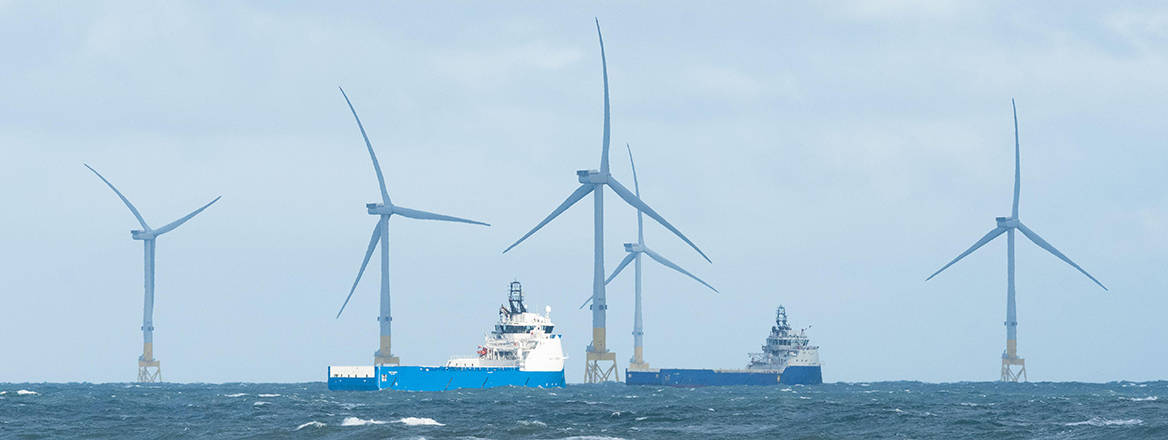
Offshore energy infrastructure is being built at pace, led by offshore wind and electrical interconnectors, but the security architecture needs to keep up.
Offshore wind has become a strategic system. The UK now operates over 16 GW of installed offshore wind capacity within a 50 GW target for 2030. At the North Sea Summit in Hamburg on 26 January 2026, nine governments, the UK and France among them, reaffirmed the target of up to 300 GW of offshore wind in the North Seas by 2050, with up to 100 GW delivered through cross-border interconnected projects. France's contribution, confirmed at Ostend in 2023 and reaffirmed at Hamburg, is at least 2.1 GW by 2030, rising to between 4.6 and 17 GW by 2050.
The system has, so far, absorbed this growth. Grid integration is keeping pace, supply chains are scaling, and the engineering is no longer the binding constraint. The capacity question is, in the relevant sense, solved.
The security and safety question is not. Defending this infrastructure has not received institutional attention proportionate to its scale. The Hamburg declaration paired the Joint Investment Pact with language on protecting the future grid against ‘physical, cyber or hybrid attacks’, but that language has not yet translated into a coherent operational answer to the basic question: when something happens to an offshore wind farm 40 nautical miles from shore, who is in charge?
Responsible Parties
The UK's answer to that question is fragmented. Maritime security and safety incidents on offshore renewables touch the writ of several departments: the Department for Energy Security and Net Zero, the Department for Transport, the Maritime and Coastguard Agency, the Home Office, the Ministry of Defence, and the operator itself. Which authority leads depends on the type of incident, not on the location of the asset. A pollution incident is the Maritime and Coastguard Agency's. A suspicious vessel near a cable is a policing matter, which could be handed to Border Force. A degraded turbine is the operator's. A deliberate act against critical national infrastructure may, eventually, be a counter-terrorism case. None of these single agencies sees the whole picture, as a matter of routine. However, recent efforts across government have seen significant effort in bolstering the national response to issues surrounding at sea infrastructure.
The result is a working system for the average day, and an uncertain one for the day on which something goes wrong. Capacity continues to be built. Authority has not been built alongside it.
The military are not the default answer to this fragmentation. Under Military Aid to the Civil Authorities (MACA), the armed forces act in support of civil authorities only when those authorities request assistance, when there is a capability gap, and when the request is endorsed through a defined ministerial process. This is a deliberate constitutional restraint, and an appropriate one. It also means that the Royal Navy does not, on a routine day, hold a permanent operational authority over the maritime space around a wind farm. It assists when asked.
The Joint Maritime Security Centre (JMSC) exists to address part of this gap. It is the UK's ‘centre of excellence for maritime security’, fusing intelligence and data across civilian and military maritime organisations, hosting the National Maritime Information Centre and a 24/7 monitoring function known as the Joint Maritime Operations Coordination Centre. It is the right institution for awareness and cross-government coordination, and that is the function its mandate describes. It is not, on its current footing, an operations centre with command authority for the defence of offshore renewable infrastructure: its published remit describes coordination and information fusion, and as argued in greater detail elsewhere, it does not give offshore renewables a directing authority on the water. The result is a working system for the average day, and an uncertain one for the day on which something goes wrong. Capacity continues to be built. Authority has not been built alongside it.
Two routes are available. They are not mutually exclusive.
The first route is to develop a UK answer from within the existing architecture by giving offshore renewables a dedicated crisis-management authority modelled on the Secretary of State's Representative for Maritime Salvage and Intervention (SOSREP). The SOSREP was designed for exactly the problem the offshore renewables sector now poses on its worst day: a fast-moving incident with multiple actors, commercial pressure to under-respond, and a public interest in decisive action. Extending and resourcing a SOSREP-type role for offshore energy in general, encompassing wind, interconnectors and oil and gas, with statutory authority to direct operators and to call in civil and military assets at a critical moment, would address the command question without redesigning the rest of government.

The second route is to look across the Channel and ask whether the routine question, who owns the maritime space around a wind farm on an ordinary Tuesday, is better answered by a permanent, geographically defined coordinator. France has had one since Colbert. The Maritime Prefecture is older than most of the British institutions that the UK might otherwise reach for, and it has been continuously adapted to the maritime present.
Maritime Prefectures
The premise of the French system is unfamiliar to a British reader and worth stating plainly. France views its territorial sea as an extension of its territory, to be governed in much the same way as the land. From that premise follow Maritime Prefects whose role mirrors that of their terrestrial counterparts: state representatives at sea, representatives of the government, and direct representatives of the Prime Minister and of each minister. The system is based around three maritime zones, each with its prefecture: Channel and North Sea, based in Cherbourg; Atlantic, based in Brest; and Mediterranean, based in Toulon. Each prefecture is headed by a Maritime Prefect, a serving vice-admiral who acts as the state's representative at sea.
Under the Prefect, the Marine Nationale, the Gendarmerie Maritime, the Douanes, the Affaires Maritimes, and the relevant police services operate under a single strategy that addresses illegal fishing, pollution, maritime borders, and the protection of critical infrastructure, framed by the Stratégie nationale de sûreté des espaces maritimes and the doctrine of Action de l'État en Mer. Surveillance, search and rescue, fisheries enforcement, pollution response, customs interdictions, the policing of submarine cables, and the security of offshore infrastructure are coordinated under the Prefect through a framework in which military capability and civilian oversight are exercised under a single strategic vision. The agencies do not negotiate their relationship at the moment of an incident; the Prefect arbitrates a relationship that is already prescribed.
For an offshore wind farm, the practical implications are direct. The Prefect is a permanent point of contact for operators, so anomalous activity can be triaged and acted on without anyone having to work out whose problem it is. The Prefect directs civil and military assets in the same breath, without the equivalent of a MACA request. And the Prefect's authority is geographic and continuous rather than incident-driven, so the routine day is governed by the same institution that governs the bad one.

The seam in the French model sits where any maritime authority must end: at the low-water mark. The zone of the Préfet Maritime de la Manche-Mer du Nord runs from the Belgian frontier to the Bay of Mont-Saint-Michel, but onshore substations, grid connection points, and the cable corridors that link them sit beyond the Prefect's writ. The French answer is a standing Conférence maritime, chaired by the Maritime Prefect, which brings the maritime and terrestrial préfets around a single table when an incident or a programme requires it. Because France treats the sea as territory, this seam is managed within a single administrative idiom rather than across institutional cultures. That is the part of the French model the UK cannot import wholesale, and the part that an honest British adaptation must engineer.
While a Ministry for Maritime Affairs would be an extreme solution, it is necessary to recognise that the UK is building a strategic system with limited institutional authority to defend it, and that two practical options are already on the table.
The first is incremental and well within reach: extend the SOSREP model, in statute and in resource, to cover offshore energy and potentially other infrastructure. The second is more ambitious: revive a regional civil-military authority for security and safety in UK territorial waters. There is a British precedent for this idea, and it predates the centralisation of the Royal Navy. The Vice-Admiralties of the Coast, introduced in 1536 to replace the medieval Wardens of the Coast, were posts established in each of the twenty maritime counties of England, with parallel appointments in Wales and Ireland. From around 1560 the Vice-Admirals took direct instruction from the Privy Council and, from 1561, the Crown itself; in 1660 their functions came under the Board of Admiralty, before eventually being phased out over the following two centuries.
The substantive function did not survive the centralisation of the Royal Navy. But the problem it was created to solve has come back. Whether the answer is an extended SOSREP, a maritime authority modelled on the French Prefect, or a hybrid that takes the personally vested decision-maker from the first and the geographically defined coordinator from the second, the underlying point is the same. Infrastructure has been built. Authority must now be built to match. In the spirit of the Lancaster House refresh and the Hamburg pact, a joint UK–France exercise built around the seam between the Préfet Maritime de la Manche-Mer du Nord and the SOSREP, supported by the JMSC and the Secrétariat Général de la Mer, would be the cheapest way to find out which of these options the next incident would actually require.
© Alexander Westley, 2026, published by RUSI with permission of the author.
The views expressed in this work are those of the author and do not represent those of the MOD, Royal Navy, RUSI or other institution
For terms of use, see Website Terms and Conditions of Use.
Have an idea for a Commentary you'd like to write for us? Send a short pitch to commentaries@rusi.org and we'll get back to you if it fits into our research interests. View full guidelines for contributors.
WRITTEN BY
Commander Alexander Westley
Guest Contributor


- Jim McLeanMedia Relations Manager+44 (0)7917 373 069JimMc@rusi.org