

Defence Up, Aid Down: Europe's New Security Blind Spot

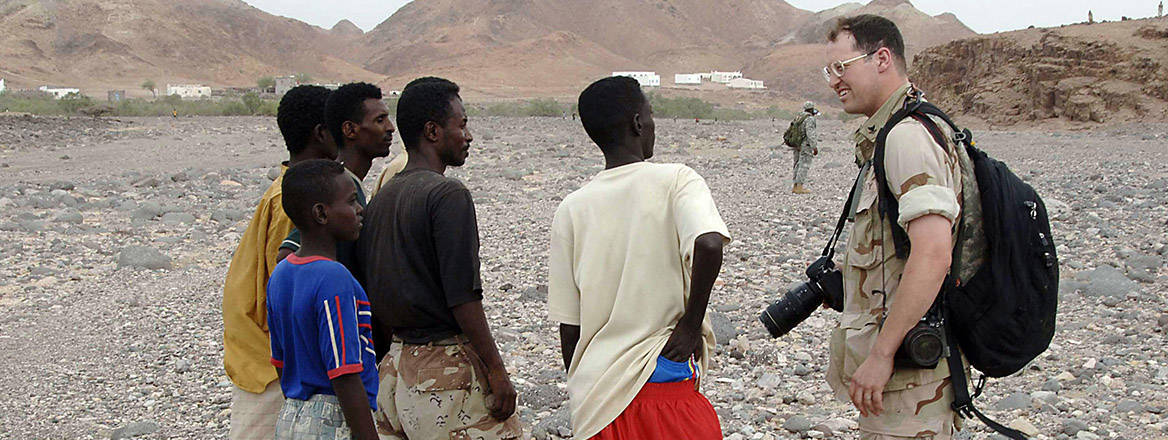
Defence spending pushes to new records as humanitarian budgets get cut. Making development expendable erodes Europe’s crisis prevention and interests in fragile regions.
Europe's New Security Blind Spot
In the wake of Russia's war in Ukraine and a more volatile global environment, European leaders have moved to strengthen Europe’s security posture, expanding defence budgets and launching new instruments. At the same time, aid, humanitarian and peacebuilding budgets are being quietly pared back, folded into more flexible external spending pots and redeployed towards politically salient priorities such as infrastructure and migration management. The result is a security approach that appears more robust on paper, but risks leaving Europe more exposed in the fragile regions where many of its long-term risks are actually brewing.
The latest cuts to USAID, combined with the fiscal and political pressures generated by the wars in Ukraine and the Middle East, have triggered a chain reaction that reaches far beyond Washington. As budgets tighten, European and multilateral donors are not simply doing less of the same; they are rerouting funds away from the slower, less visible work of peace, governance and conflict prevention towards regional envelopes, high profile infrastructure and politically salient partnerships. Country specific support in some of the most fragile contexts has collapsed, while migration deals and initiatives such as Global Gateway absorb a growing share of what used to be classic development and peacebuilding budgets. Taken together, these shifts are quietly chipping away at Europe's presence and leverage in poor, conflict-affected states just as the global security environment becomes more volatile.
If we observe the latest 20 years' timeline, we will easily conclude that conflicts and fragility do not pause when budgets are redrawn: they evolve. Shocks such as deep USAID cuts and the intensification of the wars in Ukraine and the Middle East have set off a cascade in which donors are pushed to invest more in defence and crisis response, and, by consequence, less in slower prevention work. That trade-off may look manageable on paper, but it creates security gaps we have not yet fully understood or measured, particularly in ecosystems where everything is interconnected, and small shifts in funding can have large downstream effects. The abrupt suspension of USAID funding alone precipitated a surge in riots, protests and conflict-related deaths within weeks, while studies estimate ODA reductions by major donors including the UK, France and Germany could lead to over 9 million fatalities by 2030. Upper estimates suggest 22.6 million.
The real risk is not that any single budget line disappears overnight, but that over a seven-year cycle Europe gradually normalises an external-action posture in which the most durable security gains are also the easiest funds to raid whenever political pressure mounts
None of this is happening in a vacuum. Recent multilateral development finance data point to a donor landscape that is reorganising itself underneath the surface of any single budget line. Belgian NGOs report having to restructure entire programmes around shrinking and less predictable funding, while comparable adjustments are under way across the wider European donor community. Material shortfalls appear ‘common’, with over half of surveyed women’s groups in humanitarian crisis zones facing closure due to resource cuts. Even forums built to coordinate a collective response, such as the G7, are under pressure to recast their development agenda around narrower security and economic interests rather than broader prevention goals. The cumulative effect is a sector reshaping itself faster than its institutions, or its public debate, have caught up with.
Defence Up, Aid Down
Since Russia's full-scale invasion of Ukraine, European governments have raced to expand defence budgets, launch new instruments and move toward higher spending targets. In parallel, aid and humanitarian budgets have been cut or repurposed, with EU institutions' ODA falling sharply and member states registering the largest drop in a decade. This ‘defence up, aid down’ pattern is often presented as unavoidable housekeeping in tighter fiscal times. In reality, it rewires Europe's security toolkit, privileging fire fighting over prevention and weakening the levers that once helped keep distant crises manageable.
In Brussels, these choices are being built into a more flexible, interest-driven model of external spending. The move to pool previously separate development, humanitarian and peacebuilding lines into broader external instruments is framed as a way to respond faster to crises and align funds with shifting geopolitical priorities. In practice, greater flexibility has often meant that long-term prevention and support to fragile states become the adjustment variable. Funds are reallocated towards high-profile infrastructure initiatives and migration management deals when political pressure spikes, while lower-visibility peace, governance and social programmes are trimmed at the margin. The real risk is not that any single budget line disappears overnight, but that over a seven-year cycle Europe gradually normalises an external-action posture in which the most durable security gains are also the easiest funds to raid whenever political pressure mounts.

Development as Hard Power, in Reverse
European leaders increasingly echo the idea that development is not a feel-good add on, but part of hard power: the infrastructure, institutions and partnerships that keep crises from reaching Europe's borders. Yet current budget choices run in the opposite direction. As aid and peacebuilding lines are trimmed, merged and repurposed, Europe is quietly dismantling the very field networks and prevention capacities that underpin its influence from the Sahel to the Horn of Africa. The result is a security posture that looks tougher on paper, but is less able to shape the conflict of systems, migration routes and local economies where Europe's long-term interests are actually decided.
This is not a minor inconsistency between rhetoric and practice. It reflects a deeper confusion about where security is actually produced. A defence ministry can deter a tank column or intercept a missile, but it cannot rebuild a collapsed civil service, mediate a land dispute before it turns violent, or maintain the local relationships that keep a government oriented towards Europe rather than towards its rivals. Those are the slower, less-visible functions that development and peacebuilding programmes have traditionally performed, and they are precisely the functions now being treated as discretionary.
From the Sahel to the Horn
Nowhere is this trade off more visible than along the arc from the central Sahel to the Gulf of Guinea. As European development, governance and security programmes have been scaled back or reconfigured, local administrations and civil society partners report shrinking resources just as insurgent violence, coup-led juntas and external military actors gain ground. In the same period, Russia and Gulf states have deepened their presence through security agreements, arms transfers and strategic infrastructure deals, offering alternative patrons to regimes that no longer see Europe as a reliable partner. For Europe, the consequence is not just a loss of soft power, but a growing exposure to unmanaged migration routes, jihadist ecosystems and vulnerabilities along critical maritime and energy corridors that connect West Africa to European markets.


A similar pattern is visible from Sudan across the wider Horn of Africa. As Sudan's war has shredded institutions and displaced millions, European development and peacebuilding engagement has struggled to keep pace, just as Gulf states, Russia and other external actors expand their influence through financial lifelines, arms and strategic port and corridor deals. In neighbouring countries such as Ethiopia, South Sudan and the Red Sea littoral, shrinking European support for governance, basic services and conflict prevention intersects with rising transactional offers from alternative partners. For Europe, this combination erodes leverage in a corridor that is central to maritime trade, energy flows and migration routes, and increases the risk that crises in the Horn spill over into wider economic and security shocks. Studies are already mapping ‘collateral circuits’ of cash, tech, munitions and mercenaries crosscutting Chad and Libya; markets of ‘arms and armed labour’ reconfiguring local livelihoods and regional power structures. The spread of MANPADS, UAVs, anti-tank missiles, phosphorous rounds and jamming equipment – whether exported by foreign sponsors or pilfered from SAF stockpiles – presents a region-wide threat, while UN monitors describe (attempted) drone deliveries to Islamic State brokers in West Africa. As conflict diffuses along the kinship, patronage and political networks meshing Sahelian states together, the fallout from Sudan’s collapse could have an exponential and ‘generational’ impact across the continent, if not further afield.
Europe's New Security Blind Spot
Europe's leaders like to say that the Union is finally coming of age as a geopolitical actor, with bigger defence budgets, new security instruments and a tougher strategic vocabulary. Yet, by allowing development, prevention and peacebuilding to become the flexible buffer in every fiscal squeeze, they are carving a blind spot into their own security posture. The more Europe treats aid as the line item that can always be trimmed, merged or redirected, the more it hollows out the relationships, institutions and field presence that give its deterrence and diplomacy real weight in fragile regions.
None of these calls for abandoning the case for stronger European defence. The two are not in competition, except in the way Europe currently funds them. If Europe wants to be taken seriously as a geopolitical actor it needs both a credible deterrent and a credible presence in the places where its long-term security is actually contested, and at present it is investing heavily in the first while quietly running down the second. The question for the next decade is not whether Europe spends more on defence, but whether it is willing to see development cooperation as part of the same arsenal, or whether it will instead continue to disarm itself in the very places where its security will be decided.
This commentary is part of a series published under RUSI Europe's project, Europe's Overlooked Hard Power, which examines the tools beyond traditional defence that underpin European security and influence abroad.
© RUSI, 2026.
The views expressed in this Commentary are the authors', and do not represent those of RUSI or any other institution.
For terms of use, see Website Terms and Conditions of Use.
Have an idea for a Commentary you'd like to write for us? Send a short pitch to commentaries@rusi.org and we'll get back to you if it fits into our research interests. View full guidelines for contributors.
WRITTEN BY
Dr Joana de Deus Pereira
Senior Research Fellow
RUSI Europe


Michael Jones
Senior Research Fellow
Terrorism and Conflict

- Jim McLeanMedia Relations Manager+44 (0)7917 373 069JimMc@rusi.org