

China is Not Just Claiming the South China Sea. It is Learning to Govern It

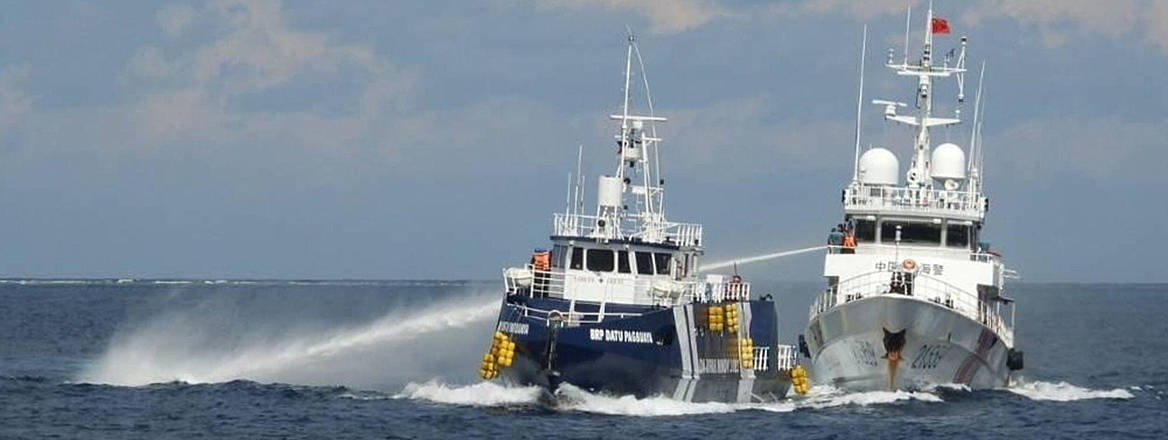
Beijing claims a Philippine resupply mission to Second Thomas Shoal was illegal, lacking approval from Beijing, China has shifted to treating this as space it administers.
The 24 September incident saw China Coast Guard patrol ships intercept Philippine vessels involved in a resupply run, destined for Second Thomas Shoal, situated within the Philippines’ exclusive economic zone (EEZ). The interception occurred 60 nautical miles from its destination of BRP Sierra Madre, the ship which Manila grounded on purpose in 1999 to assert its claim and act as a garrison. The Philippine Coast Guard commented that the manoeuvres involved in this interception ‘put Filipino personnel at risk’. China Coast Guard vessels, supported by its now infamous maritime militia, crowded the shoal, while three warships lurked nearby. The incident was subsequently followed by a military exercise. This incident is part of a consistent pattern, with the recently circulated footage of a Chinese cutter ramming a Philippine fisheries vessel in these waters on 18 September further demonstrating the aggressive tactics in play.
Much of the commentary has framed these incidents as further acts of aggression, and suggested that a more major clash between China and a US treaty ally could be on the horizon. Much more revealing, however, is a claim in China’s state-run Global Times, citing an unnamed source, stating that it acted appropriately, as the Philippine resupply mission was illegal, since it ‘had not received prior Chinese approval’. Similarly, China News attributed a comment to Jiang Lue, spokesperson of the China Coast Guard, that ‘the Philippines broke its commitments’. Manila has continually issued denials that a provisional agreement made between the two sides in 2024 mandates any prior approvals.
Fishing bans do not determine ownership over the water but still dictate who can fish. Each of these measures exists in a grey zone of sorts, whereby the threshold for significant contestation has not been met, while Chinese vessels project a vision of authority
The language used by China is exactly the sort used by an administering authority over territory, rather than the sort used to establish a claim. This incident at Second Thomas Shoal is part of a slower contest over long-term governance in the South China Sea.
Permission, Not Possession
China’s stance rests on the nine-dash line, which China uses in an official cartographic manner to state its jurisdiction over the majority of the South China Sea. This cartographic line is useful, but observers must also consider the modest, technical approach that has established China’s permission regime.
Scarborough Shoal provides one example of this strategy in motion. In November 2024, straight baselines were declared around it. These are the lines from which maritime zones are measured, including territorial waters, contiguous zones, EEZs, etc. Furthermore, in September 2025, a national nature reserve was announced for Scarborough Shoal, while management rules including the prohibition of fishing ‘without prior approval’ were issued in August 2026. As such, no individual or organisation except those permitted by law would be allowed entry to these waters, as enforced by patrols from the China Coast Guard.
The same logic has been extended by China into the wider South China Sea, as every summer, a fishing moratorium prevents access to around half of the entire sea, running from May to mid-August. Much of this space overlaps with the internationally recognised EEZs of Vietnam and the Philippines. China has even established Sansha City in this space, which administers the Paracel and Spratly Islands as Chinese districts. The 2021 Coast Guard Law also authorises the use of weapons in ‘maritime areas under Chinese jurisdiction’, without a clear definition of where those waters end. A further Coast Guard Regulation in 2024 permitted them to detain non-Chinese nationals suspected of illegally entering these waters for up to 60 days.

These measures are unclear on what exactly China owns, but are very clear on the necessity for permissions and consequences for any person or organisation that may break China’s domestic rules. Fishing bans do not determine ownership over the water but still dictate who can fish. Each of these measures exists in a grey zone of sorts, whereby the threshold for significant contestation has not been met, while Chinese vessels project a vision of authority.
The effect is cumulative. Fishing vessels begin to adhere to prohibition orders, lending legitimacy to China’s permission regime. Crews on resupply missions learn that their route and destination exist in a space of China’s apparent administration. Over time, these habits turn into something resembling jurisdiction, despite continuing protest from littoral state governments around the South China Sea. In a recent article in The Pacific Review, I call this zonation strategy, referring to the use of maritime zones, both legal and quasi-legal, as tools of state control at sea.
Why Winning in Court Has Not been Enough
A 2016 arbitral award in the Philippines v China case remains the clearest legal rebuttal of Beijing’s stance. This tribunal found that China’s historic rights claims within the nine-dash line were unfounded in international law, including the UN Convention on the Law of the Sea (UNCLOS). Indeed, it stated that no maritime feature occupied by China in the Spratly Islands should host its own EEZ, while Second Thomas Shoal exists within the Philippines’ EEZ. The legal consequences of this award have been substantial, providing Manila with a basis to challenge Beijing’s administrative expansion.
However, it changed little in practice. China has since established military installations such as bases, ports and airstrips on artificial islands, including Mischief, Subi and Fiery Cross Reefs. Meanwhile, the China Coast Guard, referred to as its ‘second navy’, has grown, and expanded its patrols. While the award concerned what China was legally entitled to, Beijing has practised governance based on what others can be made to do. China does not need to win a legal argument over sovereignty if its routines can train other actors to behave as though they must seek its permission.

The West’s response suffers the same shortfall. US Freedom of Navigation Operations express their disapproval of China’s actions by sailing into and through the contested waters. These occasional displays make a sharp legal point, but fail to administer a permanent free-seas reality when fishing bans, the nature reserve and coast guard patrols are daily realities. AUKUS, which has plans to give Australia nuclear-powered submarines, equally plays into the deterrence model of contestation to China’s jurisdictional activities, but fails to prevent the everyday small actions, including the rerouting of a Philippine resupply boat.
Refusing the Paperwork
Since China’s advantage is built upon everyday practice, it must be contested through similar means, placing four key implications on Manila and its partners.
First, the Philippines must not concede on the permission regime China has instated, publicly or in practice. Manila credits the provisional arrangement it made with China in 2024 with preventing outright confrontation, but as soon as a resupply mission to the Philippine outpost at Second Thomas Shoal, inside its EEZ, is accepted as requiring Beijing’s permission, the argument over jurisdiction has essentially been lost without shots fired. Continuing Manila’s insistence that no permission is required is the most strategically important tool it possesses.
Second, exposing China’s actions as coercive undermines its administration, as its success comes from actions looking routine. Since 2023, Manila has used a practice of ‘assertive transparency’, which attempts to highlight China’s coercive manoeuvres in the public domain. As such, enforcement acts become part of the public record that this administration is disputed, blocking Beijing from claiming acceptance.

Third, collective non-recognition of China’s administration must hold. The Philippines must not become isolated in these disputes, as they can quickly become framed by Beijing as bilateral quarrels. Manila’s 2024 Maritime Zones Act laid out its maritime entitlements under UNCLOS. Partners such as the UK and EU can therefore go further than general statements of support and explicitly reject each of Beijing’s measures by name, ensuring that their own vessels and commercial operators never apply for Chinese permits.
Finally, capacity building for the Philippine Coast Guard and its maritime domain awareness systems is essential. Beijing’s permission regime only lasts as long as it is enforced. Increased capacity for Manila to see what is happening in its EEZ will improve its response further.
The incident of 24 September is one of many, and will not be the last. There is a risk that further escalation could occur as these confrontations proliferate, but the greater danger is the quiet encroachment of Beijing’s authority. If actors in the South China Sea become adherent to the idea that resupplying Second Thomas Shoal necessitates Beijing’s approval, China will have won something more important than a simple confrontation. It will have won the authority over who may use the sea.
© Charles Pearson, 2026, published by RUSI with permission of the author.
The views expressed in this Commentary are the author's, and do not represent those of RUSI or any other institution.
For terms of use, see Website Terms and Conditions of Use.
Have an idea for a Commentary you'd like to write for us? Send a short pitch to commentaries@rusi.org and we'll get back to you if it fits into our research interests. View full guidelines for contributors.
WRITTEN BY
Dr Charles Pearson
Guest Contributor


- Jim McLeanMedia Relations Manager+44 (0)7917 373 069JimMc@rusi.org