

Cheka with Chinese Characteristics: Purges Inside China’s Red Army

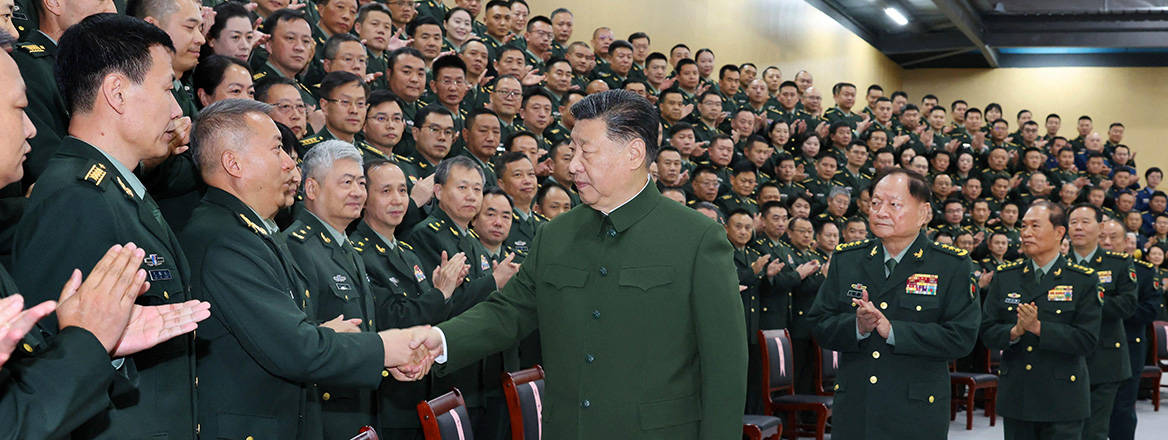
Recent purges within the Central Military Commission in China echo the Chekist approach to ideological purity and absolute loyalty to the Party and, at its core, Xi Jinping.
Remember the Cheka? The first Soviet secret security organisation, the All-Russian Extraordinary Commission, was established in 1917 by Vladimir Ilyich Lenin to protect the Bolshevik Revolution. It was designed to eliminate threats to the Soviet regime and, eventually, it was the Cheka that enforced the Red Terror against political opponents.
Recent purges within the Central Military Commission (CMC) in China echo the Chekist approach to ideological purity and absolute loyalty to the Party and, at its core, Xi Jinping. While the outside world witnesses the falling heads, in the absence of an independent judicial process, a guessing game has begun: Was it deep-rooted corruption that corroded the People’s Liberation Army (PLA)? Did the generals plot a coup against Xi Jinping? Or did they oppose Xi’s plans to take over Taiwan or Xi’s timeline for PLA modernisation? Publicly, we learned only that Generals Zhang Youxia and Liu Zhenli were under investigation for ‘serious violations,’ which implies that the verdict has already been reached, but the sentence would be provided later in a form that serves the Party.
In this context, this analysis cannot claim to shed new light on the purges, but rather to point out how absolute loyalty is the core pattern embedded in Communist Party rule, whether in the former Soviet Union or in contemporary China. This embedded pattern is not something that the Party wishes to show to the outside world; instead, the Party’s speaking points emphasise that every country has a right to choose its form of governance, and therefore, what happens in China is nobody’s business. Interestingly, only shortly after these recent purges, Xi Jinping received the Finnish and British Prime Ministers, and then spoke with Presidents Vladimir Putin and Donald Trump on the same day. The message to the outside could not be clearer: Xi Jinping is in absolute control.
Since Xi Jinping assumed leadership of the Chinese Communist Party and the Central Military Commission (CMC) in 2012, his anti-corruption and loyalty campaigns have led to numerous purges of senior PLA generals and officers – approximately 80 in total, including now all but one from the CMC – China's top military decision-making body, which he chairs. The purges have intensified notably since 2023, affecting 50 high-ranking officials and specifically targeting the Rocket Force, defence ministers, and CMC members. In the PLA, in less than three years, 28 full generals have been removed or have ‘disappeared’. This is described as one of the largest military leadership shakeups since the Cultural Revolution and, even then, Mao Zedong did not purge his officials to this extent.
Xi has created a highly centralised yet inexperienced top military leadership
During Xi Jinping’s tenure, purges and dismissals have expanded beyond the military. Thirteen years ago, Xi Jinping launched his anti-corruption campaign. Since then, more than six million officials have faced disciplinary actions, including investigations, dismissals, demotions, or other sanctions. The campaign has ultimately also been used as a political operation that has enabled the ousting of political opponents and has further centralised power in Xi Jinping’s hands.
Official reasons for investigations are typically, as mentioned above, ‘serious violations of discipline and law’, which is a code for corruption, disloyalty, or other breaches. Seeing these actions as consistent with Chekist loyalty, they conveniently fit into the pattern of consolidating Xi's absolute control. On 24 January, the top general of the PLA and the senior vice chairman of the Central Military Commission (CMC), Zhang Youxia, was detained along with another senior general, Liu Zhenli, in connection with an investigation into a range of allegations, including corruption. A day later, the PLA Daily, the official organ of the Chinese military, accused General Zhang of threatening the Party’s absolute leadership over the armed forces, citing this as one of the reasons he was placed under investigation.
On the same day, the Wall Street Journal reported that General Zhang Youxia had been accused of leaking information about China’s nuclear-weapons programme to the United States and of accepting bribes for official acts, including the promotion of an officer to defence minister. While it is not uncommon in the PLA for promotions to be bought, taking bribes is distinct from leaking information to a foreign adversary. While the WSJ’s reporting on the leak has been dismissed as implausible, it is entirely possible that the information was intentionally fed to the WSJ. Leaking secrets to a foreign power would be treason, punishable even by death. The opacity of the Chinese Communist Party invites speculation, and we are yet to see the full weight of the WSJ exposé even if it is fabricated from Beijing, and what kind of sentence will eventually serve the Party and Xi himself.
The Party Must Command the Gun
Returning to the Chinese Communist Party’s foundational doctrines, in 1938 Mao Zedong famously established the principle of ‘The Party commands the gun, and the gun must never be allowed to command the Party’ or simply ‘the Party commands the gun’ (党指挥枪) to ensure absolute party control over the military. In the Jamestown China Brief, K. Tristan Tang cited a PLA Daily article from 2 February that clearly emphasised the primacy of political control over the military, indicating that this lies at the heart of the latest purges.

Help your search results show more from RUSI. Adding RUSI as a preferred source on Google means our analysis appears more prominently.

As of now, these massive purges have crippled China’s armed forces and left them unable to operate effectively, keeping in mind that the Chinese military is different from most armies. The PLA is designed, despite its name, to protect the Chinese Communist Party's rule, not the people or the state. By design, the PLA looks inward, and Xi Jinping's task is to turn it into an external fighting force, but a controllable one. In this context, Xi’s call to ‘dare to fight’ (敢于斗) (despite the debate over the English translation between ‘fight’ and ‘struggle’) could indicate the need to raise the fighting spirit of the PLA.
By reducing the CMC to Xi himself and Zhang Shengmin, who oversees discipline and corruption, Xi has created a highly centralised yet inexperienced top military leadership. The purges undoubtedly sent further shock waves in the echelons of the Party. Before, when Xi needed to consolidate his power base, he had used Mao’s tactics in leaning to the masses, instead of elites, as a source of his power, such as in 2013-15 with his ‘Mass Line’ campaign, when he revived Mao-era language about the Party serving the people (群众路线).
He called for strengthening grassroots contacts and reducing displays of privilege, aiming to portray himself as aligning with ordinary citizens against arrogant elites. The ongoing common prosperity is another policy aimed at siding with ordinary citizens frustrated with inequality. Xi rarely seeks popularity through overt populism; instead, his modus operandi appears to consolidate elite control first, then launch a campaign framed as benefiting ordinary citizens, and finally use mass sentiment to justify elite discipline. In the military microcosmos, Xi has followed this very recipe. After the recent purges, keeping in mind Zhang Youxia’s alleged popularity and respect within the PLA, in early February, Xi Jinping turned his attention to the grassroots soldiers and officers: ‘We must adhere to the principle of putting the grassroots first and soldiers first . . . Truly care for and love officers and soldiers, and always keep their well-being in mind’, and ‘so that the broad masses of officers and soldiers can better dedicate themselves to military construction and war preparedness.’
The recent personnel upheavals in China’s military are likely to undermine the PLA’s professional competence, decision-making and combat readiness
Turning his attention to the PLA’s grassroots soldiers (the PLA has about two million active-duty personnel), Xi Jinping not only turned his attention away from the purges but also pushed his vision of war readiness and loyalty from the bottom to the top. In this light, suspicions that General Zhang Youxia may have crossed Xi’s plans for Taiwan, failed the combat readiness timeline, or both, may also hold some truth. Behind this context may also lie lessons from Russia’s war in Ukraine: poor morale, insufficient soldier training, and a lack of respect from Moscow for individual soldiers; an example for Xi of what constitutes a bad army with a failed outcome.
The Calm Before the Storm?
The recent purges cannot be discussed without considering Taiwan as a possible central trigger for Xi’s actions. Xi Jinping has designated Taiwan as integral to his national rejuvenation; it would not be complete without Taiwan. At the 20th Party Congress, Xi also famously didn’t rule out the use of force over Taiwan: ‘We will never promise to renounce the use of force, and we reserve the option of taking all necessary measures’. The purging of Generals Zhang and Liu has revived questions about how soon the CMC leadership can be reconstituted, as, in the short term, the recent personnel upheavals in China’s military are likely to undermine the PLA’s professional competence, decision-making and combat readiness, and thus, reduce the immediate pressure for a potential invasion of Taiwan.
The upcoming Two Sessions in March – the annual meetings of the National People’s Congress and the Chinese People’s Political Consultative Conference – will provide an important glimpse into China’s political dynamics. However, procedurally, the Two Sessions cannot appoint new members to the CMC; they may only endorse appointments already made by a plenary session of the CCP Central Committee. As a result, the next meaningful opportunity to observe potential changes to the CMC will come at the fifth plenum, anticipated at the Central Committee’s meeting later this year. But the challenge remains; the anti-corruption campaign and purges have depleted the PLA’s top ranks, leaving very few remaining officers eligible for CMC roles.
Xi Jinping must have considered all this, as his aim remains unchanged: to build a military force capable of conquering Taiwan and managing potential military confrontation with the United States. For one reason or another, his CMC was not up to the task.
Xi Jinping will demand complete obedience from the military and maintain absolute control over the top-ranking generals in the PLA to prevent a scenario in which the gun is pointed at himself or the Party
The next generation of military leaders will not question Xi Jinping’s decisions, nor will they form a power base that could challenge him. Xi is not a military man himself, but he knows that political power in China needs to be backed by military means, precisely as Mao Zedong's doctrine reminds us that ‘political power grows out of the barrel of a gun’ (枪杆子里面出政权). Xi Jinping will demand complete obedience from the military and maintain absolute control over the top-ranking generals in the PLA to prevent a scenario in which the gun is pointed at himself or the Party.
Back to the Cheka
Both Lenin’s and Xi’s purge apparatuses function as extra-legal instruments of political control, used to consolidate personal authority, suppress factionalism and enforce ideological obedience under the guise of security necessity. The differences lie in method: Lenin ruled through terror and chaos, whereas Xi relies on the ultimate demands of discipline and Maoist control patterns. Following the Leninist tradition, Xi Jinping has become the Party that cannot be crossed.
The recent purge of General Zhang Youxia also marks the closing episode in the story of the Zhongnanhai’s second generation of red elites, HongErDai (红二代). The powerful revolutionary families, at the latest, now understand that red blood no longer protects; only absolute loyalty does. When the official narratives for external use portray China as a responsible and stable global force, one can but wonder how durable such stability is, given the enforced homogeneity and conformity it entails. Behind it all is a lot of silence – that speaks volumes.
© RUSI, 2026.
The views expressed in this Commentary are the author's, and do not represent those of RUSI or any other institution.
For terms of use, see Website Terms and Conditions of Use.
Have an idea for a Commentary you'd like to write for us? Send a short pitch to commentaries@rusi.org and we'll get back to you if it fits into our research interests. View full guidelines for contributors.
WRITTEN BY
Dr Sari Arho Havrén
RUSI Associate Fellow, RUSI International


- Jim McLeanMedia Relations Manager+44 (0)7917 373 069JimMc@rusi.org