

Assessing China’s Language on its Stance on Ukraine and Belarus

The country’s different use of ‘territorial-integrity’ is more than a simple diplomatic gesture, but rather a useful sign of its alignment.
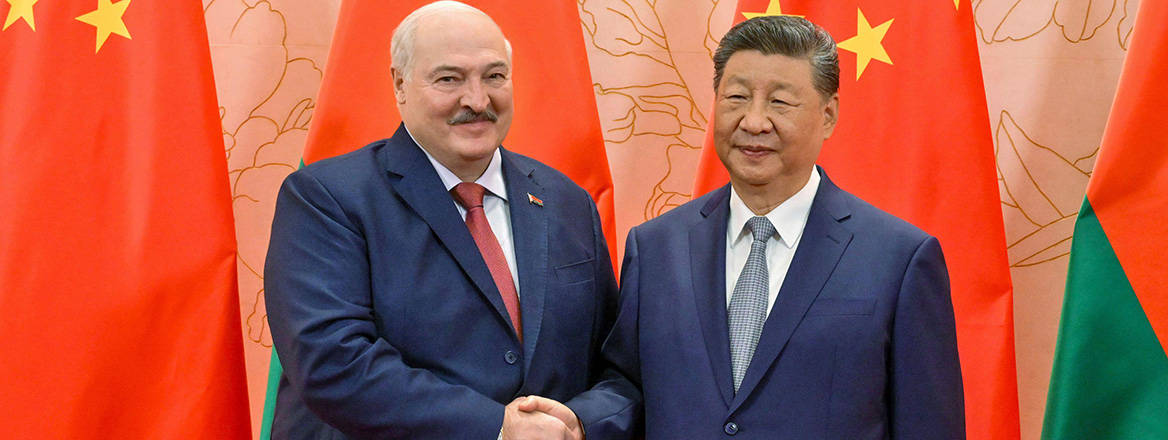
On 29 June 2026, Chinese President Xi Jinping told Belarusian President Alexander Lukashenko that China supports Belarus in safeguarding its territorial integrity. Beijing has said nothing equivalent of Ukraine at any point since Russia’s full-scale invasion. The gap is not accidental, and the grammar explains it.
In the lexicon of Chinese diplomacy, the phrase ‘territorial integrity’ is in near-constant use, but it does not always carry the same weight. Beijing deploys it in at least three distinct grammatical registers, and it is one of the more reliable indicators of where a country sits in China’s strategic order. The strongest register is the active guarantor formula: China supports a named country in safeguarding its sovereignty, independence and territorial integrity. The weakest is the universalist deflection: the sovereignty and territorial integrity of all countries should be respected. Between them sits the reciprocal formula, in which mutual respect for sovereignty and territorial integrity is named as the basis of a bilateral relationship. The verbs – support against respect – and the objects – a named partner against ‘all countries’ – carry the meaning. The registers are codified rather than casual; Foreign Ministry language is drafted with care, and a shift between them is a deliberate act. This article traces how Beijing has assigned these registers to Ukraine and Belarus, and argues that the contrast is a useful signal of alignment rather than a diplomatic ornament.
The Belarus Baseline
Receiving Lukashenko at the Diaoyutai State Guesthouse on 29 June 2026, Xi stated that China ‘supports Belarus in safeguarding its national sovereignty, independence and territorial integrity, and in pursuing a development path suited to its own conditions’. In Chinese practice, this formula is reserved for a small set of partners, including Serbia, Pakistan and Belarus, and it does two things at once: it positions China as a backer of the country’s integrity; and it implies, without naming, a threat against which that integrity must be safeguarded.
Xi’s emphasis on Belarusian independence can be interpreted as a quiet signal to Moscow
The timing sharpened the message. Lukashenko had flown to Beijing directly from a strained encounter with Russian President Vladimir Putin on 26 June, and the visit unfolded amid reports that Moscow was pressing Minsk to deepen its support for the war against Ukraine. Xi’s emphasis on Belarusian independence can be interpreted as a quiet signal to Moscow: Beijing prefers stable, autonomous partners to absorbed satellites, and an absorbed Belarus is one over which China would lose independent leverage. On that reading, the load-bearing word in the formula is not ‘territorial integrity’ at all, but ‘independence’, and the implied threat is not the West, but the over-mighty ally. That inference should be treated as an interpretation, but the standing formula and its timing together are difficult to ignore.
Ukrainian Record Before February 2022
The significance of the Belarus line emerges fully only against the Ukrainian record, because for most of the previous decade, Ukraine received the same active formula. In a telephone call on 13 July 2021, Xi himself told Ukrainian President Volodymyr Zelensky that China respected the independent path chosen by the Ukrainian people and supported Ukraine’s sovereignty and territorial integrity. At official working level, the language was stronger still: in April 2021, the Chinese side reaffirmed full support for Ukraine’s independence, sovereignty and territorial integrity within its internationally recognised borders – a phrase echoing Chinese Vice-President Wang Qishan in 2019. Wang’s qualifier ‘within its internationally recognised borders’ is another consequential element in the record, because it is the only formulation that unambiguously extends to Crimea and the territories occupied since 2014.
In short, before the full-scale invasion, Beijing was willing to name Ukraine, to use the verb ‘support’, and to specify its borders. The relationship that carried this language was not trivial: China and Ukraine had marked a decade of strategic partnership, and Beijing had been Kyiv’s largest trading partner and an important customer for Ukrainian defence technology.
The Shift After February 2022
After 24 February 2022, three changes occurred at once, and they are best read as a single retreat. First, the verb used was downgraded from ‘support’ to ‘respect’. Second, the object shifted from Ukraine-by-name to ‘all countries’. Third, the ‘internationally recognised borders’ qualifier disappeared entirely. The 12-point position paper of February 2023 opens with respect for the sovereignty and territorial integrity of all countries – a principle a sympathetic reader may take as implicitly favouring Ukraine, but which names neither aggressor nor victim. Moreover, the paper shifted focus from respecting the territorial integrity of Ukraine to ‘All parties should oppose the pursuit of one’s own security at the cost of others’ and “legitimate security interests and concerns of all countries must be taken seriously’.

When Xi finally spoke to Zelensky on 26 April 2023, in his first such call since the invasion, the readout offered not support but reciprocity: ‘mutual respect for sovereignty and territorial integrity’ as the political basis of the bilateral relationship. That phrasing is symmetrical and self-serving. It binds Ukraine to respect China’s territorial integrity – that is, its claim to Taiwan – at least as firmly as it gestures at Ukraine’s own, and it conspicuously declines to identify Russia as the party violating Ukrainian territory. At no point since the invasion has Xi, or an authoritative Foreign Ministry text, said that China supports Ukraine in safeguarding its territorial integrity.
Non-Recognition by Omission
A fair objection must be registered. China has not endorsed Russia’s annexations. It withheld recognition of the 2014 seizure of Crimea and the four oblasts claimed in September 2022, and it has continued to trade with Kyiv throughout the war. At the level of formal non-recognition, therefore, Beijing can claim that it still upholds Ukraine’s territorial integrity. But while China declines to bless the annexations, it does not assert Ukraine’s borders. Beijing extends that commitment to Belarus and withholds it from Ukraine – and the difference is not a measure of how much it privately values each country’s frontiers.
‘Support’ is for those whose integrity China can affirm without friction with Russia; ‘respect’ is for those it cannot
Why the Verb is the Diagnostic
Affirming Belarusian integrity costs China nothing with Moscow; if anything, it disciplines Russia at a point where Chinese and Russian interests quietly diverge, namely the prospective absorption of Belarus further into Russia's sphere of influence, or even further. Affirming Ukrainian integrity in the active register would cost a great deal, because it would require naming Russia as the violator and would strain the partnership that anchors Beijing’s revisionist coalition. China is also, on its own account, a champion of territorial integrity’s primacy over self-determination – a posture rooted less in solicitude for others than in sensitivity over Taiwan, Tibet and Xinjiang. That same sensitivity is what makes the reciprocal formula so attractive in the Ukrainian case: ‘mutual respect’ lets Beijing invoke territorial integrity as a principle while binding its interlocutor to honour China’s own claims. ‘Support’ is for those whose integrity China can affirm without friction with Russia; ‘respect’ is for those it cannot.
Conclusion and Watch Points
The conclusion is narrow but enlightening. The active guarantor formula: support for a named country in safeguarding its territorial integrity was part of Beijing’s Ukrainian vocabulary until February 2022 and was retired at the invasion, replaced by universalist and reciprocal constructions and stripped of the borders qualifier that alone covered the occupied territories. The same formula was extended, in full, to Russia’s junior partner, Belarus, on 29 June 2026.
Three watch points follow. Whether any ceasefire or settlement prompts Beijing to restore the active verb for Ukraine; whether the phrase ‘within its internationally recognised borders’ ever reappears in a Chinese text on Ukraine; and whether the Belarus formula hardens or softens as Moscow’s pressure on Minsk evolves. Until the verb changes, the most economical reading is that China’s territorial-integrity language is a map of its alignments – and on that map, Ukraine and Belarus now sit on opposite sides.
© RUSI, 2026.
The views expressed in this Commentary are the author's, and do not represent those of RUSI or any other institution.
For terms of use, see Website Terms and Conditions of Use.
Have an idea for a Commentary you'd like to write for us? Send a short pitch to commentaries@rusi.org and we'll get back to you if it fits into our research interests. View full guidelines for contributors.
WRITTEN BY
Dr Sari Arho Havrén
RUSI Associate Fellow, RUSI International


- Jim McLeanMedia Relations Manager+44 (0)7917 373 069JimMc@rusi.org