

Armenia’s Election and the Future of Security in the South Caucasus

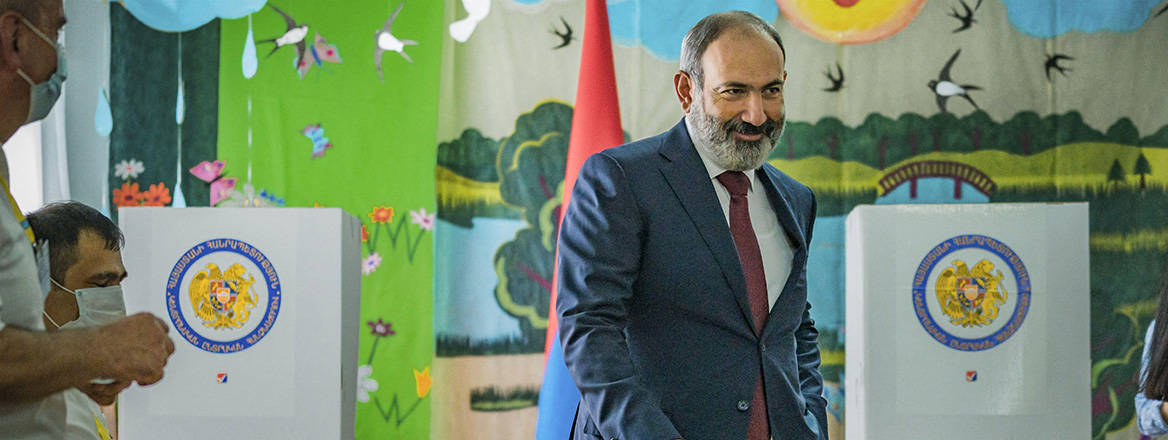
Testing Armenia’s Prime Minister Nikol Pashinyan, future integration with Europe is a live issue in the country’s first election since military defeat in Nagorno-Karabakh.
Armenia’s parliamentary election is significant beyond its domestic political context. The vote will test whether Yerevan can sustain a strategy of strategic diversification after the re-establishment of Azerbaijani control over Nagorno-Karabakh while balancing Russian pressure, growing Western engagement and an unfinished normalisation process with Azerbaijan and Turkey. The result is unlikely to produce a clean geopolitical realignment; but it may show whether Armenia can create greater strategic space for itself in a region where security has long been shaped by dependency and external competition.
Armenia’s Election in the Shadow of Karabakh
This is Armenia’s first national election since Azerbaijan’s recapture of Nagorno-Karabakh in 2023 and the forced displacement of more than 100,000 Armenians from the region. The vast majority of those displaced have since settled in Armenia proper, creating a significant demographic shift and making their integration and state support an important political issue. The vote follows a period of strategic shock that has reshaped Armenian politics and fundamentally altered the country’s foreign policy debate.
Domestically, the election will test support for Prime Minister Nikol Pashinyan’s post-war strategy and whether his government retains legitimacy after military defeat and national trauma. Regionally, it will indicate whether Armenia can continue reducing dependence on Russia while maintaining a fragile normalisation process with Azerbaijan and Turkey. More broadly, it will show whether Pashinyan has public backing for deeper engagement with European partners without provoking destabilising external pressure.
The stakes extend beyond party politics. Armenia’s strategic choices now have implications for multiple regional actors, and the direction of Yerevan’s foreign policy will shape expectations for security, connectivity and political influence across the South Caucasus.
Competing Visions of Sovereignty
The election is fundamentally about Armenia’s competing visions of sovereignty after military defeat. Pashinyan’s Real Armenia doctrine presents itself as a pragmatic response to strategic vulnerability: prioritising peace with neighbours, reducing dependence on any single external partner and building a more resilient state grounded in Armenia’s present-day territorial reality rather than unresolved historical grievances. The doctrine frames security less through territorial claims and military confrontation than through economic development, regional connectivity and preserving state sovereignty through diversification.
For supporters, this reflects the hard lessons of recent conflict that have made recalibration unavoidable. Peace with Azerbaijan and normalisation with Turkey are presented not as ideological concessions but as necessary conditions for stability and long-term resilience. In practice, this has involved politically sensitive steps: advancing a peace agreement with Azerbaijan, signalling readiness to revise constitutional references on Nagorno-Karabakh, and pursuing normalisation with Turkey without longstanding demands over historical recognition.
Putin’s suggestion that Armenia hold a referendum on whether it should remain aligned with the Eurasian Economic Union or pursue closer integration with the EU inserted a polarising geopolitical question directly into the campaign
Opponents view this same agenda differently. Pashinyan faces criticism from nationalist and pro-Russian parties, including Samvel Karapetyan’s newly formed Stronger Armenia movement, which accuses the government of conceding too much to Azerbaijan and Turkey, abandoning Armenian national interests and turning post-war pragmatism into political surrender. The government also faces accusations of democratic backsliding, excessive centralisation of power and personalisation of governance, with critics arguing that ‘Real Armenia’ masks a retreat from longstanding national commitments.
The debate is therefore broader than a geopolitical choice between Russia and the West. It is a domestic argument over what sovereignty should mean after strategic trauma: whether compromise preserves Armenia’s statehood, or whether it risks weakening the country’s position further.
Why Nagorno-Karabakh Changed Armenia’s Security Calculus
The 2020 Nagorno-Karabakh war and Azerbaijan’s 2023 operation against the self-proclaimed Republic of Artsakh transformed foreign policy into a central domestic political issue. The 2020 war between Armenia and Azerbaijan exposed significant military vulnerabilities and was followed by continued border tensions. The September 2023 Azerbaijani military operation targeted the self-proclaimed Republic of Artsakh within Nagorno-Karabakh, a predominantly ethnic Armenian entity that was not formally part of the Republic of Armenia, despite its close political, economic and security dependence on Yerevan.
The political consequences within Armenia were immediate. The dissolution of the self-proclaimed Republic of Artsakh became a profound domestic trauma defined by military losses, mass displacement and unresolved anger. It also intensified scrutiny of Armenia’s external security arrangements.
Russia’s role as Armenia’s long-standing security partner came under sustained criticism. Concerns had already emerged since the perceived failure of Russia and the Collective Security Treaty Organisation (CSTO) to adhere to CSTO Article 4 in responding effectively to earlier hostilities affecting Armenia proper. These doubts intensified after Russian peacekeepers proved unable to enforce the post-2020 ceasefire framework, impeding regional stability. By 2023, doubts about Russia’s reliability had evolved into a broader reassessment of whether Russian-led security arrangements continued to serve Armenian interests.
This perceived strategic vulnerability has created a political necessity for diversification and reassessment of foreign partnerships, including Armenia’s suspension of participation in the CSTO and the joint initiation of the EU Mission in Armenia, followed by deeper engagement with European partners.

Finally, the domestic political environment has also been shaped by external influences, including segments of the Armenian diaspora, which have at times adopted more hardline positions on security and territorial issues. The result is an election shaped as much by unresolved grief and blame as by policy preferences and competing interpretations of what Armenia learned from defeat.
Russian Leverage Amid Eroding Trust
Russia may no longer be viewed in Yerevan as a dependable security guarantor, but it retains significant economic and political leverage. Armenia remains closely linked to Russia through trade, labour migration and energy security. Moscow has repeatedly signalled that closer EU integration could carry economic consequences.
Recent restrictions on Armenian exports – including mineral water, agricultural produce, flowers and alcoholic beverages – have reinforced that message, alongside warnings from Russian officials over preferential trade arrangements and energy supplies. Energy has become a visible pressure point. In late May, Russian Energy Minister Sergey Tsivilyov warned that if Armenia continued its EU accession process, Moscow could suspend or unilaterally terminate agreements governing preferential supplies of gas, petroleum products and rough diamonds, bringing a longstanding economic dependency directly into the election campaign.
Political pressure has also intensified. Vladimir Putin’s suggestion that Armenia hold a referendum on whether it should remain aligned with the Eurasian Economic Union or pursue closer integration with the EU inserted a polarising geopolitical question directly into the campaign. That pressure was reinforced in late May, when the Russian-led Eurasian Economic Union stated it would consider suspending Armenia over its EU ambitions and publicly urged Yerevan to let voters decide between the two paths. The warning was politically significant given Armenia’s continued economic exposure: Russia accounted for roughly 35% of Armenian foreign trade in 2025, compared with around 11% with the EU. At the same time, reports of increased Kremlin-linked disinformation activity suggest Moscow is also attempting to shape the information environment ahead of the vote.
Yet Russia’s position is weaker than before. Its influence still matters because Armenia lacks immediate alternatives in several critical sectors. But the credibility gap created by Nagorno-Karabakh remains politically significant. Moscow retains leverage, but no longer a dominating influence.
Why the Election Matters Regionally
Armenia’s election has implications well beyond Yerevan.
For the EU and UK, Armenia’s diversification offers a rare opening in a region traditionally shaped by Russian security dominance. Brussels has expanded engagement through the EU Monitoring Mission, visa liberalisation talks and new investment commitments announced during the European Political Community summit and the first EU–Armenia summit in Yerevan. The UK has also deepened ties with Armenia through a series of strategic partnership agreements and increased cooperation on security, governance and economic resilience.

This reorientation is also evident in Armenia’s security posture. Historically reliant on Russian military equipment, Yerevan has increasingly diversified defence procurement in recent years, acquiring systems from partners including France and India to reduce dependence on a single supplier. In a recent military parade, a week preceding the election, Armenian forces showcased growing stocks of foreign-made equipment. This shift does not amount to a formal military realignment, but it reflects an effort to expand Armenia’s strategic options and deepen ties with European and other non-Russian partners.
Washington has focused more directly on diplomacy and infrastructure. US mediation helped finalise the August 2025 Armenia–Azerbaijan peace declaration, while the recently confirmed investment in the TRIPP transit route through southern Armenia reflects broader strategic interest in East-West connectivity.
For Turkey and Azerbaijan, Pashinyan is widely viewed as the most viable partner for continuing normalisation. A re-election would likely improve prospects for opening borders, restoring transport links and advancing regional infrastructure, while preserving momentum behind the post-2025 peace process.
This signals Armenia’s geography is gaining strategic importance. As trade routes become more contested globally, a more open Armenian corridor linking Europe and Asia would reshape economic and political assumptions across the South Caucasus.
A Test of Strategic Space
Armenia’s election is unlikely to settle the country’s geopolitical orientation.
Russia will remain influential through economics and geography. Western engagement, while growing, still stops short of offering Armenia hard security guarantees. Azerbaijan and Turkey remain both opportunity and strategic pressure, with complicated historical tensions the Armenian public is unlikely to forget.
The more immediate question is whether Armenia can sustain enough domestic legitimacy for a strategy of diversification while avoiding renewed confrontation.
If Pashinyan can preserve political support for this approach, Armenia may begin reshaping long-standing assumptions about power and security in the South Caucasus. If not, the region’s traditional dependencies may prove harder to unwind than recent diplomacy suggests.
Either way, the election is not simply about choosing a government. It is a test of whether a state emerging from military defeat can redefine security on new terms while navigating pressure from every direction.
© RUSI, 2026.
The views expressed in this Commentary are the author's, and do not represent those of RUSI or any other institution.
For terms of use, see Website Terms and Conditions of Use.
Have an idea for a Commentary you'd like to write for us? Send a short pitch to commentaries@rusi.org and we'll get back to you if it fits into our research interests. View full guidelines for contributors.
WRITTEN BY
Zoe Neiman
Course Assistant
RUSI International


- Jim McLeanMedia Relations Manager+44 (0)7917 373 069JimMc@rusi.org