

Uniting Nationalism and Threat Perception for Total Defence


Following an increase in whole-of-society attacks, the UK government should deploy tools to encourage nationalism and total defence across society.
In 2025, Russian-linked vessels entered British waters, posing a threat to the subsea pipelines, which provide a large portion of the UK’s gas supply. In the same year, Iran had backed more than 20 potentially lethal attacks on UK soil. Between 2021 and 2022, APT31, a Chinese state-affiliated cyber group, was found ‘highly likely’ to be responsible for hacking the Electoral Commission’s voter registration system. These are not threats which the military alone can address; they are whole-of-society attacks which necessitate a whole-of-society response – otherwise known as total defence.
Total defence combines traditional military defence with civil (non-military) defence, calling on the public to be involved in protecting and maintaining the nation’s resilience in a time of crisis. Research conducted by the public policy research agency Public First in March 2026 reveals that a majority of the British public agrees with the underlying concept of total defence: 57% agree that the UK’s security depends as much on its citizens as on its armed forces.
Responsibility and Agency in Total Defence
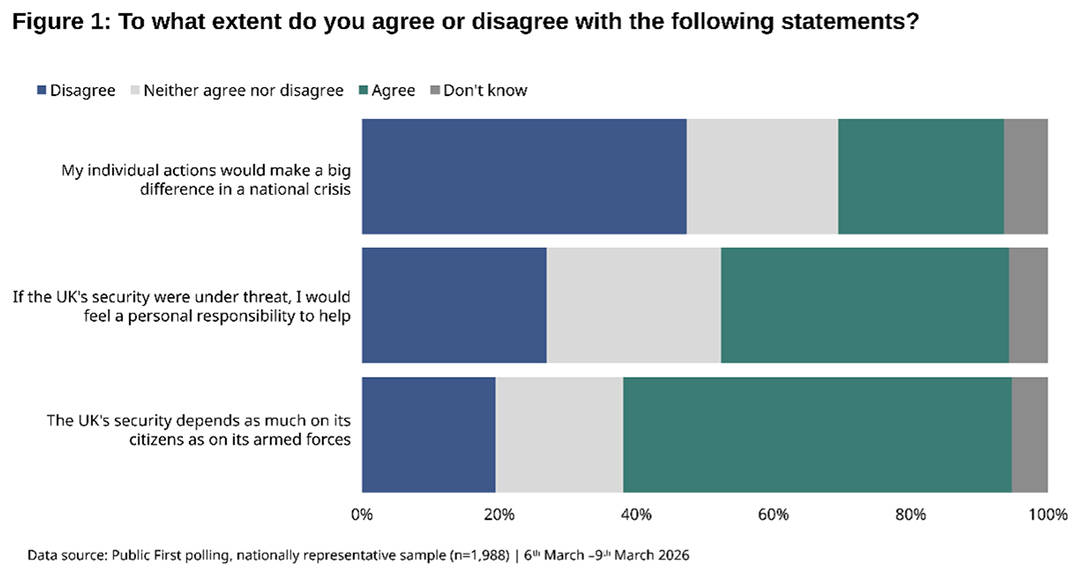
Agreeing with the concept of total defence does not equate to a sense of shared responsibility, which is necessary to carry out total defence on a national scale. Only 42% of respondents feel a personal responsibility to help, and less than a quarter (24%) believe that their individual actions would make a big difference in a national crisis.
Responsibility is built on a sense of obligation to someone else. If the public do not feel a sense of obligation to the nation, they will not feel responsible for participating in its defence. For this reason, total defence is historically most successful in small states facing a clear and imminent threat (such as Finland and Taiwan).
However, it is still possible in the UK if the government empowers the public to participate and actively encourages defence willingness. For this to be possible, a two-pronged approach is necessary: enhancing threat perception; and building a strong national identity.
Threat Perception
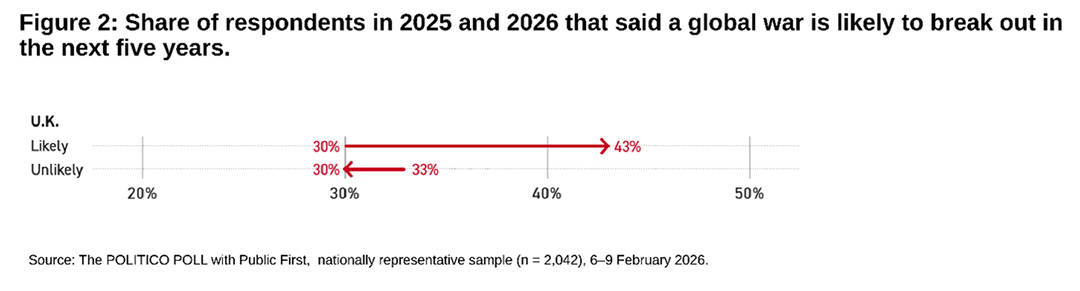
The British public believe that the world is becoming increasingly more dangerous. The number of respondents who think a global war is likely in the next five years has increased to 43%, up from 30% from the end of 2025.
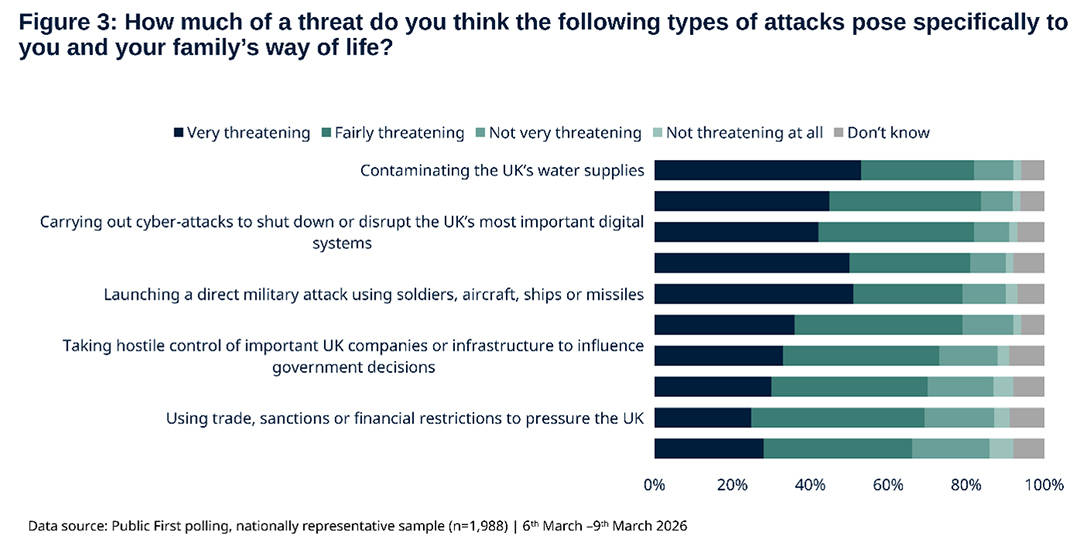
Additionally, 63% feel that hostile foreign governments are more willing to harm the UK as compared to a year ago, and 64% agree that ‘ordinary people and the systems they rely on are as much at risk as soldiers on the battlefield’.
This risk is widespread – from contamination of the water supply, to direct attacks on the UK military, to taking hostile control of critical infrastructure – and there is a clear understanding from the British public, according to the Public First data, that individual lives and families are threatened by these potential hostile attacks.
However, given that less than half of the British public feel personally responsible to help if their security were threatened, this threat perception alone does not directly translate into shared responsibility and defence willingness. It must be complemented by a strong sense of national identity and an obligation to defend that identity.
Nationalism
Nationalism could be the missing spur to drive an increased belief in shared responsibility for, and therefore in willingness to participate in, total defence. However, the type of nationalism is important. Some examples are:
- Ethnic nationalism, which privileges the exclusivity of a shared ethnic group above shared values and other more inclusive traits. It is not only toxic, but also less effective in motivating people to participate in total defence.
- Uncritical nationalism, or supporting a country whether it is ‘right or wrong’, is similarly unhelpful in driving defence willingness. This is because uncritical nationalism is undemanding; it deters participation in democracy and other activities that could improve the country because it is built on the idea that the country does not need improving.
- Civic nationalism (or ‘inclusive’ nationalism), which is predicated upon shared citizenship, values and responsibility, is better placed to drive defence willingness. Studies have found that a sense of inclusive belonging to a nation makes people feel like they have a stake in its resilience, which drives a commitment to defend it.
When combined with the UK public’s relatively high threat perception, civic nationalism could play a critical role in driving a sense of responsibility for, and the willingness to participate in, total defence. This form of nationalism relies on core institutions, and is built around a clear national identity, which can effectively convene and foster shared values and responsibility.
When combined with the UK public’s relatively high threat perception, civic nationalism could play a critical role in driving a sense of responsibility for, and the willingness to participate in, total defence
Civic nationalism should also be encouraged in conjunction with enhancing threat perception among the general public. The public needs the opportunity to understand the scale of the threats they face, and should be given the opportunity to participate in total defence.
In sum, neither nationalism nor threat perception alone are enough to drive defence willingness; nationalism provides the drive to participate, and threat perception gives the knowledge and agency required for participation.
The Swedish Example
Sweden is a useful case study of how civic nationalism and threat perception complement and rely upon each other to drive stronger defence willingness in a population.
In 2024, Russia updated its nuclear doctrine to allow for nuclear responses to conventional attacks from non-nuclear states. In response, the Swedish Civil Defence and Resilience Agency sent a pamphlet to every household in the nation, entitled ‘In Case of Crisis or War’.
The pamphlet was distributed without discriminating based on language, national origin or even citizenship versus residency, and emphasised that in the event of an invasion, everyone was Swedish, and everyone had a part to play in defending the nation.
In their research, Hanna Bäck and her co-authors suggest that after reading this pamphlet, Swedish citizens and residents were more likely to want to participate in Sweden’s total defence. This was because the pamphlet provided a boost to their feelings of self-determination and empowerment, promoting an inclusive sense of ‘patriotism, collective responsibility, and camaraderie’ among readers.

The pamphlets outlined the exact scale of the Russian threat and then set forth several ways for people to participate in the potential conflict with Russia. Favouring a whole-of-society approach, participation tended to fall within three categories, as noted by the pamphlet:
- Military defence (‘protects Sweden and its NATO allies from armed attacks, defends our national borders, and aids in conflict resolution’).
- Civil defence (‘to support the military defence … to protect the population and ensure that essential public services are uninterrupted as far as possible – even during times of war’).
- Performing usual duties to participate in total defence (‘you can get involved in our collective preparedness … [through] a voluntary defence organisation that has specific duties within the framework of Sweden’s total defence system. There are also other non-profit organisations and faith communities that play important roles.’)
The study from Bäck et al. suggests that lowering the barriers to entry for participation in collective defence makes people feel more empowered.
Total Defence in the UK
In order to engage the UK public in total defence, the government should develop a similar pamphlet which encourages inclusive nationalism and clearly communicates the threats facing the UK. If the pamphlets do not sufficiently encourage inclusive nationalism, studies suggest that people will be more likely to limit their participation in a conflict to whatever actions maximise their self-interest, rather than drawing out more robust actions to protect the nation that are based on an emotional attachment to the nation.
In addition, while Public First survey responses reflected a relatively high understanding of the threats that face the UK, reported low levels of defence willingness suggest that the British public tends to feel that threats from Russia and other malign actors are farther away than they actually are. This inhibits the public’s belief that they should step up and participate in defending the country, as the threats do not feel imminent, and it is unclear whom they are defending the country from.
Total defence is the best strategy to increase the UK’s resilience to threats from malign actors
Sweden has demonstrated that clearly communicating a crisis to the public, and giving them the agency to respond to it, can be successful. While the UK does not share a border with Russia, nor with any of the other current adversaries threatening British security, the country is being targeted all the same and the public needs to be aware if they are going to be involved in total defence. Any pamphlet the UK government publishes must address growing grey-zone threats head-on, and create a level of urgency for the public to respond.
As in Sweden, the pamphlets should be printed in several languages and emphasise national pride, empowering people throughout the country to join in a whole-of-society approach to defence. This approach ensures that the government’s urgent mobilisation message reaches everyone, regardless of language and access to the internet, which disproportionately affects minority communities.
Distribution of physical pamphlets should also be supplemented with an accessible online presence. The pamphlet should be uploaded to the government’s emergency preparedness website (prepare.campaign.gov.uk). Physical pamphlets should refer to this website, and efforts should be made on social media to increase online awareness of the site, as it is not well-known outside of policy circles. The UK could also showcase its strategic technological advantage by employing an AI assistant on the site. This assistant could synthesise information from the pamphlet and the rest of the website, and answer common questions from concerned citizens, such as ‘how can I get involved, given my job/age/beliefs?’
Conclusion
Total defence is the best strategy to increase the UK’s resilience to threats from malign actors. Given the wide range of these threats, the entire British public needs to feel responsible for, and participate in, the nation’s defence.
This article argues that pairing a strong sense of civic nationalism with an enhanced perception of the threats to the UK will increase the British public’s willingness to participate in total defence. In recent years, the UK government has been hesitant to fully and honestly communicate the scale of the threat posed by Russia and other adversaries because officials are concerned about inducing panic. However, Sweden and other countries have proven that, when given the right tools, the public can and should be trusted to participate in their own defence.
As debates continue about how best to fund and design a shared UK national defence, the public should be at the forefront – empowered, willing and prepared to defend their nation against rising threats.
© RUSI, 2026.
The views expressed in this Commentary are the authors', and do not represent those of RUSI or any other institution.
For terms of use, see Website Terms and Conditions of Use.
Have an idea for a Commentary you'd like to write for us? Send a short pitch to commentaries@rusi.org and we'll get back to you if it fits into our research interests. View full guidelines for contributors.
WRITTEN BY
Sophie Boulter
Assistant Editor, Research Publications
Publications


Margaret Ryan
- Jim McLeanMedia Relations Manager+44 (0)7917 373 069JimMc@rusi.org