

Thinking Beyond the Baltics for Deterring Russia

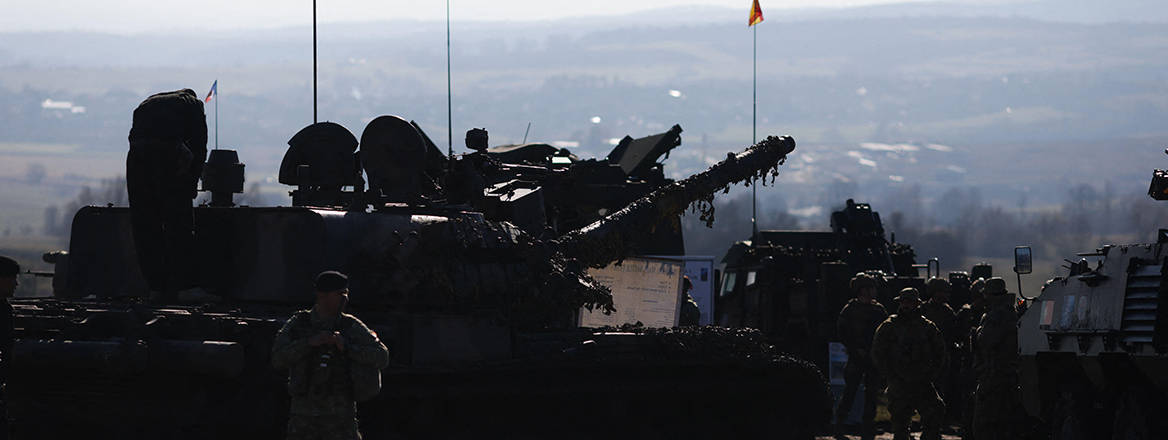
A rebalancing of the NATO Alliance should not involve Europe replacing US capabilities on a like-for-like basis.
In spite of reassuring words in the most recent NATO summit communique, there is still considerable debate over how Europe should prepare for reduced American involvement in European defence, given the focus on ‘rebalancing’ the Alliance. This often begins by asking how European allies might replace the capabilities the US would contribute to NATO’s existing plans. But it should also ask how the wider strategic context that reduces US involvement changes the problem Europe is trying to solve. For example, a crisis or major war between the US and a near-peer China would not simply reduce the American military resources available to Europe; it would fundamentally reshape the conditions under which Europe would have to deter Russia.
Discussion of European defence remains largely regional in character. Rather than treating deterrence in Europe as one component of a wider global strategic competition, it continues to revolve around a relatively narrow set of contingencies. This has encouraged a conception of European defence that may be difficult to resource without sustained American support and whose suitability for shaping the wider strategic balance is open to question.
Broadening the Scope of Scenarios
Public discussions of European defence remain dominated by a single scenario: a limited Russian seizure of territory in the Baltic states. Typically, unless NATO fails to intervene altogether, the envisioned scenario then escalates into a larger effort to evict Russia from the Baltics, involving the suppression of Kaliningrad, as well as operations elsewhere. Consequently, the requirement to contain Russian breakthroughs of varying sizes on the alliance’s eastern flank – something which requires up to 300,000 additional troops and 1400 main battle tanks by some estimates – tend to drive discussions of what Europe needs.
Russia’s best options in a Sino-American war might not be in Europe but rather in ensuring a Chinese victor, after which matters in Europe could be resolved to its satisfaction
This contingency is an important scenario for planning, but it should not dominate force planning or obscure the broader strategic context in which deterrence must operate. If Russia is confident enough in its advantages over Europe that it believes itself to have escalation dominance, might it play for bigger stakes? After all, a Sino-American crisis or war would potentially represent Russia’s last window to fundamentally revise the European order in its favour. Such substantial revisions of a regional order require the military means used to match political ends – there is no good historical case of them being achieved by limited operations. Indeed, the logic of a ‘window of opportunity’ has often been a basis for revisionism by secondary great powers, with the most notorious example Hitler’s Germany of the 1930s. However, it is precisely because a window is potentially narrow that it must be exploited to its fullest. Seizing a sliver of land and then hoping that NATO would collapse does not fit the bill. By contrast, if Russia believed European NATO (and what residual US capability remained) to still be a formidable challenge, thus foreclosing the option of major power war, then humiliating this alliance without fundamentally changing the material balance of forces would do little to alleviate the problem.
There is little indication that the Russians believe that a war with a regional coalition or alliance would be a small affair. For example, General Sterlin (formerly head of the main operations directorate of the Russian General Staff) describes conventional precision strike as being primarily useful in a local war with a single state, while in a regional conflict the employment of non-strategic nuclear weapons remains necessary. Other officers including Gerasimov discuss the need to pre-emptively destroy as many cruise missile-carrying platforms as possible at the outset of a conflict. What senior Russians do indicate about the character of a regional war does not indicate a small or containable affair.

This is not to dismiss the scenario of a ‘bite and hold’ operation. Russia might, for example, view such an operation as a means of restoring lost credibility particularly if, as scholars such as Dima Adamsky argue, the Russian concept of deterrence requires consistent action to demonstrate seriousness. An attempted seizure of land in the Baltic States might occur to secure more limited political aims than a revision of the European order – for example to compel a cessation of western support to Ukraine. However, Russia has many other means of deterrent signalling short of initiating a war which might rapidly spiral out of control: everything from snap exercises to assassinations, arson and sabotage at sea.
The sort of conflict Russian officers discuss is one which escalates rapidly, is decided primarily in the rear and in which the initial period of conflict is critical. In the context of such a vision the theatre wide balance – particularly deep strike and integrated air and missile defence (IAMD) – is of far greater consequence than the local balance of capabilities at any point on the front. If Russia expects regional war to be decided through theatre-wide strikes against infrastructure, logistics, intelligence, surveillance and reconnaissance (ISR) and command systems, then the balance that matters to deterrence is likewise theatre-wide. Capabilities such as deep strike, IAMD and the availability of attack submarines therefore assume disproportionate importance because they shape Russia’s assessment of whether it can successfully prosecute the type of campaign it expects to fight
There might be an upside to this. If Russia truly believes the only useful war it can fight in Europe is expansive, involves early strikes at depth and is thus highly risky, such a war can be easier to deter than a lower risk ‘bite and hold’ operation. Given the risks, an opponent does not need to be convinced of the certainty of failure: merely the uncertainty of success.
The Global Context Shaping the European Balance
A scenario in which the US and China are either in a crisis or a conflict in the Indo-Pacific would set the context for whatever happens in Europe. This requires thinking of deterrence in Europe as a subcomponent of a global deterrent architecture.

Russia’s best options in a Sino-American war might not be in Europe but rather in ensuring a Chinese victor, after which matters in Europe could be resolved to its satisfaction. The Russian Pacific Fleet, for example, has received roughly half of Russia’s newest Yasen Class submarines; submarines allocated to the Northern Fleet can be reallocated east via the northern sea route in comparatively short order. Russia does not have the firepower of a US or China but it has enough key capabilities – submarines and missile launchers of various kinds – to potentially swing an even balance between them. Russia could, for example, wait for both sides to exhaust their arsenals in the initial exchanges which, given data from the recent Iran war, would probably occur quickly, before exacting a high price from China for its participation in the East.
Within this context, the function of European forces would be rather different. Instead of fighting into the Baltic, the key determinant of events in the Pacific would be whether Russian capabilities most relevant to the Pacific balance could be pinned in European Russia. The suite of capabilities needed to ensure this would include the capacity to pressure the Russian Northern Fleet in its bastions to prevent the reallocation of submarines and the deep precision strike capabilities to hit targets deep within Russia, limiting Russia’s freedom to reallocate air defence and strike capabilities which might be needed in Europe. Currently, Europe has relatively little on either count.
Alternatively, Europe may need to convince Russia that it lacks a viable window for large-scale military action within Europe. However, if what is being deterred is a large scale regional war then the force balances which Russia deems most salient to assessing the likely course of such a conflict are at the level of the theatre as a whole rather than the local balances in individual parts of the theatre. The balance of long range strike and nuclear assets are of particular deterrent importance against a state which still plans around what it calls ‘noncontact warfare’.

The global context also complicates Russia’s assessment of European military capabilities. Russian officials have generally treated allied military capabilities as part of an aggregate Western military balance, rather than independent of the US. Japanese acquisition of Tomahawk cruise missiles, for example, has been discussed in Moscow less as a Japanese capability than as an extension of American power. This significantly increases the strategic value of European long-range strike, particularly if US extended nuclear deterrence remains credible. For a Russia already concerned by the emergence of a US counterforce capability combining accurate conventional strike, improved nuclear warheads and future missile defences, additional allied strike assets further complicate planning.
The Balance Between Denial and Risk Manipulation
The balance to be struck between deterrence and territorial defence is hardly a new question. However current circumstances incentivise a rebalancing of priorities, relative to NATO’s current position. As during the Cold War, what is necessary is not the capacity to inflict a military defeat on the Russian army but rather the ability to convince Russia that a regional war would be an unpredictable affair.
In a sense, Europe would be pushing on an open door during an East Asian crisis as Moscow would have compelling reasons to remain neutral. As one of China’s few major sources of hydrocarbons that does not rely on vulnerable maritime routes, Russia would be well placed to renegotiate the terms of its relationship with Beijing. Equally, conditional neutrality could provide leverage in dealings with Washington. Europe’s objective, therefore, need not be to convince Russia that it can defend every inch of soil under all circumstances (something it never envisioned during the Cold War). Rather, it should be to increase the risks of intervention to the point where neutrality appears the safer course. This implies a strategy centred less on denial than on cost imposition and risk manipulation. The aim would be to compel Russia simultaneously to retain substantial forces in Europe and to doubt that employing those forces would leave it strategically better off.
The purpose of a risk manipulation posture is therefore not to deny an adversary any and all options, but to undermine confidence that a conflict would follow a predictable escalation ladder
This is a markedly different problem from territorial defence in an area such as the Baltic region. Emphasising cost imposition and a more limited form of denial would not change the suite of capabilities Europe needs but would alter the balance of resourcing between them. It would entail an emphasis on capabilities such as deep strike and IAMD, with local defences serving to hold long enough for a conflict to be terminated at depth.
Instruments of risk manipulation would require significant investment, particularly in missile inventories. They are, however, considerably less expensive than recreating a purely denial-orientated force model sans the US. Australia’s acquisition of 220 Tomahawk cruise missiles for approximately $ 833 million (including life cycle operations and maintenance costs) compares favourably with the roughly $600 million annual cost of maintaining a single armoured brigade. To be sure, the costs of missiles exclude the ISR and targeting complexes – much of which is provided by the US. However, by the same ledger, the costs of defending territory should include the defence of supply lines, training costs for personnel and so on.
Enhancing European Security
Many of the industrial and military assets most critical to Russian power are fixed and comparatively close to NATO territory. Much of Russia’s industrial base lies within several hundred kilometres of Finland in the north and Ukraine in the south, while key military infrastructure – including elements of the Rezonans-NE radar network in the High North – can be threatened by comparatively inexpensive missiles or other deep operations from allied territory.
The same logic extends beyond strikes against Russian territory. Sea denial in maritime chokepoints, special operations against critical military infrastructure and persistent pressure on strategically significant assets could all increase the resources Russia would have to devote to a European contingency if European navies achieved higher readiness in their SSN fleets and rebuilt the capacity for forward operations.
If a confrontation between the US and China defines the strategic context, then European deterrence cannot simply consist of recreating America’s contribution to today’s NATO plans
Russia would retain ample counter-escalatory options, including its theatre nuclear arsenal. The purpose of a risk manipulation posture is therefore not to deny an adversary any and all options, but to undermine confidence that a conflict would follow a predictable escalation ladder. Any Russian attempt to neutralise European strike capabilities would have to be weighed against the continuing risks posed by the US, which remains committed to extended nuclear deterrence in Europe, as well as the possibility that a regional conflict would leave Russia strategically weaker vis-à-vis whichever great power emerged strongest from a concurrent Indo-Pacific confrontation.
Europe risks preparing for the wrong war. If a confrontation between the US and China defines the strategic context, then European deterrence cannot simply consist of recreating America’s contribution to today’s NATO plans. It must instead shape Russia’s incentives within a wider global contest. That requires asking not only how Europe might defend territory, but how it can influence the strategic choices available to Moscow. A force designed to pin Russian capabilities, threaten assets of strategic value and increase uncertainty over escalation may never promise the certainty of territorial denial. It need not. Because states initiate wars in pursuit of a more favourable strategic position, deterrence need not depend upon the ability to defeat Russia outright. It need only convince Russian decision-makers that action would leave Russia worse off than restraint.
© RUSI, 2026.
The views expressed in this Commentary are the authors', and do not represent those of RUSI or any other institution.
For terms of use, see Website Terms and Conditions of Use.
Have an idea for a Commentary you'd like to write for us? Send a short pitch to commentaries@rusi.org and we'll get back to you if it fits into our research interests. View full guidelines for contributors.
WRITTEN BY
Dr Sidharth Kaushal
Senior Research Fellow, Sea Power
Military Sciences


Matthew Savill
Director of Military Sciences
Military Sciences

- Jim McLeanMedia Relations Manager+44 (0)7917 373 069JimMc@rusi.org