


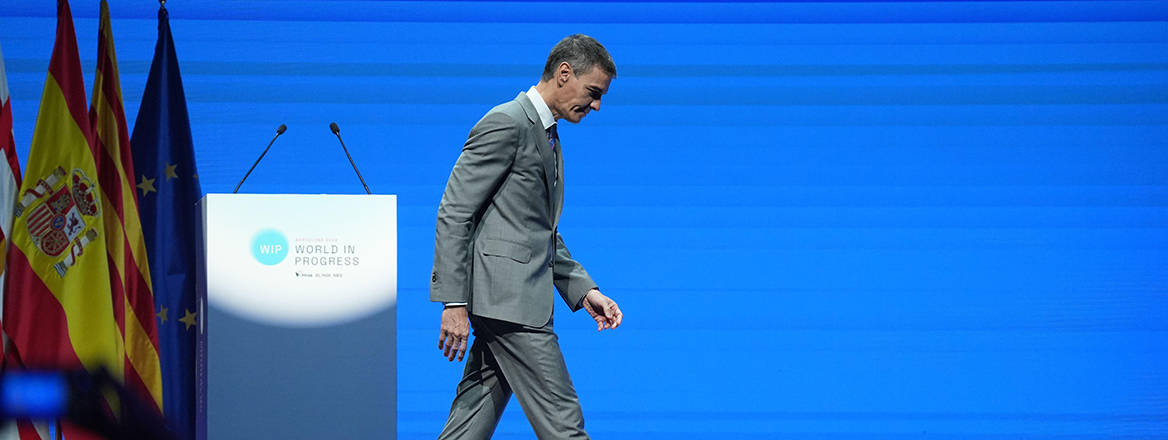
As Spain heads into a snap general election in late November, the challenges regarding the future of the country’s defence loom over the polls.
Defence is on the Ballot
Spain heads to the polls on 29 November, in a snap election called after Congress defeated two housing decrees on 2 October. Prime Minister Pedro Sánchez wants the campaign fought on housing. Defence, however, will not stay in the background.
The NATO spending dispute, the refusal to let US forces use Rota and Morón during the 2026 Iran war, and July's migration crisis in Ceuta have made it a live issue. Some private polls in late October project a combined People’s Party (PP)–Vox majority. A PP government dependent on Vox does not seem like a far-fetched reality.
As a result of global pressure stemming from geopolitical events in recent years, Western economies have seen the need to strengthen an industry that had generally taken a back seat. Many EU Member States, together with other Western countries, have seen a shift in focus, spending/financing, creation, definition and solidification of their defence industry – including the necessary and critical accompanying supply chain.
Spanish defence is no different, and it is going through the fastest expansion in its history. Spain's defence boom has been built on reaction rather than industrial growth planning, and whoever governs next will inherit an industry growing faster than some of the institutions meant to steer it.
Growth through Decrees
The numbers are striking. NATO put Spanish spending at 0.92% of GDP in 2014 and 1.28% in 2024, the lowest in the Alliance. By August 2025 it estimated Spain at 2%. SIPRI (Stockholm International Peace Research Institute) puts 2025 spending at $40.2 billion, or 2.1% of GDP, a rise of 50% in a single year.
The jump came largely from the Industrial and Technological Plan for Security and Defence, approved by the Council of Ministers on 22 April 2025. It added €10.471 billion, taking security and defence spending to €33.123 billion. The government argued the plan did not depart from the approved budget, so it was funded from redirected EU Recovery money, underspent budget lines and unused 2023 allocations.
Spain is the only Ally refusing the target agreed at The Hague in 2025: 5% of GDP by 2035, split into 3.5% for core defence and 1.5% for related security, with a review in 2029
Within the plan, 18.75% went on weapons and deterrence equipment, while 16.73% went on dual civil–military capabilities such as firefighting and rescue.Sanchez said less than a fifth would go on traditional weaponry.
The pattern has continued. 2026 funds arrive by Council of Ministers credit transfer: more than €1.3 billion in March, €124 million in May, about €1.4 billion for Industry Ministry programmes in June, €6.29 billion on 7 July, on the opening day of the NATO Ankara summit, and €1.48 billion in September. PP leader Alberto Núñez Feijóo rightly told Congress that a budget is ‘the first point of any defence plan’ and the PP argues that commitments made this way do not bind a successor.
For industry, that is the core problem. Defence programmes run for a decade or more; credit transfers run for a fiscal year. No board can commit to new capacity, hire engineers or build a supply chain on a decree the next government may abandon.
National Champions Reduce Competition
On paper the industry is thriving. TEDAE, the sector's association, reports 2025 defence and security turnover of €10.877 billion, up 16.2%. Across all its sectors, including civil aerospace and space, turnover reached €18.034 billion, about 60% of it exported. These are industry figures, not official statistics.
Look closer and the market is narrow. The Ministry of Defence awarded €31.8 billion of contracts in 2025, about three times the total for 2022–24. Almost 71% went to Indra, Airbus and the joint ventures they lead. 29 of 31 programmes, worth 88% by value, were awarded directly without competitive tender. The state also loaned €14.2 billion at 0% interest to pre-finance them, a large portion to Indra's programmes.
This is the logic of the ‘national champion’. Concentration may bring scale, but it also brings governance risk and an environment of potential conflicts forcing the likes of the state holding company SEPI to intervene and manage governance risks.

Excluded competitors are going to court. General Dynamics' Santa Bárbara is still challenging the artillery awards before the National High Court (Audiencia Nacional). Delivery is another material weakness, partly because delivered material is not yet operational.
Money is no longer the bottleneck. Competition, governance and execution are.
Strategic Choices with Commercial Costs
Madrid has also narrowed its supplier base by design. In August 2025, it ruled out the F-35, leaving no confirmed replacement for the Navy's Harriers, which retire around 2030. The Air and Space Force will take 25 more Eurofighters instead.
The break with Israel went further. Spain's first national arms embargo banned trade in defence and dual-use goods with Israel from 25 September 2025 and was validated by Congress on 8 October. The ministry cancelled the €697 million SILAM rocket launcher and €287 million Spike LR2 missile programmes. Implementation is uneven, however. The Centre Delàs estimates almost €1.2 billion of Israeli-linked contracts remain in force, and a December 2025 exception allows Israeli components in four Airbus programmes.
For companies, including those providing goods and services to the defence industry, this is the hardest part to manage. An embargo whose scope shifts by exception, and whose survival depends on an election, is difficult to build compliance programmes and supply chains around. The PP and Vox voted against it. A change of government could loosen it; a renewed Sánchez government could tighten it.
The European alternative is fragile too. Spain joined the Future Combat Air System in 2019 as an equal partner, yet in June 2026 Paris and Berlin cancelled the fighter element after a dispute between Dassault and Airbus, leaving Madrid to react to a decision taken elsewhere. Spain requested only €1 billion from the EU's €150 billion SAFE (Security Action for Europe) loan facility, against €43.7 billion for Poland. It sought the fiscal escape clause only retroactively, and the Commission noted that Spain had reported defence spending data only up to 2025.

Washington's hostility adds a further layer of risk. The threat of tariffs and suggestion of removal from NATO is a risk that many firms with US exposure cannot ignore.
Why Does the Current Way Fall Short?
First, the decree route is lawful. Credit transfers are an established budgetary tool, and no budget could have passed a fragmented Congress. The commitments are not as fragile as critics suggest: the major programmes are signed, multiyear contracts, much of their funding has been advanced as loans, and neither the PP nor Vox wants to spend less.
Second, direct awards are permitted in defence procurement under law, and national champions are the European norm. Scale may be what lets Spanish firms shape European consolidation rather than be absorbed by it.
Third, licences and exceptions are a normal feature of every export-control regime, and the Israel embargo is law validated by Congress. Buying European also fits Brussels' own industrial strategy.
These points are fair, but they defend legality, not durability. Programmes funded by decree still need money every year, and a government that inherits them without having voted for them will feel free to reprioritise. Direct awards may be lawful, yet when 88% of value bypasses competition, the exception has become the rule. Delivery problems that predate the boom are no comfort either: they show the champion model has not yet fixed execution. Lawfulness is a floor, not a strategy.
What the Next Government Inherits
Spain is the only Ally refusing the target agreed at The Hague in 2025: 5% of GDP by 2035, split into 3.5% for core defence and 1.5% for related security, with a review in 2029. The government argues that capabilities matter more than percentages. It cites close to 3,000 troops on NATO missions, €3.795 billion of military aid to Ukraine since 2022 and seventh place of 32 Allies by total defence spending. The European Parliament's research service notes, however, that Spain reached 2% partly by reclassifying security spending.
The parties divide less on how much than on how. The PSOE (Spanish Socialist Workers’ Party) treats 2.1% as a ceiling. The PP promises to meet NATO commitments with Congress's endorsement but names no figure at home, although Feijóo signed a European People's Party declaration backing 5%. Vox wants spending above 2%, aimed at Ceuta and Melilla. A PP–Vox government would face little resistance on totals, but friction over southern versus eastern priorities and over Washington. A renewed Sánchez government would again depend on parties opposed to rearmament, which is why the 2025 plan bypassed Congress in the first place.
Whoever wins this November will have three key concerns regarding the defence industry. Secure funding, so defence commitments rest on law rather than decree. Restore competitive tendering for most programmes, so the national champion strategy does not become a closed shop. And give the industry legal certainty on export controls and the Israel embargo, through published guidance rather than ad hoc exceptions. Spain has identified the funds but requires strengthening the framework that operates today to support the needs of the industry, which includes the firms that provide services to the defence industry and those involved in any part of its supply chain.
© RUSI, 2026.
The views expressed in this Commentary are the author's, and do not represent those of RUSI or any other institution.
For terms of use, see Website Terms and Conditions of Use.
Have an idea for a Commentary you'd like to write for us? Send a short pitch to commentaries@rusi.org and we'll get back to you if it fits into our research interests. View full guidelines for contributors.
WRITTEN BY
Dara Fernandez
RUSI Associate Fellow, CFS


- Jim McLeanMedia Relations Manager+44 (0)7917 373 069JimMc@rusi.org