

One Operator, Many Platforms: Unlocking the Full Potential of Attritable Mass

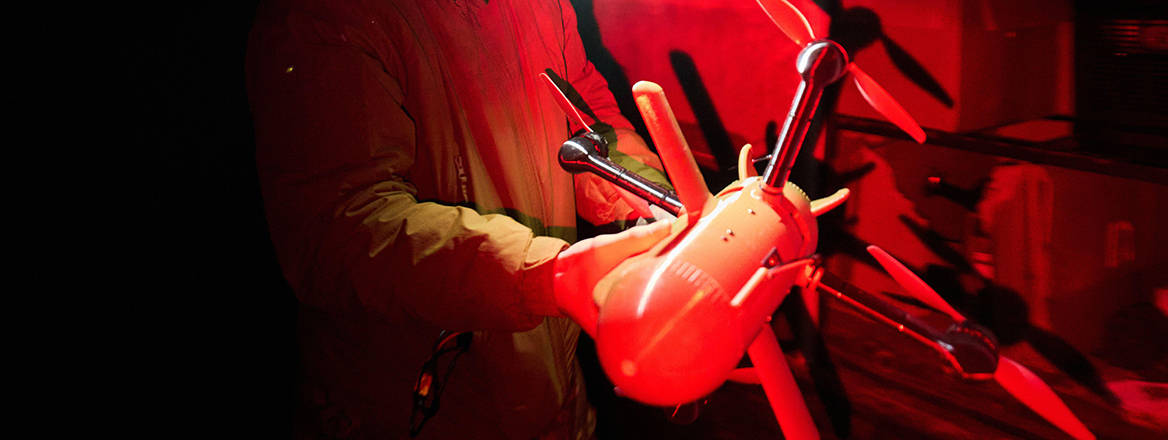
One-to-many control of drones makes mass truly usable, circumventing the limiting factor of human attention.
Ukraine’s use of uncrewed platforms is challenging a long-standing Western preference for small numbers of exquisite platforms. It is also a reminder that mass still matters. Through a combination of uncrewed surface vessels, deception and persistence, Ukraine has compelled Russia’s Black Sea fleet to disperse, despite lacking a conventional navy. On land, low-cost first-person-view drones have repeatedly disabled tanks and other armoured vehicles at a fraction of their value.
The lesson here is not that classic constraints like terrain, concealment and deception no longer matter. Rather, they are now contested differently. The concept of ‘attritable’ mass – reusable platforms cheap enough to be lost, quickly replaced and rapidly improved – is altering how force can be generated at scale. Exposure is punished faster, but losses can also be replaced faster.
Humans as the Bottleneck
There remains, however, a constraint that Ukraine’s success exposes. Most of these attritable platforms are operated on a one-to-one basis: one operator per drone. Even then, Ukraine is the exception. There are typically several or more operators involved in running one uncrewed system. Legacy drone platforms can require up to 150-200 people to man each one, when considering the multiple maintenance crews, remote joystick pilot crews and targeting crews needed to conduct sustained operations.
Training a single operator for traditional, remotely piloted weapons takes between three and four weeks, which sounds manageable until it is scaled across the thousands of platforms required to make this form of mass work. One-to-one control also makes coordination across multiple platforms and areas of operation even more challenging. Each extra platform adds another feed, another decision loop and another kill-chain to a given combat task, turning missions into individual sorties rather than a coherent package.
Another issue with one-to-one is iteration cycles. As RUSI’s Justin Bronk and Jack Watling wrote in April 2024: ‘Any UAV becomes increasingly ineffective over time as the adversary refines its countermeasures.’ They add that maintaining effectiveness requires updates to ‘software . . . sensors and radios, every six to 12 weeks.’ The challenge for NATO is sustaining that cadence at scale when each update creates a training demand, and in some cases, a change in tactics. It adds cognitive load for operators already working at high tempo.
If one-to-many is a shift in the control model, a change in force design must follow it
NATO nations cannot assume they will have the training capacity nor manpower required to make one-to-one work at scale, especially while simultaneously managing other, more complex capabilities.
What One-to-Many Changes
Unlocking the full potential of attritable mass requires a different model: one-to-many, where a single operator can supervise multiple uncrewed platforms at once and coordinate their effects as a package. In practice, this means the operator is not ‘flying’ a platform minute-by-minute. Instead, they set objectives and constraints – such as ‘orbit and search this area’; ‘investigate this track’; ‘decoy here’; ‘strike there’ – while the software manages routine navigation, deconfliction and coordination. The operator’s job becomes supervision: authorising engagements and re-tasking the package as the threat or mission evolves.
This logic achieves three things. First, it acts as a multiplier. Instead of effects scaling linearly with troop numbers or platform numbers, a force can scale through autonomy, better networking and software that reduces operator workload – fusing feeds, prioritising alerts, deconflicting routes and flagging when human intervention is required. For forces under constant pressure to ‘do more with less’, this is decisive. These platforms can also more easily coordinate or pair with crewed platforms as well, taking the burden off the crewed operator.
Second, one-to-many technologies improve survivability. It allows small teams to manage multiple platforms from protected positions, reducing the number of forward operators and the electronic signatures they create. It also enables dispersion: instead of concentrating antennas, vehicles, materiel and personnel in predictable locations, forces can distribute control nodes and move them frequently, using relays to extend range while complicating an adversary’s targeting.
Finally, one-to-many enables coordinated effect rather than isolated missions. Attritable mass operating in a cluster can be tasked as an autonomous package. This means one platform to find, one to confirm, one to strike, one to jam or decoy. This kind of coordinated effect once required multiple teams, expensive platforms and high workload. With one-to-many, these roles can be coordinated by a small team and executed as a single mission package.
Implications for Force Design and Procurement
If one-to-many is a shift in the control model, a change in force design must follow it. The UK’s Strategic Defence Review 2025 pointed in the right direction with its proposed ‘20-40-40’ mix: a smaller proportion of crewed platforms, paired with larger numbers of reusable uncrewed ones and consumable effects designed to be expended. The logic is sound: mass and endurance come from platforms you can afford to lose and replace, while crewed platforms provide judgement, resilience and command.

Help your search results show more from RUSI. Adding RUSI as a preferred source on Google means our analysis appears more prominently.

Military planners cannot simply bolt uncrewed systems onto existing formations, but rather they must use them to explore and redefine how a joint force generates effect. This means aircraft, vessels and ground units increasingly acting as command nodes, coordinating multiple uncrewed platforms to generate effects. Ultimately, integrating uncrewed systems effectively requires a fundamental shift not just in force design, but also in how we procure platforms and define command relationships.
Ukraine demonstrates that procuring rapidly and iterating capability on weekly cycles, faster than adversary countermeasures can adapt to the threat. For NATO, the lesson is about buying systems that enable the combination of software and scale, allowing a small team to supervise many platforms at once – rather than just buying more platforms. Procurement should therefore prioritise measures that matter for one-to-many: operator workload; how quickly a package can be re-tasked; and how rapidly new platforms and payloads can be brought into the same operating model.
Buying for attritable mass in a one-to-many model should not resemble a traditional programme built around fixed requirements or a single ‘final’ configuration. It means procuring at the speed of relevance: fielding early versions quickly, learning from use, and upgrading in short cycles. It also means contracting for capability, not just hardware. This entails buying the entire system and the support to enable integration, as well as iteration.
Practically, that points to three shifts. First, contracts should reward integration speed and upgrade cadence as much as initial performance – how fast a new payload can be onboarded and how quickly software can be updated.
Second, procurement should favour open architectures and common control standards over closed, proprietary stacks, so that hardware, sensors and payloads can be swapped without rebuilding the system. Vendor lock-in cannot be an accepted part of procurement.
Third, the logic of ‘cheap enough to lose’ only works if the platform is also easy to replace and the force can reconstitute. Stockpiles, spares, repair capacity and surge manufacturing must be integral requirements from day one.
Buying thousands of attritable platforms is not enough if they cannot be coordinated safely and effectively. Doctrine should treat attritable mass as a core component of deterrence and warfighting: emphasising scale, redundancy and rapid regeneration, rather than assuming survivability of a small number of expensive platforms. One-to-many control also changes the human task. Operators should be trained less as ‘pilots’ of individual vehicles and more as supervisors and orchestrators: defining objectives, managing risk, intervening at critical decision junctures and coordinating packages of sensing, deception and strike.
With Ukraine setting a new standard for affordable, expendable platforms, the question now is how the West can remodel force design, procurement and training fast enough to turn affordability into coordinated effect – before our adversaries.
© Richard Drake, 2026, published by RUSI with permission of the author.
The views expressed in this Commentary are the author's, and do not represent those of RUSI or any other institution.
For terms of use, see Website Terms and Conditions of Use.
Have an idea for a Commentary you'd like to write for us? Send a short pitch to commentaries@rusi.org and we'll get back to you if it fits into our research interests. View full guidelines for contributors.
WRITTEN BY
Dr Richard Drake
Guest Contributor


- Jim McLeanMedia Relations Manager+44 (0)7917 373 069JimMc@rusi.org