

Middle Powers and the Illusion of a Post-America Middle East

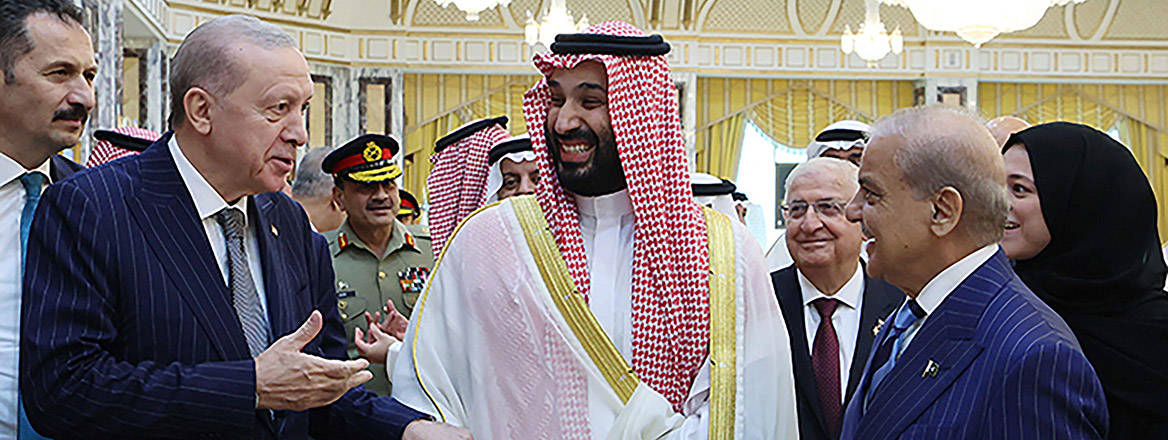
Gulf diplomacy fuels claims of a middle-power moment, but the Iran war exposes limits to strategic autonomy and enduring US supremacy.
Intensifying US–China rivalry, the erosion of post-Cold War certainties and recurring doubts over the durability of American leadership on the global stage have helped propel one of the more fashionable ideas in contemporary foreign policy debates – the rise of the world’s ‘middle powers’ into more autonomous and consequential actors, capable not merely of hedging between great powers but of shaping the regional orders around them. Nowhere does the thesis appear more compelling than in the Gulf region, where states have converted energy, capital, geography and increasingly active roles in mediation into influence far beyond their size. These states have diversified their relationships, expanded their diplomatic reach and have become more willing to resist the preferences of the US, even as Washington continues to maintain the post-Cold War security architecture in the region.
Both the UAE and Saudi Arabia engage China and Russia, working closely with both countries on mutual economic and security interests, while retaining their longstanding alliance with Washington. Qatar mediates conflicts involving actors Washington cannot easily reach or engage directly and has expanded ties with China, even as a Major Non-NATO Ally to the US. These states are less wholly dependent on the US, more autonomous and more active than they were during much of the post-Cold War period.
Their greater agency and diplomatic reach can be read in two ways: a transformation from bystanders to consequential players in the global international order or as evidence that a more contested system has simply created greater room for manoeuvre beneath the level of great-power primacy.
The Myth of American Retreat
The idea of the middle-power moment has been driven in large part by the perception of American retreat. As Washington has increasingly looked to allies and partners to shoulder more of the burden for addressing challenges to international security, those states have gained greater room to hedge and pursue their own agendas. However, this shift has been mistaken for a transfer of power, rather than a change in how American power is exercised.
The shocks supposedly driving the rise of the middle powers have, therefore, simultaneously established their continuing dependencies
A principal reason for caution is that the apparent retreat of American power can be deceptive. The US can reduce troop numbers, transfer greater burdens to regional partners and redirect strategic attention elsewhere, while retaining the bases, intelligence networks, logistical infrastructure, naval and air power that allow it to re-enter a crisis at scale. The war on the Islamic State demonstrated this under Obama following America’s pivot to Asia, and Gaza illustrated this under Biden; the Iran war has done so under President Trump, who has exercised American military supremacy across multiple theatres.
Diversification is, therefore, not strategy, and accumulating partners is not the same as acquiring autonomy. In addition, periods of geopolitical transition routinely create openings for ambitious actors. Pakistan’s role in mediating between the US and Iran is a case in point: Islamabad gained diplomatic relevance precisely because the crisis created an opportunity for actors who could bridge otherwise hostile camps. This was the central lesson of previous regional inflections, which were effectively litmus tests that either exposed the difficulty of displacing American supremacy or highlighted the limitations facing actors that saw themselves as emerging alternatives.
Russia exploited American indecisiveness in Syria and used its military intervention to become the predominant external actor in the country until the fall of the Assad regime in December 2024. China has used trade, infrastructure and investment to deepen its regional presence. Yet even these two states, great powers, proved opportunistic rather than transformative actors. China’s shortcomings will have proved the most acute for a region and international community that has long vaunted its role as an alternative to the US. Beijing’s much-heralded 2023 brokering of the Saudi–Iran rapprochement was treated as evidence that China could begin to arbitrate regional order but the Houthi escalation, Hormuz crisis and Iran war demolished that proposition, even as Saudi Arabia turned to Beijing to press Tehran over Houthi attacks on Saudi infrastructure.
Lessons from History
Mediation, summitry and strategic partnerships signal autonomy, relevance and influence but can also be largely performative. During the Cold War, Egypt, Iran, Saudi Arabia and Turkey all learned to extract economic, military and diplomatic concessions by playing Washington and Moscow against one another but their activism did not amount to a redistribution of systemic power. It reflected the opportunities created by competition between powers. During the 1973 oil embargo – a useful warning against overreading BRICS de-dollarisation efforts – Arab producers demonstrated that control over a strategic commodity could impose significant costs on far stronger states but it proved difficult to sustain, divisions emerged among producers, consuming states adapted and the political demands attached to it were only partially realised.

The current debate on so-called middle powers risks making the same analytical mistake: extrapolating from successful episodes of bargaining or mediation to a much larger claim on the distribution of power. Europe offers a useful comparison. Even with their economic scale, industrial base and institutional architecture, European countries have not yet converted calls for strategic autonomy into a genuinely independent pole of power and are divided over what such autonomy should mean, how far it should extend from the US and who should provide the political and military leadership required to sustain it.
Most recently, the 7 August 2026 Mecca pact established a collective-defence arrangement that has the potential to become a pillar of the regional security architecture, particularly if it can give operational meaning to its core provision that an attack on one signatory is an attack on all. However, that provision was tested, and then failed to live up to its intended purpose, almost immediately by renewed Houthi attacks on Saudi Arabia, and again on 10 October by the deadly Houthi attack on King Khalid International Airport in Riyadh. Turkey and Pakistan signalled support and the three states began discussing intelligence sharing and military coordination, and on 5 October the signatories moved to activate their collective-defence commitments, agreeing to provide military forces and capabilities for rapid deployment to Saudi Arabia. However, we have not yet seen collective military action on Saudi Arabia’s behalf.
The Middle East is no stranger to ambitious collective security arrangements. The 1955 Baghdad Pact developed into an anti-Soviet containment effort linking Iraq, Turkey, Iran, Pakistan and Britain. Yet divergent interests, limited institutional integration, the unwillingness to absorb costs for another and domestic political upheaval prevented it from becoming anything like a Middle Eastern NATO.
The Test of War
The more revealing test, however, has come in war rather than institutional designs. The war with Iran has underscored vulnerabilities that portray the extent to which regional actors are still tethered to US military supremacy, from missile-defence dependence to their own limited coercive capabilities. Since the war began in February, Iran has fired more than 7,000 missiles and drones at Gulf Cooperation Council states. The UAE alone has faced more than 550 ballistic missiles and 2,265 drone attacks, while the attacks have wiped out 17% of Qatar's liquefied natural gas (LNG) export capacity, causing an estimated $20 billion in lost annual revenue for up to five years. To the credit of the Gulf states, their air defences intercepted the majority of those threats but the scale of the assault placed extraordinary pressure on interceptor stocks, command-and-control systems and critical infrastructure.

In 2021–25, Saudi Arabia and Qatar were the world’s third- and fourth-largest arms importers; the US supplied 77% of Saudi imports and 48% of Qatar’s, while more than half of all major arms imported into the Middle East came from the US. Iranian attacks revealed the limits of procurement as a substitute for strategic depth: integrated air and missile defence, intelligence and surveillance, logistics, munitions reserves, command integration and, ultimately, credible external deterrence. In addition, the formidable arsenals at the disposal of the Gulf states remain deeply embedded in Western supply chains and maintenance systems.
From Buying to Building
The shocks supposedly driving the rise of the middle powers have, therefore, simultaneously established their continuing dependencies. However, even amid such vulnerabilities and limitations, we may still be witnessing the acceleration of strategic autonomy among the Gulf states. The UAE is attempting to move beyond buying advanced weapons towards producing more of the underlying systems at home, including drones, autonomous platforms and propulsion technology. Saudi Arabia is pursuing the localisation of its military capabilities, targeting more than 50% by 2030 and expanding into components for missile-defence systems. Qatar is pursuing the same direction using joint ventures and technology-transfer agreements to build domestic production and technical expertise.
The war with Iran may accelerate the investment in domestic manufacturing and supply chains needed to make autonomy more credible and durable. These domestic capabilities have the potential to move the Gulf states beyond diplomatic activism and towards a more substantive form of strategic independence, built on an indigenous military-industrial base capable of underpinning diplomatic reach and reducing the extent to which regional objectives remain conditioned by external suppliers and security providers.
© RUSI, 2026.
The views expressed in this Commentary are the author's, and do not represent those of RUSI or any other institution.
For terms of use, see Website Terms and Conditions of Use.
Have an idea for a Commentary you'd like to write for us? Send a short pitch to commentaries@rusi.org and we'll get back to you if it fits into our research interests. View full guidelines for contributors.
WRITTEN BY
Dr Ranj Alaaldin
RUSI Senior Associate Fellow, International Security


- Jim McLeanMedia Relations Manager+44 (0)7917 373 069JimMc@rusi.org