

Losing Control of the West’s Longstanding Interests in Seychelles

A democratic and well-functioning international financial centre that has benefited from Western support, Seychelles seems to now be choosing its friends elsewhere.
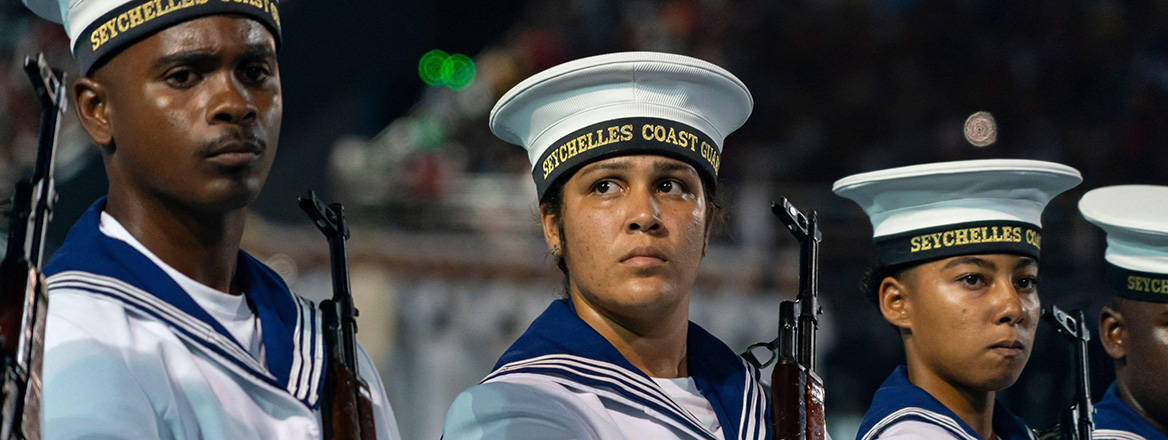
On 29 June, Seychelles celebrated a remarkable anniversary of independence, preceded by a week-long spectacle that this author witnessed by sheer chance. Once French, then later a British colony, the Indian Ocean island archipelago of some 150 thousand inhabitants became a sovereign nation in 1976, exactly five decades ago. In a rare showcase of splendour, the country’s capital Victoria was decorated in flags, and a rare military parade was ordered to take place by the winners of the 2025 general election, the United Seychelles party, led by incumbent president Patrick Herminie.
As so often happens during such occasions, many foreign dignitaries were invited to celebrate at the Unity Stadium. The guest of honour was India’s Prime Minister Narendra Modi, as well as high ranking officials from Russia, China, the Gulf States and neighbouring Mauritius, with foreign platoons taking part in the parade – soldiers from Mauritius, Russia, China and India. The US and its European allies were completely absent.
The key question is: why is this relevant? Formally, the Western governments did not want to parade alongside Russian troops, but the choice of military collaboration begs a question as to why the Russians were given priority, rather than contingents from Britain, France or the US.
Seychelles can be a Stable Partner for the West
Despite historical ties to the USSR, Seychelles has been a stable democracy since the introduction of a multi-party system in the early 1990s. It grew to become Africa’s richest economy, betting on a mix of international financial services and tourism driven by the country’s exceptional environmental and geographical features.
For Seychelles observers the conclusion is that the onset of democratic rollback in Seychelles, as well as the potential subsequent collapse in governance standards can be attributed to two main reasons – one internal and one external
While some might associate Seychelles with a long list of the so called ‘secrecy jurisdictions’ or ‘tax havens’, it has never been among the worst culprits in harbouring financial crime and stayed well clear of the Financial Action Task Force’s grey list during its most recent evaluation. It’s democracy and transparency has been underpinned by the mandate of the Constitutional Appointments Authority (CAA) , a body independent of the government but responsible for key appointments to the judiciary and public media.
Last but not least, unlike many of its counterparts in Africa, Seychelles consistently maintained a working public infrastructure and a deep care for its environment. One great example of the latter is the pioneer pilot of Nature Bonds, where Seychelles national debt was restructured to finance marine conservation – essential when the country’s exclusive maritime economic zone is bigger than that of China.
Seychelles has so far appeared a perfect partner for the West in Africa. Stable, secure, transparent, well connected with the international financial system and with well-entrenched democratic institutions. Perhaps this is exactly what lulled Western diplomacy into a false sense of comfort. After all, with so many crises brewing elsewhere, who has time to pay attention to what is happening in small island states? The US did not even have permanent diplomatic presence in Victoria between 1996 and 2023. While the British and the French did, they have been outcompeted by other actors for years on public relations. A great illustration of this is the Seychelles Airport flight timetable, including direct flights to Russia, UAE, Qatar, India and Ethiopia by carriers from those countries, but no direct services by British Airways or Air France.

While the West, largely in the form of EU nations and the UK, still represents the major trading partner of Seychelles, it does not fight to retain this role. It bets on polite cooperation and balanced partnership, whereas the non-Western nations are offering incentives and trying to tilt Seychelles into its sphere of influence with a certain ferocity. The policies of the new government in Victoria do not help.
The Current Situation is Concerning
The current cabinet was officially sworn-in in November 2025, representing the United Seychelles party which has ruled the country for over 40 years. This includes the autocratic period when it was known as Seychelles People’s United Party and led by Albert René. One of the key issues in Seychellois politics is the legacy of this time and the fact that the President remains at the forefront of politics. Indeed, Dr Herminie has been accused by the opposition and independent observers of attempting to re-centralise power and roll back certain democratic controls, including independent media, as well as the independent oversight of the judiciary guaranteed by the CAA. His administration has taken dubious steps to overturn certain longstanding anti-corruption proceedings. It has also stopped cooperation with the Qataris on the development of a resort on Assomption Island, allegedly due to concerns over its environmental impact, but raising suspicions that it might be given up to other foreign parties interested in establishing a military presence. These developments, together with indications that the new government’s risk appetite for tolerating organised crime and nefarious state sponsored actors is far greater than before, all present a pretty grim picture.
For Seychelles observers the conclusion is that the onset of democratic rollback in Seychelles, as well as the potential subsequent collapse in governance standards can be attributed to two main reasons – one internal and one external. Firstly, the political leadership in Seychelles has a perception of impunity and international insignificance. The politicians governing the country currently believe that their centralisation of power and relaxation of approach towards illicit finance will go unnoticed and unpunished. Secondly, and more importantly, they are willing to cooperate with those countries that bring in material incentives and remain deeply involved in Seychelles – Russia, India, China and the Gulf States. The West can reverse this state of affairs but it needs to act, and it needs to act now, otherwise it is facing yet another scenario of autocratic encroachment into an African country that has so far performed admirably well.
The West Must Remain Involved or Yield to Autocracies
Because Seychelles is a major financial centre, with 200,000 registered offshore companies, the West has a vested interest in it not becoming a safe harbour for money launderers and tax evaders. The West should also be concerned about the growing cooperation between Russia and Seychelles, which is showing signs of moving beyond a strictly neutral partnership. It is resulting in renewed diplomatic heft for the Russian Federation at international fora, namely the UN and African regional organisations, with one more vote favourable to Moscow. Additionally, Russia has long used Seychelles-registered entities, such as Alpha Consulting, to facilitate sanctions evasion, with growing diplomatic ties only strengthening the probability of further such activity happening.

The UK and its allies need to get involved in a concerted diplomatic effort in Seychelles, re-emphasising both the benefits of upholding democratic values and protecting the international financial system, as well as the potential consequences of not playing ball or letting controls slip. Western countries have the capacity to reward Seychelles for good democratic and international compliance performance, through partnerships promoting tourism, foreign direct investments, trade and environmental cooperation, as well as technological capacity building, all of which far outweigh the counteroffer by autocracies, in terms of real value.
Furthermore, Europeans and Americans should work hard to emphasise to the Seychellois government that not adequately protecting the Seychellois financial system from abuse by illicit actors, whether related to international organised crime or sanctions evaders, will have far-reaching consequences. One of the most valuable instruments of international pressure, that carries a real ‘stick’ in the form of international scrutiny is the Financial Action Task Force system, which regularly monitors countries for compliance with a set of recommendations and efficiency indicators related to their performance in implementing money laundering, terrorist financing and proliferation financing controls. Western governments can reiterate to Victoria that relaxation of compliance culture and an uptick in cases of Seychelles financial system’s abuse can lead to grey-listing – and that means dramatic economic impact, a fall in real gross domestic product that takes years to reverse.
In the end, it remains a truly concerning picture, that on its 50th anniversary the Republic of Seychelles is facing an unprecedented campaign of encroachment by autocratic governments on the one hand, and an internal drive to align itself with them on the other. The West is paying the price for not having remained sufficiently engaged, or perhaps believing, as it often does, that things will regulate themselves naturally towards the right path without much interference. Fortunately, it is still not too late, as Seychelles have built a remarkably resilient democratic system and created institutions willing to safeguard it, filled with genuine professionals that want to work for the benefit of their country. It would be wise for Washington, Brussels, London and Paris to reach out to them and empower them before it is too late.
© RUSI, 2026.
The views expressed in this Commentary are the author's, and do not represent those of RUSI or any other institution.
For terms of use, see Website Terms and Conditions of Use.
Have an idea for a Commentary you'd like to write for us? Send a short pitch to commentaries@rusi.org and we'll get back to you if it fits into our research interests. View full guidelines for contributors.
WRITTEN BY
Wojciech Pawlus
Head of Countering Proliferation Financing Programme
Centre for Finance and Security


- Jim McLeanMedia Relations Manager+44 (0)7917 373 069JimMc@rusi.org