

Israel’s Foreign Funding Inquiry is Not Evidence of a Stolen Election

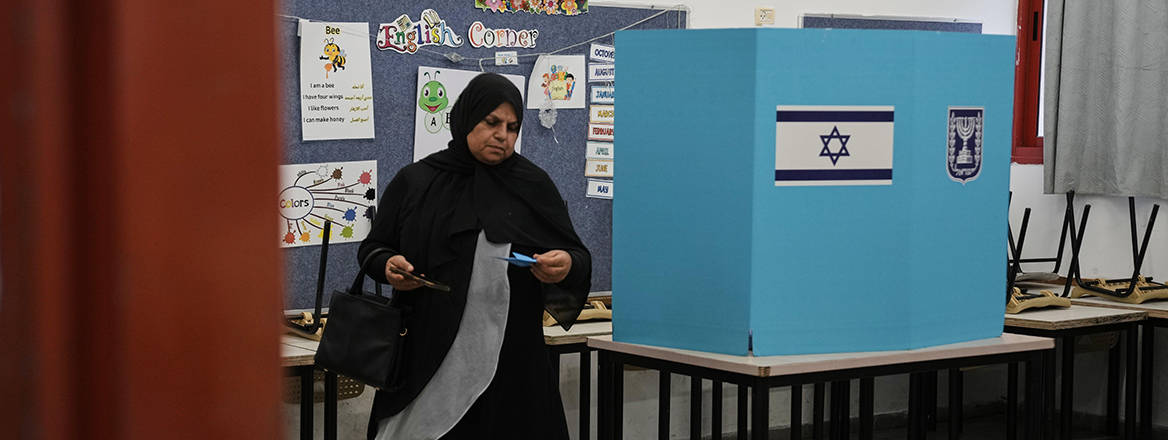
The incumbent appears to be using a national security foreign-funding inquiry to discredit 19 Arab-held seats and perhaps disrupt formation of a replacement government.
President Isaac Herzog has entrusted Gadi Eisenkot with forming Israel’s next government after parties holding 67 seats - including the Joint List and Ra’am - recommended him. He has 28 days to turn that support into a government (though this can be extended for up to two weeks).
Two days after Israel’s 27 October election, Supreme Court Justice Noam Sohlberg, who chairs the Central Elections Committee (CEC), wrote to David Zini, the head of Israel’s domestic security service (Shin Bet). He asked for an investigation into ‘serious suspicions’ of ‘improper influence on the elections – exerted through funding provided by foreign entities acting against Israeli interests’, adding that he could not ‘attest to the substance of these suspicions’. Within hours, Likud had a name for the affair, ‘Ra’amgate’, and a verdict: ‘They stole the election in Israel!’.
The CEC could not vouch for the suspicions, but – to wide opprobrium – Likud has cast doubt on the election results and on the legitimacy of any government dependent on Arab party support. Investigating foreign campaign money is legitimate; using an unfinished inquiry to discredit the votes of Arab citizens and exclude their representatives from government would, however, be a political manoeuvre.
The arithmetic explains the urgency. The final count gave Benjamin Netanyahu’s bloc 53 seats and the opposition bloc led by Gadi Eisenkot 48, with the Joint List and Ra’am on a combined 19. That is a record for Arab parties, and it is also the difference between either camp and the 61 seats needed for a majority.
Likud and other outgoing coalition factions sought to delay certification pending two separate investigations: a Shin Bet inquiry, with Mossad involvement, into suspicions that money from Qatar and other countries reached the Joint List through disguised donations; and a police investigation into alleged vote-buying in the Negev.
The law provides no automatic disqualification for campaign-finance breaches or receipt of foreign funding
The CEC nevertheless certified the results on 4 November after reviewing material from 9,069 ballot boxes. It found no irregularities that compromised the integrity of the election or altered its outcome. The results were presented to President Isaac Herzog on schedule. In the full committee’s certification vote, 15 representatives voted in favour, two Otzma Yehudit representatives voted against and the other 14 outgoing-coalition representatives abstained. Sohlberg stated that the suspicions remain only suspicions and that ‘even if they are verified, the scope of their potential influence is limited’. He added that they ‘do not cast aspersions on the votes of the Arab community in any way’ and that high turnout is welcome. Casting broad doubt on the certified results, he said, is a ‘real danger’ to democracy.
Three Claims, Not One
The ‘stolen election’ case currently bundles three propositions that need to be picked apart. First, that some money of foreign origin may have entered Arab politics illicitly. Second, that this money explains the surge in Arab turnout. Third, that the surge therefore taints the 19 seats and any government that would depend on them.
The first claim is a proper subject for investigation and may turn out to be true in a range of forms. The Shin Bet is examining reports that a Joint List member of the Knesset received ‘thousands of shekels’ from Qatar; investigators have said they have ‘no evidence of what the money was used for’ and that it is ‘unclear what piece of evidence suggests that the funds originated from Qatar’. Mossad has reportedly been asked to assist on the foreign-source side.
On 4 November, the Shin Bet briefed the committee that intelligence indicated ‘widespread transfers of large sums from foreign countries’, originating with parties holding ‘concealed and even hostile interests’; this involved ‘thousands of people and possibly more’. It said further collection was required to ‘connect the dots’ and establish the scale with high certainty – but named no countries or individuals. Law-enforcement sources later said they were unfamiliar with claims of ‘huge sums’ or ‘thousands of people’, noting that Zini had stated on election day that voting was proceeding safely.
Qatar’s spokesperson Majed Al-Ansari called the allegations ‘ridiculous and dangerous’. Israeli politicians had accused Doha of buying Netanyahu, the left and now the Arab vote: ‘Qatar would apparently own all of Israel’. While hardly an alibi, Qatar is at risk of becoming a standard explanation for otherwise inconvenient Israeli political behaviour.

And even if money changed hands, the claims about turnout and the legitimacy of the 19 seats would still need proving.
What the Money Would Have to Do
Consider what the second claim would actually entail: nearly 840,000 people voted for Ra’am and the Joint List, a 64% increase from 2022. The Mossawa Centre put Arab turnout at nearly 80%, against 53% last time; while national turnout was 77.9%. Those alleging that foreign money drove the increase need to show how it was used and what difference it made to turnout or voting choices. Vote-buying is of course an offence, and it is worth noting that funding get-out-the-vote work can also break the law – even without affecting anyone’s political choice. But neither finding justifies treating every Israeli Arab ballot as suspect.
Even the Shin Bet’s latest allegation of widespread transfers does not, by itself, establish that foreign money changed the allocation of seats. The separate vote-buying case involves three residents of Bedouin communities in the Negev, arrested on election morning. Police said searches found envelopes containing tens of thousands of shekels and Ra’am ballot slips. A court has since released one suspect unconditionally and refused to extend the detention of the other two. A law-enforcement source told Channel 12 that this case and the foreign-funding inquiry were unrelated. Police have said election day saw ‘relatively few election-integrity incidents’ and that they had ‘no investigative or intelligence support’ for Likud’s broader allegations.
Nor do the officials running the inquiry believe it bears on the result. Acting Central Elections Committee director-general Dean Livne said the election ‘was conducted lawfully’, that there was ‘no basis for claims of systematic harm to the integrity of the elections’, and that the investigation ‘does not affect the final results … nor does it concern any particular sector of the population’.
The Shin Bet has meanwhile said its inquiry was ‘focused and narrowly defined’, based on its own intelligence rather than anything supplied by a political party, and ‘should not be used to cast suspicion on or accuse an entire sector of society that exercised its democratic and legal right to vote’.

There is also a simpler explanation for the turnout, and it was reported before anyone mentioned Qatar. Reporting from Arab towns pointed to demolitions of Bedouin homes, unchecked gun violence and the reversal of budget commitments made when Ra’am sat in the previous coalition; more broadly, it notes four years of Itamar Ben-Gvir as national security minister. CNN research found ‘an urgent desire to oust’ Netanyahu. What changed this year was that a community which had often stayed away from the polls concluded the alternative was worse.
Who Gets to Form a Government
The Shin Bet can investigate offences. It cannot decide whether an election stands. Sohlberg also rejected the idea that the outgoing coalition’s majority on the CEC could block certification: ‘The transfer of power cannot depend on the wishes or consent of representatives of the majority in the outgoing Knesset.’ Under Section 86 of the Knesset Elections Law, a result can be challenged only by appeal to a Jerusalem court within 14 days of publication, and only where the alleged irregularity ‘could have affected the election results’. The law provides no automatic disqualification for campaign-finance breaches or receipt of foreign funding. The results were submitted to Herzog on 4 November, and Likud has said it intends to seek the invalidation of results at individual polling stations where it suspects irregularities – those challenges should be judged on their evidence.
In recent days, the Attorney General, Gali Baharav-Miara, has rejected moves by Zini (a Netanyahu appointee) to interrogate under caution senior Arab-party figures including Mansour Abbas, Ahmad Tibi and Sami Abu Shehadeh. She cited the absence of an evidentiary basis, parliamentary immunity and the rule of law, and noted that Shin Bet had delayed the process by failing to transfer intelligence materials promptly. Likud accused her of concealing the truth and tying the Shin Bet’s hands – National Security Minister Ben-Gvir publicly called for Zini to arrest the figures even without her approval.
Herzog said he had spoken to both Zini and Baharav-Miara on 4 November amid reports of severe disagreements over the investigations’ handling. He expressed respect for both and full confidence that law-enforcement agencies would investigate the suspicions properly.
Abbas said his party fears no investigation, and he is prepared to appear under proper procedures. He described the reports as an attempt to tarnish the Arab public. Opposition leader Gadi Eisenkot has called the effort a ‘pogrom against democracy’.
The political function of the ‘stolen election’ label may now be clearer: to place those 19 Arab seats beyond the pale, obstruct the majority that recommended Eisenkot and increase the prospect of another election, with Netanyahu remaining in office as caretaker
Other democracies offer examples of electoral wrongdoing or foreign interference being investigated without overturning the outcome. The US special counsel documented Russian interference in 2016 and charged Russian nationals, but did not establish a conspiracy with the Trump campaign, and the outcome stood. The UK Electoral Commission fined Leave.EU £70,000 for breaching referendum spending rules, and the referendum was not reopened. Canada’s public inquiry concluded that foreign interference ‘likely impacted some votes’ in 2019 and 2021, but did not change which party formed a government. In none of those cases did anyone claim that an ethnic or national minority’s ballots were collectively foreign.
The obstacles are not all of Likud’s making. Several opposition factions had already ruled out a minority government dependent on Arab-party support, as well as a unity government with Netanyahu. Herzog has urged parties to reconsider campaign commitments to avoid another election.
The Joint List and Ra’am have already helped Eisenkot receive the mandate. The question is whether he will now rely on the Arab parties - in coalition, through confidence and supply or by their acquiescence in a minority government - or seek a bare majority through concessions to the ultra-Orthodox parties.
The political function of the ‘stolen election’ label may now be clearer: to place those 19 Arab seats beyond the pale, obstruct the majority that recommended Eisenkot and increase the prospect of another election, with Netanyahu remaining in office as caretaker. Herzog has asked politicians to ‘avoid tarnishing an entire community that sought to exercise its right to vote’ and reiterated the point on receiving the results. The inquiry should run its course, and anyone who broke the law should answer for it.
Why This Matters Closer to Home
Stepping back, who governs Israel is not merely a question of domestic arithmetic or legitimacy. A prolonged caretaker period leaves Netanyahu with the formal powers of a sitting prime minister, including on the use of force. Israeli law does not bar a caretaker government from authorising military action, though courts have historically expected restraint.
While Eisenkot attempts to form a coalition, and with reports of planning for renewed strikes on Iran following the US midterms, the political incentive to keep the current government in place carries direct consequences for regional stability.
For Britain, the stakes include regional stability and the prospect of containing any current and future escalation alongside European and Gulf partners.
It also should matter whether decisions on war and diplomacy remain with a government fighting to stay in office or pass to one with a settled mandate. The people who have seen the intelligence have said, repeatedly and on the record, that it does not undermine the election result. Herzog has now acted on that result by entrusting Eisenkot with forming a government. The test for Eisenkot and his prospective partners is whether they will treat the Arab parties’ 19 seats as legitimate instruments of parliamentary government - or allow an unfinished inquiry to determine which elected representatives are politically acceptable.
© Alex King, 2026, published by RUSI with permission of the author.
The views expressed in this Commentary are the author's, and do not represent those of RUSI or any other institution.
For terms of use, see Website Terms and Conditions of Use.
Have an idea for a Commentary you'd like to write for us? Send a short pitch to commentaries@rusi.org and we'll get back to you if it fits into our research interests. View full guidelines for contributors.
WRITTEN BY
Alexander King
Guest Contributor
- Jim McLeanMedia Relations Manager+44 (0)7917 373 069JimMc@rusi.org