

Hybrid Navy: Building the Maritime Operating System

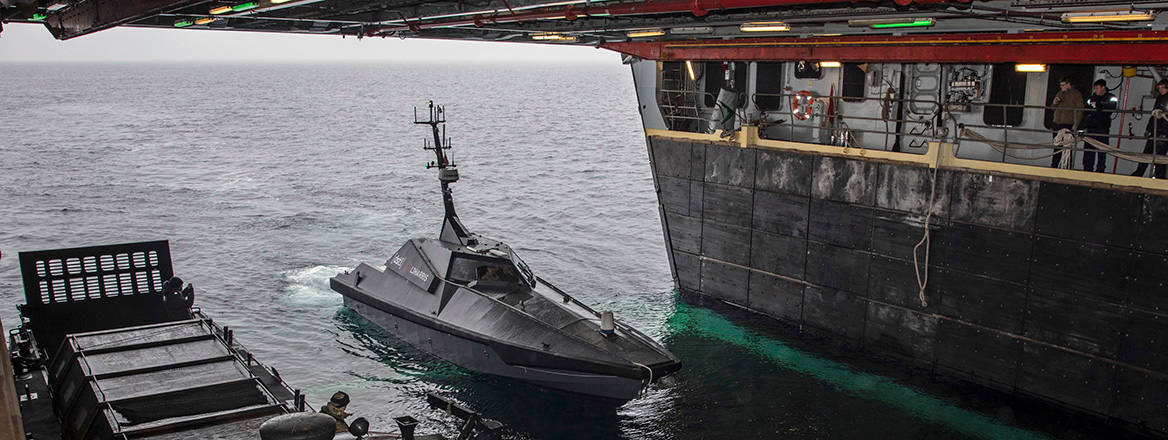
To implement the Hybrid Navy, the Royal Navy must follow the example of other successful technology transformations and build an ecosystem, not just a Fleet.
The announcement of the Royal Navy's Hybrid Navy concept has inevitably focused attention on the visible manifestations of technological change: autonomous surface vessels, extra-large uncrewed underwater vehicles and swarming drones. This is perfectly understandable. Maritime platforms are things that can be visualised by CGI and, once built, ministers can have their photographs taken with them. They make for convenient programme milestones and are easy to line up in the dockyard and count.
But focusing on the platforms risks missing the point entirely: the ships are, relatively speaking, the easy bit.
The Hybrid Navy is not fundamentally about robot ships. It is about building a maritime ecosystem capable of integrating, exploiting and continually evolving technology at the speed demanded by modern conflict. The autonomous vessel is simply one type of node within that ecosystem.
The temptation is to see Hybrid Navy as a programme to deliver autonomous ships. That would be a profound misunderstanding. Autonomous vessels are not the point; they are simply the most visible applications of a much bigger idea
If Defence gets this right, the Royal Navy will possess an architecture that can absorb new technologies for decades to come. If it gets it wrong, it risks repeating a familiar pattern: acquiring impressive individual capabilities that never truly combine to deliver transformational operational advantage. The distinction matters because history suggests that organisations rarely fail because they choose the wrong technology. More often, they fail because they misunderstand where the value actually lies.
In his excellent Cautionary Tales podcast series, Tim Harford presents an insightful episode on Sir Clive Sinclair. He observes that the concept behind the Sinclair C5 was essentially right: personalised electric transport. The 21st Century prevalence of e-bikes and e-scooters shows us this is so. But the underlying technologies and infrastructure weren’t ready, and so it flopped. The design was also rubbish. The lesson here for the Hybrid Navy is obvious.
Lessons from Silicon Valley
Senior leaders in Defence are often somewhat overenthusiastic in drawing comparisons with commercial technology companies, yet the environments are different, the incentives are different and the consequences of failure are incomparable. The wholesale adoption of tech start-up techniques to run the MoD and Armed Forces is a folly. Yet one lesson especially is strikingly transferable.
The world's most successful technology companies do not compete by building better products alone. They compete by building better ecosystems. Tesla is often described as a car manufacturer. In fact, its competitive advantage is the integration of battery technology, software, artificial intelligence, charging infrastructure, digital engineering, energy management, manufacturing and over-the-air software updates into a single, coherent system. The vehicle is simply the customer's point of interaction with that ecosystem.
The success of transformational technologies is, in large part, owing to the deliberate and systematic removal of barriers to adoption. In Tesla’s case EV adoption was held up by range anxiety. Building a proprietary, seamless global fast-charging network made long-distance driving practical. But this alone wasn’t enough, the psychological effects were addressed in the software. Tesla owners enter a destination, and the vehicle calculates terrain, temperature, wind, and real-time charger availability, automatically routing the driver through Superchargers with exact arrival battery percentages.
Apple followed the same path. The iPhone is successful not because it contains exceptional individual components but because it sits within an ecosystem of hardware, software, cloud services, developers and user experience that continually reinforces itself. Amazon Web Services transformed enterprise computing not because it built better servers, but because it created a digital platform upon which almost limitless capability could be deployed. The ecosystem became the product.
This distinction is critical because it shifts attention away from individual technologies and physical products, and towards the architecture that allows those technologies to create value collectively. And that is precisely the challenge facing the Hybrid Navy.
The Platform Trap
Defence acquisition, and naval procurement in particular, has traditionally been organised around platforms. Even in the recent Defence Investment Plan, the focus was on which classes of ship (whether crewed or uncrewed) were in or out of the plan. And this makes a certain sense – ships are necessary to get fighting capability out to sea and allow it to operate there. It makes considerably less sense, however, when operational advantage increasingly emerges from connectivity, software, data and integration.
There is a real danger that Hybrid Navy simply recreates the traditional acquisition model using different platforms.
The risk is that instead of independently procuring frigates, submarines and helicopters, we independently procure autonomous surface vessels, underwater vehicles, drones and artificial intelligence.
If those capabilities are developed as separate programmes with distinct architectures, proprietary interfaces and isolated support arrangements, we will have created a digital version of today's Fleet rather than the Hybrid Navy of tomorrow. Replacing crewed platforms with uncrewed ones does not, in and of itself, constitute transformation. Changing the operating system does.
Hybrid Navy Needs an Operating System
Every modern digital ecosystem depends upon an operating system. Users rarely think about it because it sits beneath the applications they interact with every day. Yet it is the operating system that enables new software to be installed, security to be maintained, updates to be deployed and different applications to work together seamlessly.
The operating system is not a single piece of software. It is the combination of digital infrastructure, communications, command-and-control, cloud services, cyber resilience, data standards, software deployment, artificial intelligence, digital engineering and logistics that allows new capabilities to be integrated rapidly into operational service.
Hybrid Navy requires exactly the same philosophy. That’s why the talk of Type 9X and CCVs, and what they will and will not be, is distracting. It is the cognitive architecture (who or what is making which decisions where and when and under what circumstances?), the enabling information and data architecture and the logistics and engineering ecosystem that will get the Hybrid Navy to sea and keep it there, which are the vital ground. Thankfully, some thinking is being done on these topics, but nowhere near enough. Whilst the Maritime Fighting Web is talked about as the ‘Number One priority’ it lacks a clear vision, senior ownership and adequate resourcing. Uncrewed, or even Autonomous, systems are not the operating system. They are applications running on it.
The uncrewed vessel contributes almost no operational advantage in isolation. Its value emerges only when connected to a digital ecosystem comprising resilient communications, edge computing, AI, synthetic training, digital engineering, mission data, software deployment, logistics and command-and-control.
This has important implications for Defence Acquisition, especially in the era of the National Armaments Director and a centralised portfolio approach to procurement planning and delivery. Moreover, the regulatory framework too must evolve to enable the rapid adoption of technologies and, where it exists, a change to the risk appetite for assured safety and performance in favour of increased speed of adoption and iteration. No such enabling change in the Health, Safety and Environmental policies of Ministers, senior officials or Service Chiefs has yet been seen, despite repeated exhortations for the system to ‘take more risk’.

These are rarely the most visible aspects of transformation and nor are they particularly exciting to announce, yet they are precisely where competitive advantage will increasingly reside. The temptation will always be to invest in the next autonomous platform and deliver, say, the Maritime Fighting Web, and engineering and logistics ecosystems as side-quests. The main effort now should not be on the uncrewed surface vehicles themselves but on genuine combat autonomy, the digital ecosystem, enabling communications infrastructure, and the logistics and engineering enablers. In the jargon of the military: C2 (command and control), N6 (communications) and N4 (logistics and fleet readiness) will win the day.
The strategic advantage has always migrated towards the ecosystem. Maritime historians often describe the late nineteenth century in terms of the Royal Navy's transition from sail to steam. In reality, that is only half the story. Steam engines had existed for decades before they transformed naval power. What enabled the transition was not the engine itself but the creation of a global ecosystem of coaling stations, dockyards, logistics, engineering expertise, industrial capacity and imperial infrastructure. Steam became decisive only when the supporting ecosystem matured.
Hybrid Navy should be viewed through precisely the same lens.
Test the Premise
What might the first step look like? In addition to racing towards a prototype Large USV (Uncrewed Surface Vessel), key milestones should be about testing the key assumptions underpinning the Hybrid Navy’s force design. Demonstrating that the Navy can fire a missile at an air target on the basis of that target being indicated to the weapon solely from another platform’s sensors needs to be proven. Being able to do so is axiomatic to the idea of a disaggregated air defence combat system.
So, when is the first demonstration of, say, a Sea Ceptor missile engaging a target tracked only by an accompanying Type 45 destroyer and not from its ship’s own onboard sensors? What would this take, not just to simulate it but to actually do it – safety case and everything? The UK should do that by the end of this year, demonstrating a significant step towards a disaggregated combat system. If such a challenge overfaces the MOD, what does that say about its strategy? It does not need to build any new ships or hardware to prove it can achieve this basic building-block activity for the Hybrid Navy.


And then the UK must develop from there; iterating quickly through the next adjacent possible, and the next, and so on to realise the vision – adjusting this vision as it goes to account for the lessons that it uncovers.
The New Measure of Maritime Power
If Hybrid Navy succeeds, future historians are unlikely to conclude that autonomous vessels transformed the Royal Navy. Rather, they will observe that the Royal Navy recognised earlier than most that maritime power was, and has always been, an ecosystem challenge rather than a platform challenge.
They will note that success came not from acquiring more autonomous systems than potential adversaries, but from creating an architecture capable of integrating new technology faster than anyone else and achieving effects across disaggregated yet integrated combat systems for enduring, deep water maritime operations. USVs might host some of that, but the key principles can (and should) be proved first on crewed vessels that already exist. This distinction is important because the technology itself rarely provides enduring advantage. It is the ability to absorb and field technology to achieve capability advantage over one’s adversary, however ephemeral, that does.
Throughout its history, the Royal Navy has repeatedly demonstrated its ability to master new technologies, from steam and radar to nuclear propulsion and carrier aviation. In every case, the decisive factor was not simply acquiring new equipment but adapting the institution around it. Hybrid Navy presents a similar moment, and the technologies are arriving regardless.
The strategic question is whether the Royal Navy builds an ecosystem that allows those technologies to reinforce one another, evolve continuously and rapidly deliver operational advantage. That is a far more ambitious objective than acquiring and deploying remote-controlled ships. It is also a far more important one. If successful, it will have changed the way the Royal Navy generates fighting power. And that, not the uncrewed vessels themselves, is where the potential for real transformation lies. There is a real risk that the focus is currently in the wrong place.
© RUSI, 2026.
The views expressed in this Commentary are the author's, and do not represent those of RUSI or any other institution.
For terms of use, see Website Terms and Conditions of Use.
Have an idea for a Commentary you'd like to write for us? Send a short pitch to commentaries@rusi.org and we'll get back to you if it fits into our research interests. View full guidelines for contributors.
WRITTEN BY
Commodore (Ret’d) Steve Prest
RUSI Associate Fellow, Military Sciences


- Jim McLeanMedia Relations Manager+44 (0)7917 373 069JimMc@rusi.org