

The End of Orbánism? Bosnia, Magyar and Europe’s Strategic Credibility

Viktor Orbán’s electoral defeat removes one of the most important European patrons of secessionist and illiberal actors in Bosnia and Herzegovina. Will Peter Magyar’s government change course?
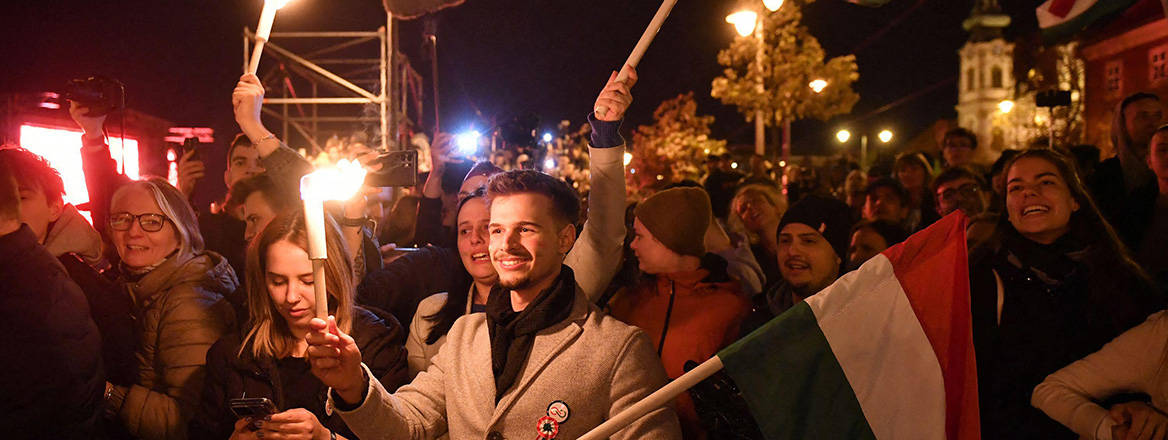
When Péter Magyar won Hungary’s national elections on 12 April, Europe breathed a sigh of relief. After 16 years in power, Viktor Orbán and his Fidesz government suffered a decisive defeat. Magyar’s Tisza Party secured 138 of 199 parliamentary seats, delivering a result that resonated far beyond Hungary itself. From Berlin to Kyiv, the outcome was seen as a potential turning point: the end of Europe’s foremost laboratory of illiberalism and, with it, the prospect of renewed EU cohesion and more unified decision-making at a moment of mounting geopolitical pressure on the continent.
However, Orbán’s defeat represents more than a setback for Europe’s illiberal right. In Bosnia and Herzegovina, the Hungarian leader served as one of the most influential external patrons of authoritarian and Kremlin-aligned actors in Republika Srpska (RS), one of the country’s two entities established under the Dayton Agreement. Through political backing, economic ties and diplomatic shielding within the EU, Budapest became an important pillar sustaining the region’s secessionist and destabilising currents.
Illiberal Nexus in Europe
The relationship between the previous government in Budapest and Milorad Dodik, the former president of RS, has long been well established. It formed part of a broader illiberal nexus linking Dodik with Aleksandar Vučić, Vladimir Putin and Orbán. Over the years, Hungary steadily expanded its political and economic footprint across the Balkans, particularly in Bosnia and Herzegovina, while Orbán himself consistently projected an illiberal, nationalist anti-European and ultimately anti-Bosnian position.
For nearly two decades, the predominantly pro-Russian leadership in RS has systematically worked to erode the authority of state-level institutions in Bosnia and Herzegovina, while obstructing the country’s Euro-Atlantic trajectory and advancing a gradual secessionist agenda through legal and institutional confrontation. With the departure of High Representative Christian Schmidt now approaching, Dodik has called for the annulment of all decisions brought by the Office of the High Representative throughout its tenure – the body responsible for overseeing the civilian implementation of the Dayton Agreement.
Throughout his rule, Orbán provided crucial political cover for such policies, most notably by blocking joint EU sanctions against RS officials. Budapest’s support, however, extended beyond diplomatic and political shielding. In early 2025, Hungarian counter-terrorism units (TEK) were deployed to Banja Luka under the cover of joint police exercises with contingency plans prepared to facilitate Dodik’s extraction to Hungary if an arrest order was issued by Bosnian judicial authorities following Dodik’s sentencing to one year in prison and a ban from political office.
Across Sarajevo and several European capitals, Orbán’s defeat was quickly interpreted as signalling a decisive break in Hungary’s approach to Bosnia and Herzegovina. Such optimism is premature
In effect, the Orbán–Dodik nexus demonstrated how illiberal networks within the EU itself could be mobilised not only to paralyse common EU policy, but to actively shield secessionist actors challenging the constitutional order of a candidate state from both European pressure and domestic judicial accountability. The result was a steady erosion of Brussels’ credibility, both as a geopolitical actor in the Balkans and as a guarantor of rule-of-law conditionality.
More so, Dodik’s response to Orbán’s electoral defeat revealed how central Budapest had become to the political imagination of the region’s illiberal actors. Describing Orbán as a ‘voice of reason’ who stood with RS against the ‘neoliberal world’, Dodik effectively framed Hungary under Fidesz as a strategic outpost for secessionist and anti-liberal politics within the EU itself.
Orban’s Support For Far-Right in Bosnia
With the return of the Trump administration, Bosnia’s recurrent political crises have engulfed the country with the broader campaigns of propaganda, demonisation and dehumanisation directed at Bosniaks, who remain the country’s principal pro-state political constituency.
Initially cultivated within RS, such rhetoric has been completely adopted by mainstream Croat nationalist officials and affiliated actors seeking to secure greater international sympathy for their own separatist and ethno-territorial ambitions in an era marked by the resurgence of radical right-wing politics across both Europe and the United States. Central to this effort has been the portrayal of Bosniaks as ‘Islamists’ allegedly threatening a vulnerable Christian minority – a narrative that forms part of a broader transnational ecosystem of right-wing Islamophobia that continues to place growing strain on democratic discourse and social cohesion across the West.
Hungary during Fidesz’ rule has long been a consistent supporter of the Islamophobic narratives advanced by the political establishment in Croatia regarding Bosnia and Herzegovina. His backing of Dragan Čović, leader of the Croatian Democratic Union of Bosnia and Herzegovina (HDZ BiH) – and his demands centred on greater ethno-territorial and ethnically homogeneous political units – formed part of this broader illiberal alignment. Orban’s defeat therefore represents a setback for nationalist Croatian political forces in Bosnia and Herzegovina.
A recent conference in Zagreb organised by conservative and nationalist organisations linked to transnational Trump-aligned networks, including groups supported by The Heritage Foundation, openly advanced proposals for the territorial reorganisation of Bosnia through the creation of a separate Croat ‘third entity’ – effectively reviving war-time goals associated with the Herceg-Bosna project, ruled as Joint Criminal Enterprise by the ICTY judgements.

The concept of a ‘third entity’ has consistently been framed by its proponents as a question of ‘legitimate representation’, while in practice seeking to entrench ethnic fragmentation through electoral engineering and institutional redesign. Central to these efforts have been proposals to amend Bosnia’s electoral framework in ways that would disproportionately amplify votes from Croat-majority areas dominated by the HDZ BiH.
The fusion of electoral revisionism with overt Islamophobic rhetoric represents a continuation of the strategy cultivated by Budapest and its Bosnian Croat partners. During a 2021 visit to Sarajevo, Péter Szijjártó, one of Orbán’s closest allies and Hungary’s foreign minister, explicitly pledged Budapest’s support to Čović’s efforts to impose a new election law aligned with HDZ BiH’s political demands, framing the partnership in explicitly civilisational and ‘Christian values’ terms.
After all, Orbán himself made the ideological underpinnings of such policies explicit when, during a 2021 press conference, he described the ‘challenge’ with Bosnia and Herzegovina’s integration into the EU as ‘how to integrate a country with two million Muslims’ – a remark that laid bare the civilisational and exclusionary logic embedded within segments of Europe’s illiberal right in which Dodik and Čović are now embedded.
Magyar and the Bosnia Question
Across Sarajevo and several European capitals, Orbán’s defeat was quickly interpreted as signalling a decisive break in Hungary’s approach to Bosnia and Herzegovina. Such optimism is premature. Magyar himself continues to reflect elements of the national-conservative political culture from which he emerged, including a degree of Euroscepticism and scepticism towards progressive liberal politics. Before founding Tisza, Magyar spent years within Fidesz and emerged from the same political ecosystem that nurtured Orbán’s rule.
Yet Magyar’s victory nevertheless presents an opportunity that extends beyond merely resetting Hungary’s relations with authoritarian actors in Bosnia and Herzegovina. Alongside the possibility of rebuilding ties between Budapest and Sarajevo, Magyar also has an opportunity to help restore the EU’s geopolitical weight in Bosnia after years in which Orbán’s obstructionism diluted Brussels’ capacity for coherent action.
If Magyar works together with Brussels – as indicated by a recent deal to unlock €17 billion of frozen EU funds – a recalibrated Hungarian policy could help strengthen the EU’s leverage in confronting secessionist politics, defending Bosnia’s constitutional order and re-establishing the Union as a consequential strategic actor in the Western Balkans.

If, indeed, Magyar’s promise is to build a ‘modern, European Hungary’, then the first and most straightforward step for the new leadership would be to distance itself from Dodik and Čović and their secessionist agendas, while publicly condemning policies that undermine the sovereignty and constitutional order of Bosnia and Herzegovina. This should be followed by a more tangible operational shift, which includes the closure of the recently established office of Hungary’s counter-terrorism unit TEK in Banja Luka. Magyar’s dismissal of TEK director János Hajdu – who oversaw the unit’s controversial expansion into RS – represents an important first step. However, the ultimate test will be whether Budapest dismantles what remains one of the most politically charged legacies of Orbán-era policy – a narrative built on the image of radicalism and instability in Bosnia and Herzegovina.
Equally important would be abandoning Budapest’s long-standing obstruction of collective EU measures against RS leadership, including the repeated blocking of sanctions targeting officials involved in attacks on Bosnia’s constitutional order. Such a shift would signal that Hungary is no longer willing to serve as the principal European shield for secessionist politics in the Western Balkans and would demonstrate a true willingness to respect Bosnia’s territorial integrity, sovereignty and political stability.
Rebuilding European Credibility
For the EU, Magyar’s victory represents more than a domestic political transition in Hungary. It signals that entrenched illiberal systems, long viewed as politically unassailable, can still be defeated at the ballot box. For Bosnia and Herzegovina, Orban’s defeat offers a rare opportunity to weaken one of the most important external pillars sustaining secessionist politics and institutional destabilisation in the Western Balkans.
Whether that opportunity materialises, however, will depend not only on the direction taken by Budapest under Magyar, but also on the willingness of the EU itself to treat Bosnia as a strategic European political and security challenge. Orbán’s Hungary demonstrated how illiberal networks within the EU could hollow out European leverage from within. The challenge facing Europe now is whether it can rebuild, together with Magyar, that credibility before the political forces empowered over the past decade become further entrenched across the region.
© Ismet Fatih Čančar, 2026, published by RUSI with permission of the author.
The views expressed in this Commentary are the author's, and do not represent those of RUSI or any other institution.
For terms of use, see Website Terms and Conditions of Use.
Have an idea for a Commentary you'd like to write for us? Send a short pitch to commentaries@rusi.org and we'll get back to you if it fits into our research interests. View full guidelines for contributors.
WRITTEN BY
Ismet Fatih Čančar
Guest Contributor


- Jim McLeanMedia Relations Manager+44 (0)7917 373 069JimMc@rusi.org