

A Decade-Long Struggle to Thwart Iran’s Drones Carries Warnings for the UK

UK counter-drone technologies are few and costly; what are British troops’ near-term risks?
Iran’s lethal drone capability has again been on display in this latest conflict, killing six American soldiers and one French soldier, and damaging sites with British personnel, including an RAF base. Millions of dollars’ worth of US equipment losses, including& radars and satellite communications, underline the threat of the roughly $50-70,000-drones. RAF personnel have already shot down a significant number of them, but the next challenge is ensuring the whole force is adequately protected. Recent history shows this is easier said than done.
The threat itself is hardly news, but the crisis reveals a riddle: the US and UK have been working on counter-drone systems, fielding short-range air defence (SHORAD) equipment for years, while facing lethal drone threats in the region for nearly a decade, since around 2017. We have watched this technology evolve at stunning speed in Ukraine, but have been left with, in most cases, high-cost solutions which are few in number. This article is focused on one drone threat, in the NATO Class II category, chiefly the Shahed 136 (Geran-2 in Russian service) and similar Uncrewed Aerial Systems (UAS).
The Evolving Threat
The puzzle of America’s sub-par drone defences becomes stranger when considering the mismatch in how the problem has been resourced.
In 2022, Ukraine compressed timelines to optimise countermeasures to the Geran-2 before building an effective network with what was available to hand, largely due to slow foreign aid. This included acoustic sensors initially using cell phones, and mobile gun teams, some armed with obsolete Maxim machine guns, attempting to offset the cost of hitting the drones with expensive and scarce missiles. In the air, everything from 1970s Yak-52 propeller planes to F-16s have been used to hunt the Gerans.
This sustainable approach evolved into a dynamic mix of state-of-the-art and almost low-tech solutions, as well as mid-range ad hoc systems, the so-called FrankenSAMs, which utilised old but still costly air-to-air missiles fired from Soviet-era ground platforms (although these at least had a double use against high cost cruise missiles.)
Ukraine’s network stopped the vast majority of Gerans, while the rise of low-cost interceptor drones which US forces are now using in the form of Merops, was another boost, harnessing Ukraine’s large drone innovation ecosystem. Despite interception rates fluctuating between 80-90% even a small number of Geran 2 ‘leakers’ can deliver hundreds, even thousands of kilograms of explosives because salvos are so large.
Ukraine shows the urgency to turn experimentation into density of defences
This remains a challenge for the US despite resources that Ukraine could only hope for, for example, funds to buy tactical radars. In 2020, the US announced the Stryker vehicle-based IM-SHORAD project would go ahead at a cost of $1.2 billion with an initial procurement of 144 systems, the first prototype having been delivered in 2019. This contract has since been modified at a further cost of $621 million, and procurement of the system will rise to several hundred units. Billions have been spent developing laser systems.
By contrast, when it was announced that the VAMPIRE system would be sent to Ukraine to counter Gerans, only 14 launch systems were delivered at a cost of $40 million. In this timeframe, US programs have rolled on amid ongoing casualties in the Middle East with hundreds of drone attacks on US forces, killing three and wounding dozens in Jordan in early 2024. The Jordan attack accelerated US counter-drone efforts, after an inquiry found a lack of adequate countermeasures at the site.
Yet there was still reportedly not enough counter-drone and early warning equipment at the Shuaiba facility in Kuwait where six Americans were killed and scores injured on March 1. Ukraine shows the urgency to turn experimentation into density of defences, something not necessarily dependent on funds, but certainly on numbers of systems.
The Middle East Crucible
US efforts began in earnest four years before Russia’s full-scale invasion of Ukraine, in 2018. Responding to the growing use of small drones by ISIS and Iran-backed militias in Syria, US forces deployed experimental interceptor drone systems. The previous year, a Shahed 129 – an Iranian drone bigger than the Geran-2 – fired on US forces in Syria, while another was shot down by an F-15. This introduced the cost curve challenge: F-15s costing tens of thousands of dollars an hour to fly, firing $500,000 missiles at systems as much as 10 times cheaper would not be sustainable.
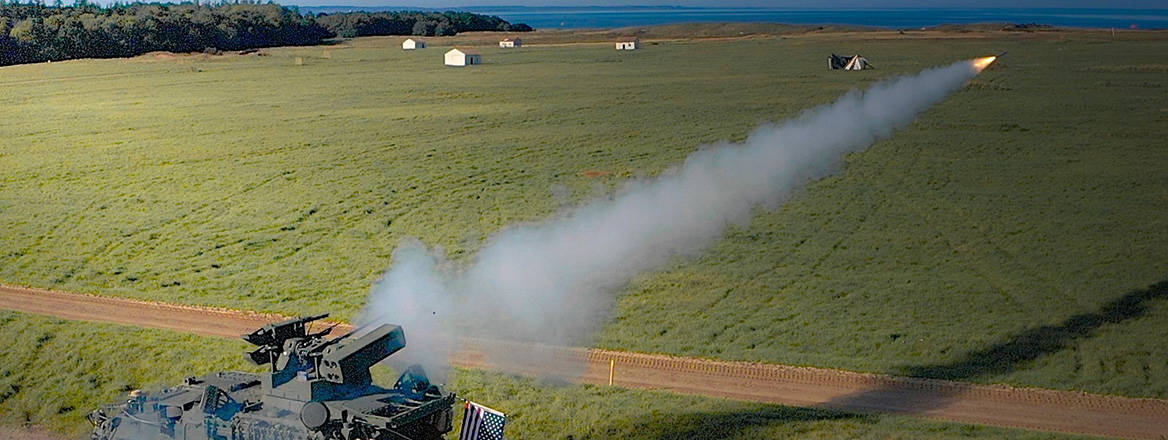
The Coyote is integrated with its launcher vehicle with a bespoke 360 degree coverage radar system optimised to detect and hit ‘low, slow and small’ targets at range. By 2020 Coyote was regularly hitting targets in tests, guided with agility from Ku-band radar tracks transmitted from the launch truck. Three years later, Coyote systems downed several drones in an attack in Syria, although a ‘leaker’ got through to injure several allied Kurdish militiamen.

Deployment of the $100,000 interceptor continued, but not at scale. Two dozen US soldiers were injured in a spate of drone attacks by Iranian proxies in October 2023. British forces, still in Iraq, were spared casualties but the threat, even from small Iran-backed militias (let alone a peer adversary) was clear.
For the US, autocannon C-RAM (counter rocket, mortar and artillery) remained critical for last ditch defence. At the same time, the US was replacing ageing TPS-75 radars which were barely able to detect drones. In the Tower 22 attack in Jordan, the TPS-75 was reportedly non-functional. Coyote interceptors were present, but layered defence was lacking.
Coyote and IM-SHORAD were far from the only US effort. Around 2023, the US deployed Stryker-mounted 50 kw lasers to Iraq, with unsatisfactory results, with reports of maintenance and reliability problems in the dusty environment. A palletised laser system reportedly enjoyed more success but has not been adopted at scale. Pursuing the dream of lasers costing pennies per shot, the UK already had a demonstrator of a laser system on a Wolfhound vehicle. The US meanwhile, announced procurement plans for nearly 7,000 Coyote interceptors through 2029, nearly 300 launchers and 33 tactical radars in December 2023. An order of 600 interceptors was confirmed the following year.
The biggest threat however, emerged in the Red Sea. The ongoing Houthi blockade of the waterway deepened the drone dilemma: lacking low-cost systems, a number of exquisite missiles were used to stop Houthi drones by US and British forces, with the Royal Navy in some instances firing £1 million Aster 15 missiles at the low cost Shaheds.
US adaptation in some ways resembled Ukraine’s high-low capability mix, using high fidelity airborne Hawkeye radars as well as Mk 45 5-inch naval guns with canister rounds and adapted 2.75 inch rockets fired from jets, APKWS. Both weapons were significantly cheaper than the drones they targeted, but fighter jet interceptions are less than ideal due maintenance costs and involve difficult low-level flying.
Iran’s colossal attacks on Israel through 2024-2025 further laid bare the problem. Some US jets ran out of missiles and subsequently made dangerous low-level attacks with cannons.
From Ukraine to the Future
Efforts in Ukraine and the Middle East were not isolated and among NATO countries there was a paucity of interception capability. Gepard integrated radar-autocannon systems donated to Ukraine, which proved highly effective, were not enough and had limited ammunition supply. Some systems were purchased back from Middle East countries to fight the Geran threat. Under strain, the US diverted APKWS intended for Ukraine to the Red Sea crisis, amid increasing awareness of the cost-curve challenge countering drones.


Many systems, such as VAMPIRE, that would go on to be procured by several NATO forces had already been tested in Ukraine. These included the Israeli SMASH Smartshooter sights, which use machine vision to assist the shooter and while not designed for the Geran threat, can be integrated into larger calibre guns for this aim. Likewise, the UK sent thousands of versatile Lightweight Multirole Missiles (LMM) to the Ukrainians.
In other words, by the onset of the Iran war, battle tested solutions existed. The US, having taken a significant bet on IM-SHORAD, was left rushing for Ukrainian assistance, because deployment of the system, as well as truck-mounted lasers and further Coyote production, remains a work in progress. Where then, does this leave the UK?
Learning from Ukraine
Firstly, the UK has jointly worked with Ukraine on an AI-assisted gun turret, Sky Sentinel. If the 22 planned for delivery prove effective, one issue is that it only solves the lower cost, low altitude portion of the threat. LMMs have successfully defended a larger portion of the sky but at the moment the Army is phasing out their use on the Stormer, a number of which have been sent to Ukraine. For the Navy, LMMs have been fired by Wildcat helicopters which have reported successful interceptions. The RAF also has the capable Orcus counter drone detection and jamming system.
This suggests the UK could benefit from something like IM-SHORAD when replacing Stormer, but needs to move quickly (if the IM-SHORAD’s six year timeline from prototype to procurement at scale is a guide) or could follow Germany’s lead, placing a bet on the combat-proven Skyranger turret.
Germany is procuring hundreds of the system and autocannons are an important fallback if missiles run low. But again, this would not be able to intercept drones at higher altitudes. Importantly, the German investment represents a bet to scale production for a density of defences.
Like the US, Britain has also been experimenting with directed energy but is yet to enable production, although the Royal Navy hopes to deploy the Dragonfire laser by 2027. The UK has also made progress with high-powered microwave weapons, but these are optimised for smaller drones.
At some point, experimentation must end, and forces must accept operational risk and make a bet on a system
But the Army is at risk in the fight to defend as many sites as possible from a pervasive threat. With Stormer being phased out, a number of projects have either just reached the stage of defining requirements or calls for submissions. In both cases, work focuses on integrating short-range air defence missiles and remote weapon stations to vehicles in a dedicated counter-drone role. These must then be built at scale and supported by mobile tactical radars and other detection equipment.
If there is some good news, the Army has increased orders of ground-based surveillance radars which have drone detection capability, but this would not be their sole purpose in conflict, while supporting radar equipment and new tactical radar procurement is currently going to the Royal Artillery. Dedicated mobile solutions are needed. In 2025, the Army stepped up purchases of Land Ceptor air defence systems, but these are not a low cost solution.
Like the US, the UK has seen the opportunity of Ukraine’s low-cost interceptor drones. But only with sufficient radar enablement and the ability to network with other systems will laudable efforts to co-produce Ukraine’s Octopus interceptor drone bear fruit. In terms of protecting small units and command and control nodes - the kind of sites hit by Iran in Kuwait - Britain has yet to make a bet on a deployable solution. The US, meanwhile, is betting big on Coyote, placing a $5 billion order in late 2025.
The bottom line is that at some point, experimentation must end, and forces must accept operational risk and make a bet on a system, or risk being left with prototypes, demonstrators and not enough equipment to provide the required density of protection.
If anything, the US experience against Iran shows that the world’s most powerful military still has significant gaps despite capabilities vastly beyond that of the UK. Given how long it has taken the US to turn counter-drone experimentation into fielded equipment, this effort must be urgently prioritised in the UK.
© RUSI, 2026.
The views expressed in this Commentary are the author's, and do not represent those of RUSI or any other institution.
For terms of use, see Website Terms and Conditions of Use.
Have an idea for a Commentary you'd like to write for us? Send a short pitch to commentaries@rusi.org and we'll get back to you if it fits into our research interests. View full guidelines for contributors.
WRITTEN BY
Robert Tollast
Research Fellow, Land Warfare
Military Sciences


- Jim McLeanMedia Relations Manager+44 (0)7917 373 069JimMc@rusi.org