

Beyond the Menu – Pragmatism over Purity in UK–EU Relations

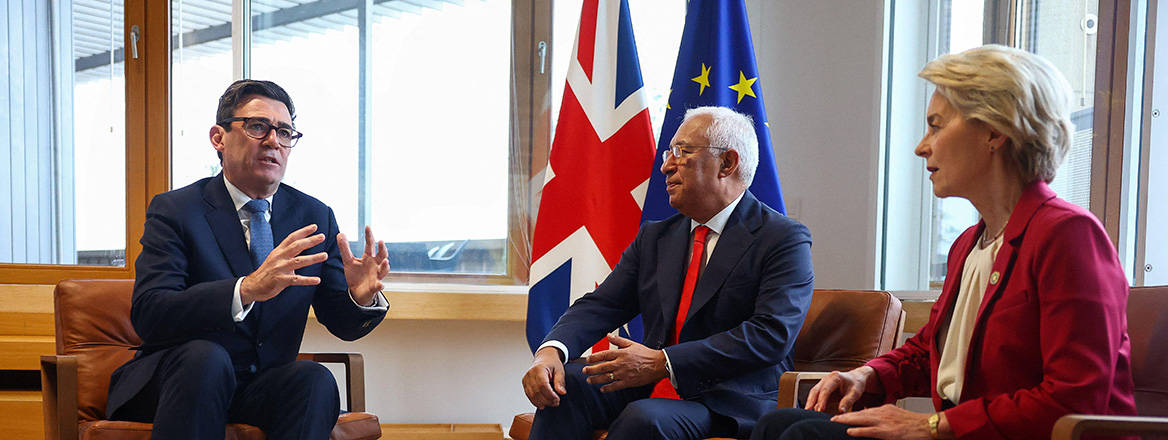
At today’s UK–EU Summit, both sides should drop Brexit-era red lines and fixed institutional models in favour of pragmatic cooperation built on shared interests.
In the months preceding today’s UK–EU Summit, the old guard on both sides of the Channel emerged to offer their opinions on the future relationship. Chief among these were two men present at the destruction: former EU Brexit negotiator Michel Barnier and former UK Prime Minister David Cameron. While Barnier warned that the UK must not be allowed to ‘cherry pick’ in seeking to rejoin the EU internal market, Cameron cautioned that any effort to rejoin the bloc would be ‘very long and painful’. For years, the EU has presented the UK the same trio of available institutional arrangements – namely a customs union, joining the single market or full membership – rather than entertaining any flexibility or deviations from this menu fixe.
While a purist, one-size-fits-all approach was feasible in a relatively benign security environment underpinned by US security guarantees, it is ill-suited to today’s more volatile, less predictable geopolitical environment in which the US is reducing its contributions to transatlantic security. To increase its leverage and influence globally, the EU needs to join forces with willing, capable and like-minded countries. This means shedding the shared trauma of Brexit and adopting a more flexible approach to the future relationship with the UK, with its £3 trillion economy and significant defence assets. Public opinion supports this direction of travel. A June 2026 European Council on Foreign Relations poll revealed that three-quarters of Britons support a closer relationship with the EU while EU voters are also positively inclined toward a closer relationship with the UK.
Mutual recognition may be a better path than full alignment, with the EU even choosing to adopt elements of the UK regulatory approach, and vice versa, as best practices emerge. Differentiation is already accepted practice within the EU
As UK Prime Minister Andy Burnham and his EU counterparts advance the UK–EU relationship at today’s Summit, the politicians and civil servants steering the process would do well to adhere to several guiding principles to gain momentum and maintain public support for even more ambitious cooperation in future.
Focus on Substance, Not Structure
Most importantly, the UK and EU should not fixate on the specific institutional arrangements. Rather, they need to focus on the substance and begin by defining common interests and challenges as well as the results they want to achieve. These might include spurring growth, lowering energy prices, protecting critical infrastructure, building supply chain resilience or increasing defence production and innovation. Today’s anticipated agreements – dynamic alignment on sanitary and phytosanitary standards (SPS), linkage between their emissions trading systems and a youth experience scheme – are an important start in demonstrating the value-add of closer cooperation. Logistics UK estimates that the SPS deal will cut export costs by up to 8%, adding £5.1 billion per year to the UK economy, for example. Future deals such as UK participation in the EU electricity market, greater cooperation on security and defence, or UK inclusion in the EU’s ‘Made in Europe’ agenda would add to these tangible gains.
Set Aside Red Lines
Additionally, both sides should set aside their respective red lines at this early stage. While some argue guardrails are necessary to protect key EU principles (for example, no single market without freedom of movement) or maintain voter trust in the UK (in other words, by adhering to the 2024 Labour Manifesto), experience shows that red lines can constrain outcomes and reduce negotiating leverage by taking options off the table. This is exactly what transpired during the 2017 Brexit negotiations, where the UK’s initial red lines on staying outside the single market, customs union and European Court of Justice while also rejecting free movement of people limited its room for manoeuvre throughout the negotiations. As its positions encountered realities such as the Irish border question, the UK was forced to soften its red lines even as the EU held firm. Arguably, greater flexibility from both sides at the outset would have produced agreement earlier and generated less ill will.

Help your search results show more from RUSI. Adding RUSI as a preferred source on Google means our analysis appears more prominently.

Leave Room for Divergence
Finally, they should keep the door open for meaningful divergence in a few select areas. In the case of the UK, its local comparative advantage in financial services and financial technology could prove a boon to the EU. Because the UK Financial Conduct Authority sets its own rules, it can move faster in testing and innovation of financial technology via AI-focused sandboxes, in turn attracting continued investment. While the EU AI Act mandates national sandboxes, implementation has been slow, giving the UK a head start. In such areas, mutual recognition may be a better path than full alignment, with the EU even choosing to adopt elements of the UK regulatory approach, and vice versa, as best practices emerge. Differentiation is already accepted practice within the EU. For example, not all member states are part of Schengen or the Eurozone. This same flexibility should be afforded to the UK and other partners when mutually beneficial.
Urgency and geopolitical reality call for political courage and creative thinking, not fixed solutions from another era. The most difficult questions, such as the institutional framework and degree of alignment, do not need answers on day one. Pragmatism, not purity, is the best approach, and today’s Summit is a positive step in this direction.
© RUSI, 2026.
The views expressed in this Commentary are the author's, and do not represent those of RUSI or any other institution.
For terms of use, see Website Terms and Conditions of Use.
Have an idea for a Commentary you'd like to write for us? Send a short pitch to commentaries@rusi.org and we'll get back to you if it fits into our research interests. View full guidelines for contributors.
WRITTEN BY
Rachel Ellehuus
RUSI Director-General
Senior Management


- Jim McLeanMedia Relations Manager+44 (0)7917 373 069JimMc@rusi.org